


If you want to make a bedroom feel cozy, you don’t need a big budget or a designer. You need the right changes, in the right order.
Some bedrooms you walk into and immediately exhale. The tension drops. The noise from the day goes quiet. Something tells your nervous system: you’re safe here, you can rest now.
Other bedrooms feel like a place where sleeping happens, but not much else. Functional. Adequate. Fine. But not a cozy bedroom you actually look forward to coming home to.
I’ve spent years figuring out how to make a bedroom feel cozy on a real budget, across rental apartments where I couldn’t paint walls or make permanent changes. Everything here is practical, tested, and honest about what it costs.
Here are 15 ideas that genuinely work, and why each one works.
Why Most Bedrooms Don’t Feel Cozy (And the Fix Is Simpler Than You Think)
Before diving into the specific ideas, it helps to understand why a bedroom feels cold — because once you know the root cause, you fix it faster than just throwing decor at the problem.
Most bedrooms that fail at coziness have one or more of these five issues:
Harsh overhead-only lighting. A single ceiling light casts flat, shadowless light — like a waiting room. Coziness needs warm, layered light at multiple heights.
No soft surfaces. Hard floors, minimal textiles, smooth-only materials — these create rooms that echo both literally and visually. Soft surfaces absorb sound and visual sharpness, which instantly makes a room feel warmer.
Clutter without intention. A cluttered bedroom is stressful, not cozy. But a completely bare bedroom is cold, not calm. The sweet spot is curated warmth — meaningful objects, not random stuff.
Poor color temperature. Cool whites and greys with cool-toned bulbs make a bedroom feel sterile. Coziness is almost always warm in tone.
Scale problems. Furniture too small for the room creates a disconnected, showroom feel. Choosing the right rug size and color makes a bigger difference than most people expect — I’ve covered this in detail here on what color rug goes with a grey couch, where rug scale and tone completely transform how a room feels.
Once you understand these five root causes, the 15 ideas below start making more sense. You’re not just adding things — you’re solving specific problems.
1. Swap Your Bulbs Before You Buy Anything Else
This is the single highest-impact thing you can do to make a bedroom feel cozy — and it costs under $15.
Standard LEDs in most apartments sit around 4000K–5000K. That’s the cool, bluish-white light of offices and retail stores. Designed for productivity, not rest.
Warm-toned bulbs sit between 2700K and 3000K. At 2700K, a room takes on the quality of candlelight — golden, soft, enveloping.
Swap every bulb in your bedroom to 2700K warm white LEDs. Overhead fixtures, bedside lamps, floor lamps, everything. Keep the color temperature consistent — mixing warm and cool bulbs in one room creates an unsettling, patchy feel.
The transformation is immediate. Same room, same furniture, different bulbs — and it feels like a completely different space.
According to the Sleep Foundation, warm light in the 2700K–3000K range also supports your body’s natural wind-down process before sleep — making this the rare upgrade that improves both aesthetics and sleep quality at the same time.
2. Add a Second (and Third) Light Source to Make Your Bedroom Feel Cozy
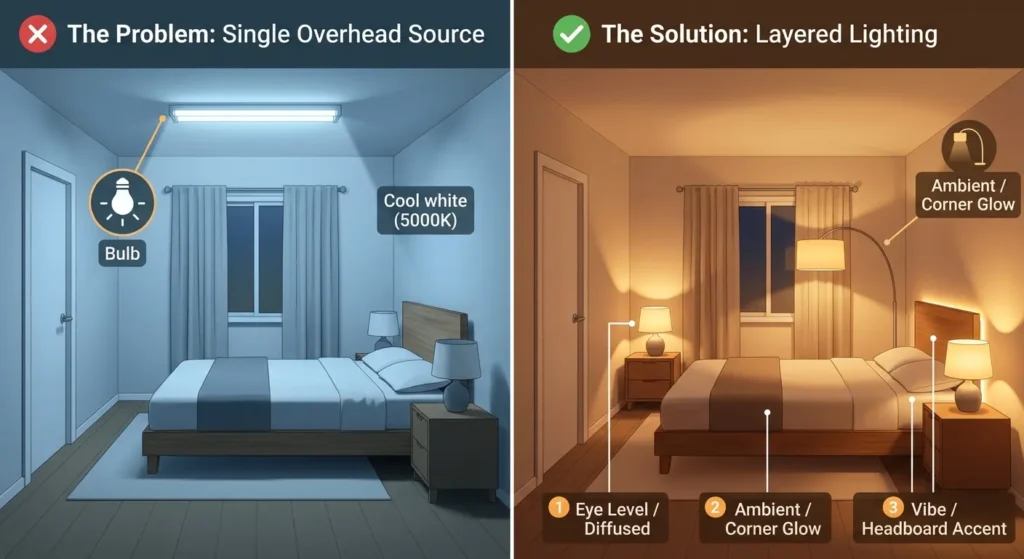
Even with warm bulbs, a single overhead light creates flat, one-dimensional illumination.
Coziness requires layered lighting — multiple sources at different heights, creating overlapping pools of warm light with soft shadows between them.
Think about why candlelit restaurants feel romantic: it’s not just the warm color. It’s that light comes from table level, not the ceiling. Shadows fall naturally. The eye has somewhere to rest.
Replicate this in your bedroom with three types of sources:
Bedside lamps. Two lamps on your nightstands immediately warm the room and anchor the bed. Budget options from Target, IKEA, or Amazon run $25–45 each. Look for fabric shades in white or cream — they diffuse light softly rather than projecting it harshly.
A floor lamp in a corner. A warm-toned floor lamp aimed at a corner creates a soft ambient glow from a low angle. Arc lamps are especially effective. IKEA’s HEKTAR is under $60 and does the job well.
String lights or LED warm strips. Warm-toned string lights draped behind a headboard or above a window create genuine atmosphere for under $15. LED strip lights in 2700K behind furniture or under the bed frame add a soft ambient glow that makes the whole room feel warmer.
The goal: by evening, you should be able to turn the overhead light off entirely — and the room should still feel perfectly warm and illuminated.
3. Layer Your Bedding — This Is Where Cozy Bedrooms Are Made
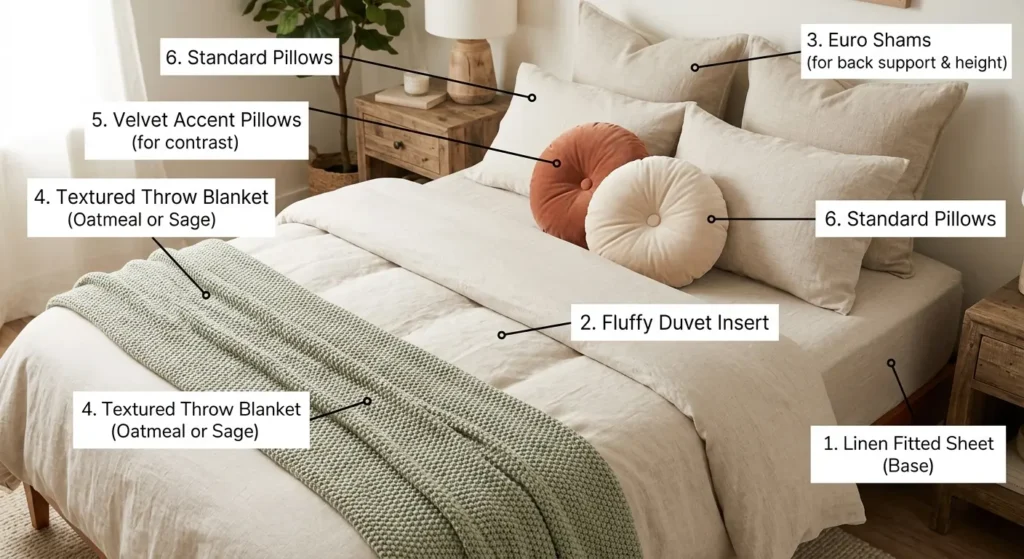
One duvet and two pillows is functional. A duvet, throw blanket, euro shams, and accent pillows in layered textures is the kind of bed you see in boutique hotel photos and immediately want to sink into.
Layered bedding is the visual center of any cozy bedroom. The bed takes up the most space in the room, so getting the layering right has an outsized impact on how everything else feels.
Base layer: Fitted sheet and flat sheet (or go straight to the duvet — no judgment). Linen is the gold standard for cozy, lived-in texture. IKEA’s linen range makes it accessible at $30–50 for a set.
Middle layer: Duvet or comforter in a color that suits your palette. Warm neutrals — cream, oatmeal, soft sage — feel cozier than stark white, which can tip clinical. Even an affordable duvet insert from Amazon ($25–40) looks significantly more lush than a flat, worn-out one.
Top layer: A throw blanket draped across the foot of the bed or pulled back at one corner. This single element adds more perceived warmth than almost anything else in the room. Choose a texture that contrasts with your duvet — smooth duvet plus chunky knit throw, or vice versa.
Pillows: Two euro shams at the back (24″x24″), two standard pillows in the middle, one or two accent pillows at the front. Build this over time — even just adding euro shams to an existing setup makes the bed look noticeably more luxurious.
Budget for a full bedding overhaul: $80–150 spread across a few purchases. Start with the throw ($20–40).
4. Get the Right Rug — And Make Sure It’s Big Enough
A bedroom without a rug, especially one with hard flooring, feels unfinished and cold. Your feet hitting bare wood or tile first thing in the morning is a small but real comfort problem.
More importantly, a rug visually anchors the room. It defines the sleeping space as a cozy zone rather than a functional area.
The most common rug mistake: going too small. An undersized rug that partially slides under the bed looks like an afterthought.
Sizing: For a queen bed, minimum 8×10 with the front two-thirds of the bed sitting on it. Ideally 9×12, letting the bed, nightstands, and some open space all sit on the rug. For a king, 9×12 or larger.
Material: Soft-pile rugs — wool, plush polyester, or faux sheepskin — feel genuinely luxurious underfoot. Jute and sisal bring natural texture but are rougher — better for coastal or boho than cozy hygge.
Color: Warm tones — cream, oatmeal, warm taupe, rust, soft terracotta — make bedrooms feel softer. Cool greys and stark whites can work if your textiles are very warm, but in general, a warm-toned rug is the safer cozy choice.
Budget: $40–120 at IKEA, Amazon, Wayfair, or Target. A $70 rug in the right size does more for a cozy bedroom than $200 of small accessories.
5. Add Texture Everywhere You Can
Coziness is physical before it’s visual. A room that looks good in photos but has no soft surfaces, no interesting materials, nothing that invites touch — doesn’t actually feel cozy to live in.
Texture tells your nervous system: this room is soft, warm, safe.
Here’s where to add it affordably:
Curtains. Linen or linen-blend panels add softness and movement. IKEA’s DYTÅG is a perennial favorite at under $30 a panel. Even simple linen curtains transform a room with bare windows or plastic blinds.
A woven or macramé wall hanging. Organic texture directly on the wall that no framed print can match. Etsy and Amazon options run $15–40.
Throw pillows in different fabrics. Mix velvet, linen, and cotton. Velvet reads as luxurious even at budget prices — a velvet pillow cover on Amazon runs $8–12 and feels more expensive than it is.
Storage baskets. Woven seagrass or cotton rope baskets are functional and textural at the same time. A basket of extra throws beside the bed is a classic cozy-room move.
A chunky knit throw on a chair or bench. Even a small accent chair with a draped throw looks inviting rather than functional.
If you’re building out a cozy feeling across the whole home, many of these same texture principles apply to living spaces too — our guide on budget-friendly ideas to make a rental apartment feel like home covers texture layering room by room.
6. Hang Curtains High and Wide
This costs nothing but repositioning — and it makes a dramatic difference in how cozy and spacious a bedroom feels.
Most people hang curtains at the window frame. Curtains hung this way look fine but make the room feel exactly the size it is.
Curtains hung 6–10 inches above the window frame — ideally close to the ceiling — and extended 6–10 inches beyond the window on each side do something dramatic. The window looks larger. The ceiling feels higher. The room feels more enveloping.
For cozy bedrooms specifically, floor-length curtains are non-negotiable. Curtains that stop at the window sill look unfinished. Curtains that graze or gently pool on the floor feel romantic and intentional.
If your rod is mounted at window level, a removable adhesive rod or tension rod higher up avoids any drilling. Most landlords won’t object.
For fabric: go with an opaque or semi-opaque material in a warm tone. Sheer white brightens without warming. Linen, velvet, and heavier cotton all work beautifully for coziness.
7. Bring In Natural Wood to Warm the Room
Cold bedrooms — ones that feel sterile no matter how much is in them — often have one thing in common: no natural materials. Everything is synthetic, manufactured, uniform.
Natural wood is one of the fastest fixes for this. It brings warmth, organic variation, and a grounding quality that manufactured materials simply can’t replicate.
You don’t need to replace furniture. Small wood elements work:
- A wooden tray on your dresser or nightstand (groups small objects into a cohesive vignette)
- A wood or rattan-framed mirror
- A small wood stool as a nightstand or plant stand
- Rattan or bamboo baskets, a small side table, or a rattan headboard
- A wood cutting board used decoratively on a shelf
If you do have budget for one furniture piece, a rattan or bamboo headboard is one of the highest-impact investments for a cozy bedroom. It adds texture, warmth, and visual interest to the most prominent wall in the room.
Budget: Thrift stores are excellent for wood and rattan pieces at $3–15. New options at IKEA, Target, and Amazon typically run $10–40 for small pieces.
8. Add Plants — Even One Makes a Cozy Bedroom Feel More Alive
Plants work. A living plant adds color, organic form, and a sense of life that no manufactured object can replicate.
Against white walls or warm neutrals, green pops with a freshness that feels both natural and designed. Plants also add vertical interest at varying heights when placed on stands, dressers, or shelves.
For bedrooms, choose plants that thrive in medium to low light and don’t demand constant attention:
Pothos. Nearly indestructible. Trails beautifully from a high shelf or hanging planter. Tolerates low light, goes a week without water. $3–8 at most nurseries.
Snake plant. Architectural, sculptural. Does well in low light. Needs watering once every two to three weeks. $8–20 depending on size.
ZZ plant. Glossy deep green leaves. Extremely low-maintenance, thrives in indirect light. $10–25.
Peace lily. If you want something that flowers, peace lilies are forgiving. They also actively improve air quality, according to NASA’s Clean Air Study.
If plants aren’t your thing, high-quality faux plants have improved dramatically. IKEA’s artificial range and many Amazon options now look realistic enough that most visitors don’t notice.
9. Style Your Nightstand as a Mini Vignette
Your nightstand is the last thing you see before sleep and the first thing you see when you wake up. In most bedrooms, it’s also a disaster zone of cables, random items, and dust.
A styled nightstand doesn’t just look better — it feels better to wake up to. And you don’t need to buy anything new. It’s about editing and grouping what you already have.
The formula:
One lamp. At roughly eye level when lying down. Warm-toned shade.
One small plant or vase. A succulent, dried pampas grass, or a sprig of eucalyptus from the grocery store.
One book or small stack. Signals this is a space for winding down.
One small tray (optional but powerful). A ceramic, wood, or marble tray groups items so they read as a curated collection rather than clutter.
Remove everything else. Cables in a drawer, medications hidden, water glass refreshed daily.
The whole thing costs nothing if you work with what you have. The impact on how the room feels — visually and emotionally — is completely disproportionate to the effort.
10. Create a Reading Nook or Cozy Corner
A bedroom with a designated cozy corner feels more intentional. It signals: this room isn’t just for sleeping, it’s a place to actually rest and exist.
You need four things:
One chair or large floor cushion. A small accent chair, papasan, or floor cushion in a corner is enough. IKEA’s POÄNG starts around $99. Second-hand accent chairs at thrift stores run $10–40.
A light source nearby. A floor lamp beside the chair, a plug-in wall sconce above it, or a clip-on reading light. The corner needs its own light, separate from the rest of the room.
A throw blanket. Draped over the arm or folded on the seat.
Something to rest a book or drink. A small side table, a stool, or a stack of books used as a surface.
That’s it. Four elements, and you’ve created a retreat within your retreat.
11. Use Scent as an Invisible Layer of Coziness
This is the most underrated cozy-bedroom strategy, and it costs almost nothing.
Scent activates memory and emotion more directly than any other sense. A bedroom that smells good doesn’t just feel pleasant — it actively contributes to the psychological experience of coziness.
The coziest scents for bedrooms: vanilla, sandalwood, cedarwood, lavender, amber, chamomile. Avoid anything sharp or citrusy in a sleep space — those are stimulating rather than relaxing.
A reed diffuser. Continuous, low-maintenance, no open flame. $10–20 and lasts two to three months. IKEA has basic options; Amazon has more variety.
Linen spray. Spritz on your pillow and duvet before bed. A lavender linen spray runs $8–12 and is one of the simplest sleep-quality upgrades you can make.
A soy candle. Used when you’re awake and present — never when sleeping. Vanilla amber, cedarwood, or woodsmoke adds scent plus the visual warmth of a flickering light.
Dried botanicals. A small bowl of dried lavender, eucalyptus in a vase, or a bundle of dried herbs — very gentle, natural scent with zero maintenance.
12. Hang Art That Actually Means Something to You
Blank walls are one of the primary reasons bedrooms feel cold and unlived-in. Art tells the room’s story and makes it feel personal.
For cozy bedrooms, the priority isn’t expensive art. It’s art that feels warm, personal, and appropriately scaled.
Scale first. Art above the bed should be at least two-thirds the width of the bed. For a queen, that’s roughly 40 inches or more for a single piece. Art that’s too small floats disconnectedly on the wall and looks like an afterthought.
Warmth second. For maximum coziness, lean toward art with warm tones — botanical prints, landscape photography, abstract art in earthy palettes, soft watercolors.
Budget art options that actually look good:
- Printable art from Etsy: $3–8 download, $10–15 to print large at Staples. Under $25 total for a large piece.
- Thrift store frames + free prints: Replace existing content with a Unsplash photo or printable. Under $10 total.
- Personal photos, printed large: A meaningful photo at 16″x20″ or larger is more personal and cozy than any purchased art.
For gallery wall ideas — how to arrange frames so they look cohesive rather than chaotic — our post on how to decorate a bedroom with white walls on a budget covers the full approach in detail.
13. Control Temperature and Sound — Two Things No One Talks About
Two factors that almost never appear in decorating guides but profoundly affect how cozy a bedroom feels: temperature and sound.
Temperature. Most sleep research points to 65–68°F (18–20°C) as the ideal range — slightly cooler than most rooms are kept during the day. A slightly cool room with warm, heavy bedding to snuggle into is one of the most universally described cozy experiences. If you have control over your thermostat, experiment with this.
A small electric fan helps too — it moves air, slightly cools the room, and creates white noise. A basic tower fan costs $20–40.
Sound. Cozy environments are quiet or have soft, consistent sound. Hard surfaces — tile floor, bare walls, no soft furnishings — create echo that makes a room feel colder. Every soft element you add (rug, curtains, pillows, bedding) reduces echo and makes the room acoustically warmer.
White noise from a fan, air purifier, or dedicated machine ($30–50) is consistently linked to better sleep and a more retreat-like feel. The fan handles both temperature and sound for one low cost.
14. Declutter With Intention — Not Minimalism
There’s a difference between cozy and cluttered, and between cozy and sterile. The sweet spot is intentional: meaningful objects stay, visual noise goes.
A cluttered bedroom creates low-level stress, not coziness. But a bedroom stripped to just the functional minimum feels cold and impersonal.
Clear surfaces first. Take everything off your dresser, nightstand, and shelves. Put back only what serves a function or is genuinely beautiful.
Find a home for the rest. Cables in a drawer. Extra items in baskets or closed storage. If something doesn’t have a home, decide: does it deserve one, or does it leave the room?
Keep the personal, meaningful things. A photograph you love. A gift from someone important. A small souvenir from a trip. These are what make a room feel lived-in rather than staged. Don’t declutter your personality out of the space.
This costs nothing and takes an afternoon. The transformation in how the room feels — calmer, bigger, more intentional — is consistently one of the most dramatic upgrades in this entire list.
15. Make the Bed Every Morning
This last one isn’t about buying anything or rearranging anything. It’s about habit — and it matters more than most people expect.
A made bed is the visual anchor of a cozy bedroom. Because the bed occupies so much visual space, an unmade bed makes the whole room feel chaotic. A made bed — even imperfectly — makes the room read as intentional.
There’s also a psychological element: a made bed at the end of the day is something to come home to. It signals that this room is a retreat you’ve prepared for yourself, not just a place you collapsed and left.
You don’t need hospital corners. A fluffed duvet, positioned pillows, and a straightened throw takes two minutes. Pair this with the layered bedding approach from Idea #3, and your bedroom becomes an inviting space at any hour of the day.
How to Make a Bedroom Feel Cozy on a Budget: Priority Order
If you’re working with a limited budget, here’s the order to tackle these ideas for maximum impact per dollar:
First priority (under $50 total):
- Swap bulbs to 2700K warm white ($10–15)
- Add one throw blanket to your existing bedding ($20–40)
- Style your nightstand with what you already have (free)
- Make the bed every morning (free)
Second priority ($50–150 total):
- Add a second light source — bedside lamp or floor lamp ($25–60)
- Add a rug in the right size ($40–100)
- Add two accent pillows in a warm fabric ($15–30)
- Hang curtains high and wide ($30–60)
Third priority ($150–300 total):
- Add plants in good pots ($15–40 for two or three)
- Add wall art at appropriate scale ($15–50)
- Introduce a cozy corner element ($30–100)
- Add a reed diffuser or soy candle ($10–20)
At each tier, your bedroom gets meaningfully cozier. The first tier alone — under $50 — is genuinely transformative.
If you’re working on making other rooms feel just as warm and livable, the same layered approach applies everywhere. Our guide on living room color ideas for rental apartments covers no-paint color strategies room by room. And our post on how small living room mirrors make a space feel bigger and warmer covers light and space strategies that pair beautifully with everything above.
Cozy Bedroom Checklist
Run through this before you close the tab:
Lighting:
- Warm-toned bulbs (2700K) in every fixture
- At least two light sources beyond overhead
- Evening lighting that doesn’t require the ceiling light
Textiles and texture:
- Layered bedding — duvet, throw, accent pillows
- Appropriately sized rug
- Floor-length curtains hung high and wide
- Mix of materials throughout the room
Organization:
- Clear, intentionally styled surfaces
- Personal items kept, visual clutter removed
- Bed made daily
Warmth and life:
- At least one plant (or quality faux)
- One natural wood element
- A scent source — diffuser, candle, or linen spray
Personal touches:
- Wall art at the right scale
- Nightstand styled as a mini vignette
- One element that’s purely, specifically yours
A bedroom that checks most of these boxes doesn’t just look cozy in photos. It feels cozy to live in — which is entirely the point.
Your bedroom should be the room you’re most glad to come home to. With these changes, it can be.
FAQ: How to Make a Bedroom Feel Cozy
What is the fastest way to make a bedroom feel cozy?
Swap your light bulbs to 2700K warm white LEDs and add a throw blanket to your bed. These two changes cost under $30 total and create an immediate, noticeable difference in how warm and inviting the room feels — no furniture shopping required.
How to make a bedroom feel cozy on a budget?
Start with the highest-impact, lowest-cost changes first: warm bulbs ($10-15), a throw blanket ($20-40), and styling your nightstand with what you already have (free). These three steps alone transform a flat, functional bedroom into a noticeably cozier space before you spend anything significant.
What kind of lighting makes a bedroom feel cozy?
Warm-toned bulbs between 2700K and 3000K create the golden, soft light that makes bedrooms feel cozy rather than clinical. Layer multiple sources at different heights — bedside lamps, a floor lamp, and string lights — so you can turn off the harsh overhead light completely by evening.
What colors make a bedroom feel cozy?
Warm, earthy tones work best — cream, oatmeal, terracotta, warm sage, and soft rust. These colors absorb light softly rather than reflecting it harshly, which creates a sense of warmth and enclosure. Even if your walls are white, introducing these tones through bedding, rugs, and pillows achieves the same cozy effect.
What type of bedding makes a bedroom feel cozy?
Layered bedding makes the biggest difference — a duvet plus a textured throw blanket, euro shams, and at least one or two accent pillows. Linen and brushed cotton are the coziest materials because they feel soft, breathable, and lived-in rather than stiff or synthetic.



Pingback: Small Bedroom Storage Ideas That Actually Work
Pingback: How to Make a Small Kitchen Look Bigger: 14 Real Tricks
Pingback: How to Layer Rugs in a Living Room: 10 Tips That Work