
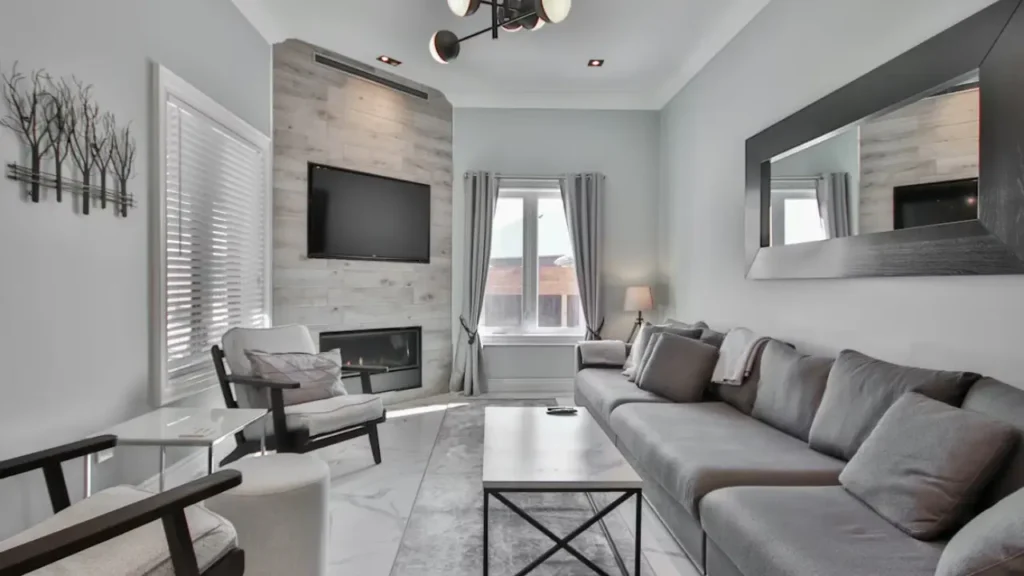

Making a small living room look bigger with mirrors is one of the most cost-effective design decisions you can make — and also one of the most misunderstood. There’s a moment every small apartment dweller knows. You’ve rearranged the furniture for the third time, painted the walls the lightest shade of beige you could find, and still — the room feels like it’s slowly closing in on you. I’ve been there. A 280-square-foot studio in the middle of a city, with a living room that doubled as a dining room and sometimes a home office. The ceiling felt low. The walls felt close. Every piece of furniture looked like it was apologizing for existing.
Then I made one change — a single large mirror leaned against the far wall — and the room exhaled.
That sounds dramatic. It kind of was. And that experience sent me down a rabbit hole of studying exactly why mirrors work, when they don’t, and what separates a genuinely space-expanding mirror setup from one that just bounces your reflection awkwardly back at you from the wrong angle.
If you’re trying to make a small living room look bigger with mirrors, this isn’t going to be the article that tells you to “hang a mirror opposite a window.” You already know that. What I want to share is the reasoning behind these strategies, the mistakes I made and watched others make, and the specific decisions that actually move the needle.
The Physics Behind Making a Small Living Room Look Bigger With Mirrors
Mirrors don’t literally expand space. What they do is replicate light and depth — and your brain is remarkably bad at distinguishing between the two.
When you place a mirror in a room, your eye receives two visual planes: the actual wall behind you, and the reflected image of the space opposite the mirror. If that reflected image contains depth — a hallway, a window, another room, or simply a long stretch of your living space — your brain reads it as additional square footage. It’s not magic. It’s visual processing.
The implication? Where a mirror reflects matters infinitely more than the mirror itself. A massive ornate mirror reflecting a blank wall is almost useless. A smaller, well-positioned mirror that captures a window, an open doorway, or the longest visual line in your room can double the perceived depth of the space.
This is the principle that most decorating advice glosses over. They tell you to hang mirrors. They don’t tell you to audit what your mirror will actually see.
The “What Does the Mirror See?” Test
Before buying or hanging anything, I started doing what I now call the “mirror test.” Stand at the location where you want to place a mirror. Hold your phone up in camera mode, facing the direction the mirror would face. What’s in the frame?
If it’s a sofa back, a TV, or a closed door — reconsider the placement. If it’s a window, a light source, an open area, or the longest diagonal of your room — you’ve found your spot.
I did this in a client’s London flat (a friend who asked for advice before redoing her living room). She had a beautiful antique mirror above the fireplace, centered on the chimney breast. It looked perfect stylistically. But when I did the test — the mirror was reflecting the opposite wall directly, which was painted in a deep green. It was beautiful color-wise, and utterly suffocating spatially. We shifted a smaller accent mirror to the left wall instead, where it picked up the bay window and a slice of the room’s diagonal depth. The difference was immediate.
The same principle applies when you’re working around dominant furniture colors. If you have a bold anchor piece — say, a deep-toned sofa — what the mirror reflects around it matters just as much as the sofa’s own presence. We’ve gone deeper into this in our guide on decorating a living room with a brown sofa, which covers how to balance strong furniture tones with light and space.
Mirror Placement Strategies to Make a Small Living Room Look Bigger
The Leaned Mirror vs. The Hung Mirror
There’s a functional difference between a mirror leaned against a wall and one mounted flush. Leaned mirrors create a slight downward tilt, which reflects the floor — particularly useful if you have beautiful flooring (light wood, patterned tile, or even a well-chosen rug). That reflection of the floor creates a visual impression of the room extending downward and outward simultaneously.
Hung mirrors, depending on height, often reflect the ceiling more than the floor — which can be either helpful or neutral, depending on ceiling height.
For small living rooms with standard or low ceilings, a large leaned mirror is often the better choice. It avoids that “you’re being watched from above” feel that tall hung mirrors sometimes create.
The Diagonal Depth Trick
Every room has what designers call a “primary visual axis” — the longest straight line your eye travels when you stand at the entrance. In a rectangular room, it’s usually the diagonal corner-to-corner line.
Placing a mirror so it captures and extends this diagonal is one of the most underrated tricks for making a small living room look bigger with mirrors. It doesn’t even need to be a large mirror — a well-angled medium mirror that reflects that long diagonal creates tremendous perceived depth.
In practice: if your front door opens into a living room and the far corner has a window, a mirror placed on the left or right wall (angled slightly toward that window and that corner) will reflect the entire diagonal sweep of the room.
The Gallery Wall Mirror Strategy
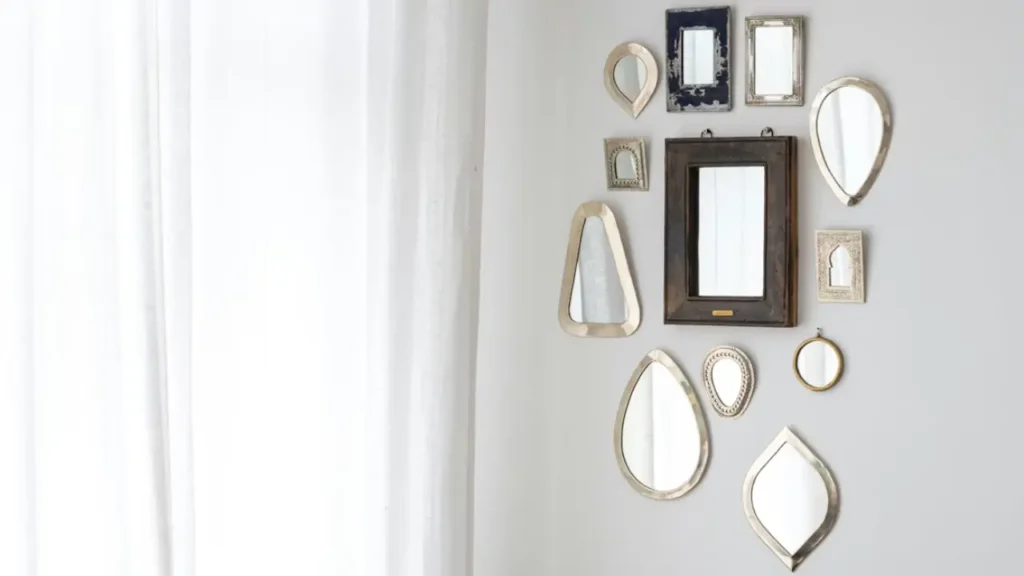
Instead of one large mirror, try a cluster of smaller mirrors arranged as a gallery wall — with one important rule: all mirrors should face the same light source or the room’s deepest visible point. Mixed reflections in a cluster can be chaotic. Unified reflections create cohesion and depth simultaneously.
I’ve seen this done brilliantly with a mix of circular and rectangular mirrors of varying sizes, all arranged on the wall adjacent to a window, angled very slightly toward it. The effect isn’t “fun decorative wall.” It’s genuinely space-expanding.
Mirror Mistakes That Make Your Small Living Room Look Smaller (Not Bigger)
This is the part most articles skip, and it’s arguably the most valuable.
Mirrors facing each other. The infinite reflection tunnel looks interesting in a barbershop. In a living room, it creates visual confusion. Your brain can’t settle on a depth reading — it keeps registering more and more reflections — and the effect is disorienting, not spacious. Avoid placing mirrors directly opposite each other in small rooms.
Mirrors that are too small for the wall. A small mirror on a large wall reads as a picture frame, not a spatial illusion. The mirror needs to be substantial enough — ideally at least half the height of the wall or more — to register as a depth cue. This is where people underestimate and under-invest.
Dark or heavily tinted mirrors. Antique mirrors with oxidized patina are fashionable and can look beautiful, but they absorb light rather than amplifying it. In a small living room already starved for light, a dark mirror is counterproductive spatially, even if it works aesthetically.
Mirrors directly above a sofa at a low angle. If you’re seated on the sofa and the mirror above shows your head from a slightly downward angle, it registers as a portrait wall, not a depth extender. Mirrors placed so that seated viewers see mostly ceiling and room depth (not themselves) are far more effective at expanding perceived space.
This becomes especially relevant in rental apartments where you’re working within constraints — you can’t always move walls or repaint freely, so mirror placement becomes one of your most powerful tools. If that’s your situation, our full breakdown on how to make a rental apartment feel like home covers the non-permanent changes that have the biggest visual impact.
What Kind of Mirror Actually Works Best?
Let me be direct: the frame matters less than the glass. What you want for a space-expanding mirror is:
Clear, non-tinted glass. No grey tint, no bronze tint, no antiqued patina. Clear mirrors reflect the most light and create the sharpest depth illusion.
Frameless or thin-frame options. Thick ornate frames eat into the reflective surface and add visual weight to the wall — the opposite of what you want in a small room. Thin metal frames (brass, black, or chrome) or completely frameless mirrors maximize the reflective area while keeping the look clean.
Large format, single piece. A full-length mirror or a wide landscape-orientation mirror will outperform most decorative options in terms of spatial effect. IKEA’s Hovet mirror (78×78 cm, frameless) has become something of a cult favorite for exactly this reason — it’s not glamorous, but it works.
Floor-to-ceiling options when possible. In spaces where you can run a mirror from floor to ceiling — even just one panel of it — the effect is dramatic. It eliminates the wall entirely from that plane. IKEA PAX wardrobe mirror doors used purely decoratively (leaned or wall-mounted) achieve this in living rooms at a reasonable cost.
Room-Specific Scenarios
The Narrow Rectangular Living Room
This is the most common layout in urban apartments — a room that’s much longer than it is wide. The instinct is to place mirrors on the short end walls to “push out” the length. This is correct in principle, but execution matters.
The mirror on the short wall needs to reflect the length of the room, not just the furniture in front of it. If your sofa is positioned close to that wall, the mirror will mostly reflect the sofa back. Consider repositioning furniture slightly away from that wall, or mounting the mirror high enough to capture the room’s full length over the sofa.
Alternatively, mirrors on the long side walls (reflecting the width) can break up the tunnel feel more effectively than you’d expect.
The Square-ish Box Room
Ironically, square rooms are trickier. There’s no dominant axis to extend — every direction is roughly the same depth. Here, the mirror strategy should focus on light amplification rather than depth extension. A large mirror opposite the primary light source (window or doorway) will brighten the room significantly, which has its own space-expanding effect. Brighter rooms feel larger — that’s consistent across nearly all interior design research.
[Insert internal link: Lighting Tricks That Make Small Living Rooms Feel Airy]
The L-Shaped Living Room
L-shaped rooms have a natural “elbow” — a corner that interrupts visual flow. Placing a mirror at that corner (on the interior angle) can visually smooth out the bend and make the room read as a single connected space rather than two awkward segments. This works particularly well with a floor-leaning mirror placed at 45 degrees in the corner.
Mirrors vs. Other Space-Expanding Techniques: An Honest Comparison
| Technique | Cost | Effort | Effectiveness | Best For |
|---|---|---|---|---|
| Large wall mirror | Medium | Low | Very High | Immediate spatial impact |
| Light paint colors | Low | Medium | High | Rooms with good light |
| Furniture declutter | Free | High | High | Visually crowded rooms |
| Vertical curtains | Low | Low | Medium | Low ceiling rooms |
| Glass/lucite furniture | High | Low | Medium | Dense furniture layouts |
| Under-furniture lighting | Medium | Medium | Medium | Evening ambiance |
Mirrors outperform nearly everything else in the “cost to effect” ratio. A single good-quality large mirror, placed correctly, delivers more perceived space than a complete furniture overhaul in many cases. The limitation is that mirrors are passive — they amplify what’s already in the room. If a room has bad bones (no windows, no natural light, dark walls), mirrors will reflect the problem, not solve it.
A Real Test Case: What Happened in a 180 sq ft Living Room
A friend in a compact city apartment agreed to let me experiment with her living room before she moved out. The room was 180 square feet, one window on the east wall, no overhead lighting except a builder-grade fixture, and furniture that was appropriately scaled but still made the room feel packed.
Before: One small decorative mirror above the console table. The mirror was about 50×50 cm, framed in thick dark wood. It reflected the sofa directly opposite. The room felt exactly as small as it was.
Change 1: Replaced the small mirror with a 90×180 cm frameless floor mirror leaned against the same wall, positioned to the left of the console — angled slightly so it captured the window and the room’s longest diagonal. Cost: about $80.
Result: Immediately noticeable. The room visually widened. The floor reflection made it feel like the room extended past the wall.
Change 2: Added a circular mirror (60 cm diameter, thin brass frame) on the perpendicular wall — the one with no window — positioned so it captured daylight from the window indirectly. This was specifically to brighten that side of the room, not to extend depth.
Result: The left side of the room went from shadowy and flat to alive. Two mirrors, total cost under $120, and the room genuinely looked different in photos — not just in person.
The key insight from this experiment: two mirrors working in concert, each with a specific job (one for depth, one for light), outperformed any single large mirror doing both jobs mediocrely.
One thing worth noting from the experiment — the leaned mirror’s floor reflection worked so well partly because the rug underneath was a warm neutral that photographed well. Rug color has a surprisingly strong relationship with how grounded and spacious a room feels, and that’s worth thinking about in the same breath as mirrors. If you’re deciding on a rug alongside all this, our piece on what color rug goes with a grey couch has solid guidance that applies even if your sofa isn’t grey — the color logic translates broadly.
The Design Layer Nobody Talks About: Mirror Shape Psychology
Round mirrors feel softer and more expansive — they don’t have corners that “stop” the eye. Rectangular mirrors feel more formal and directive. Arch-top mirrors are increasingly popular and have an interesting spatial effect: the curved top echoes a doorway or window arch, and the brain reads it as an opening rather than a reflective surface.
For small living rooms, arched mirrors have become a genuine game-changer specifically because they trigger the “opening” response. I’ve seen 60×120 cm arched mirrors in small living rooms that genuinely read as an additional window or doorway. It’s subtle, but the psychology is real.
Horizontal wide mirrors (landscape orientation) are underused. Most people default to portrait-orientation mirrors. But a wide horizontal mirror mounted at eye level on a low-ceilinged room can make the room feel wider without drawing attention to the ceiling height.
What Interior Designers Actually Do (And What They Admit Works)
I spoke with a few interior designers about their go-to strategies for making a small living room look bigger with mirrors. The consistent answers surprised me with how simple they were.
Most said they never use a mirror smaller than 24 inches in the smallest dimension for a spatial effect. Below that, it functions purely as decor.
Several mentioned that they avoid placing mirrors where the first thing reflected is the television — because the screen creates glare and the reflection reads as “noise” rather than depth.
One designer specifically mentioned an approach she calls the “borrowed view” — positioning a mirror so it reflects a piece of artwork, a beautiful plant, or a styled bookshelf on an adjacent wall. The mirror doesn’t just extend space; it curates what it shows. A mirror reflecting a styled corner of the room makes that corner appear twice, which adds richness and depth simultaneously.
According to research from the Lighting Research Center at Rensselaer Polytechnic Institute, the distribution of light within a space directly affects perceived room size — which is why mirror placement relative to light sources is functionally significant, not just decorative.
Styling the Mirror Without Losing the Spatial Effect
Here’s the tension: decorative styling around a mirror (frames, ledges, objects placed in front) can undermine its spatial function. An object placed in front of a mirror — a vase, a plant, a candle — reduces the visible reflective surface and draws attention to the object rather than the depth behind it.
For small living rooms, keep the area immediately around mirrors clean. The mirror should be the focal point of that wall, not competing with other elements for attention.
If you want to add some warmth (because a large bare mirror can feel clinical), lean toward a slim shelf below the mirror rather than objects beside or in front of it. The shelf grounds the mirror visually without interrupting its function.
And consider mirror placement relative to your sofa. Many people want to hang a mirror above the sofa — and it can work beautifully — but make sure it’s mounted high enough that it doesn’t reflect the back of the sofa. A mirror that shows the top half of the room and the ceiling reads as “depth.” A mirror that shows sofa cushions reads as “you forgot to put something here.”
Wall color plays into this too. If the wall your mirror reflects is painted in a heavy, saturated tone, the mirror amplifies that weight rather than the space. Lighter, well-chosen colors on the opposite wall make a significant difference in what the mirror gives back to the room. For renters especially, this is worth thinking through carefully — our guide on living room color ideas for rental apartments covers which tones open up a space without requiring permanent changes.
The Overrated Move and a Better Alternative
The most commonly repeated advice for making a small living room look bigger with mirrors is: “place a mirror opposite a window.” It’s not wrong. It’s just often overdone and sometimes executed poorly.
The problem is that “opposite the window” is often directly behind your main seating area. Which means guests sitting in that area see themselves reflected back constantly — which is actually slightly uncomfortable and draws attention to the room’s boundaries rather than erasing them.
A better alternative for the same light-amplifying goal: place the mirror at a 90-degree angle to the window, on the adjacent wall. It still captures daylight. It still amplifies it across the room. But the reflection shows the room’s depth rather than the room’s inhabitants. Less self-conscious, more spatially effective.
Before You Buy: A Checklist
Before purchasing a mirror to make your small living room look bigger, answer these:
- What will the mirror reflect? (Do the mirror test with your phone.)
- Is the reflective surface at least 24 inches in its smallest dimension?
- Is the glass clear (not tinted or antique)?
- Is the frame thin or absent?
- Does the placement compete with the TV glare?
- Will the mirror reflect a person sitting on the sofa directly and uncomfortably?
- Is there another mirror it will face directly?
If you’ve answered these honestly and your placement survives the checklist, you’re likely to get a genuine spatial result.
Final Thought: Mirrors as a Design Decision, Not a Quick Fix
What I’ve come to believe after years of paying attention to this — in my own spaces, in friends’ homes, and through intentional observation — is that mirrors work best when they’re treated as architecture rather than accessories.
A mirror placed correctly isn’t decoration. It’s a spatial tool. It restructures the visual experience of the room. The difference between a mirror placed thoughtfully and one placed casually is the difference between a room that breathes and one that just has glass on a wall.
The goal of making a small living room look bigger with mirrors rewards that thoughtfulness more than almost any other design approach. And the cost of doing it right is lower than almost any other meaningful design intervention.
If you’ve been on the fence about committing to a large mirror in your living room — this is your nudge. Get the mirror. Do the test. Position it for what it reflects, not just for how it looks. Then watch what happens to the room.
Did any of these strategies surprise you? Drop a comment below and tell me what your small living room looks like and what you’re working with — I’d love to help you think through placement. And if you’re tackling other parts of the space, check out our guides on [small living room furniture layouts that actually work] and [how to use curtains to make ceilings feel taller] — both are worth reading alongside this one.
Sources referenced: Lighting Research Center, Rensselaer Polytechnic Institute (lrc.rpi.edu) — research on light distribution and spatial perception.

Pingback: Decorate Rental Apartment on a Budget: $200 Plan
Pingback: Small Apartment Living Room Ideas That Actually Work
Pingback: What Size Rug Goes Under a Sectional Sofa
Pingback: How to Place a Rug in a Living Room the Right Way
Pingback: Small Living Room Layout Mistakes to Avoid