

Here’s the truth nobody tells you when you’re standing in your 300-square-foot living room surrounded by furniture that looked perfectly fine at the store: square footage isn’t your real problem. Arrangement is.
I’ve lived in four apartments in the last eight years. Two of them had living rooms that felt like a shoebox no matter what I did — until I stopped following generic “small space” advice from the internet and started paying attention to why certain rooms feel bigger than they are. The difference wasn’t always the furniture. It was usually something much simpler: light, sight lines, and the willingness to get rid of one piece I loved.
If you’re looking for a room full of floating shelves and minimalist white boxes — this isn’t that article. These are real, tested ideas for real apartments where you actually have stuff, have guests, and still need somewhere to collapse at the end of the day.
Whether you’re working with 150 square feet or 400, these small apartment living room ideas will help you make the most of what you have — without expensive renovations or a total room overhaul.
Why Small Living Rooms Feel Cramped (It’s Not What You Think)
Most people assume their living room feels small because it is small. But I’d bet that at least half the time, a small room feels suffocating for one of three reasons that have nothing to do with square footage:
The Furniture Is Too Big — Or Too Small
Oversized furniture is the most common culprit. A sectional that seats eight people does not belong in a 12×14 room, no matter how comfy it is. But here’s the flip side that surprises people: furniture that’s too small can make a space feel just as disjointed. A loveseat floating in the middle of a room with three feet of empty space on all sides looks awkward and unanchored.
The sweet spot? Furniture that fits within the room’s “activity zones” without blocking natural pathways. More on this in the arrangement section below.
The Room Has No Visual Anchor
Without something to draw the eye — a piece of art, a striking rug, an accent wall — the eye bounces around and the room reads as chaotic no matter how tidy it actually is. Visual anchors create a sense of intentionality, and intentional spaces feel larger.
The Layout Is Working Against the Light
Light makes rooms feel bigger. Full stop. When furniture blocks windows, when dark curtains eat up natural light, or when the only lamp in the room sits in a corner at floor level, the room contracts. The fix is often as simple as moving a bookshelf six inches to the left.
If your living room feels cramped even when it’s clean and organized, one of these three things is usually the root cause. Light, in particular, is so powerful that I wrote an entire separate guide on it — specifically on how to use mirrors to make a small living room look bigger, which is worth reading alongside this one.
Furniture Selection: The Rules That Actually Matter
Choose Pieces With Legs (Seriously)
Furniture that sits directly on the floor — bulky sofas with skirted bases, floor-level entertainment units, big solid coffee tables — visually weighs down a small room. When you can see the floor underneath a piece of furniture, the room reads as having more open space, even if the actual footprint is identical.
What to look for: Sofas and chairs with legs that are at least 4–6 inches off the ground. A mid-century style sofa with tapered wooden legs is one of the most space-efficient choices for a small apartment, and they look intentional rather than utilitarian.
For coffee tables, a slim metal or acrylic option lets the eye travel through and underneath, maintaining visual flow. I switched from a large solid wood coffee table to a round smoked-glass one in my last apartment, and the room immediately felt 20% bigger — same room, same sofa, same rug.
Scale Your Sofa to the Room, Not Your Guest List
A 90-inch three-seater sofa is the gold standard of American living rooms, but in a small apartment, you often don’t need it and definitely can’t fit it. A loveseat (54–68 inches) paired with one armchair gives you seating for four without dominating the room.
If you do need more seating, choose pieces you can move: a lightweight accent chair that can slide in when company comes, or a pair of pouf ottomans that tuck under a console table when not in use.
My honest take: I resisted downsizing my sofa for two apartments because I was convinced I needed the space. I didn’t. Most of the time it was just me and my partner, and the massive sofa just ate the room. The loveseat I replaced it with was one of the best small-space decisions I made.
The Power of Dual-Purpose Furniture
If you’re choosing between a standard piece and a dual-purpose one at similar quality, always go dual-purpose in a small apartment. This isn’t about cheap sofa beds — it’s about smart design.
Best dual-purpose picks for small apartment living rooms:
- Storage ottomans: Replace your coffee table entirely or use alongside it. Store throws, remotes, board games.
- Console-plus-shelving combos: A slim console that acts as both a sofa table and book/decor display.
- Nesting tables: Take up almost no visual space, but expand into three surfaces when needed.
- Lift-top coffee tables: The surface lifts to desk height, so your living room moonlights as a home office. Excellent for renters.
If you want to see what a difference these swaps actually make in a real space, check out these before and after small space transformations — the dual-purpose furniture results especially are pretty eye-opening.
Layout Strategies That Open Up the Room
Pull Furniture Away From the Walls
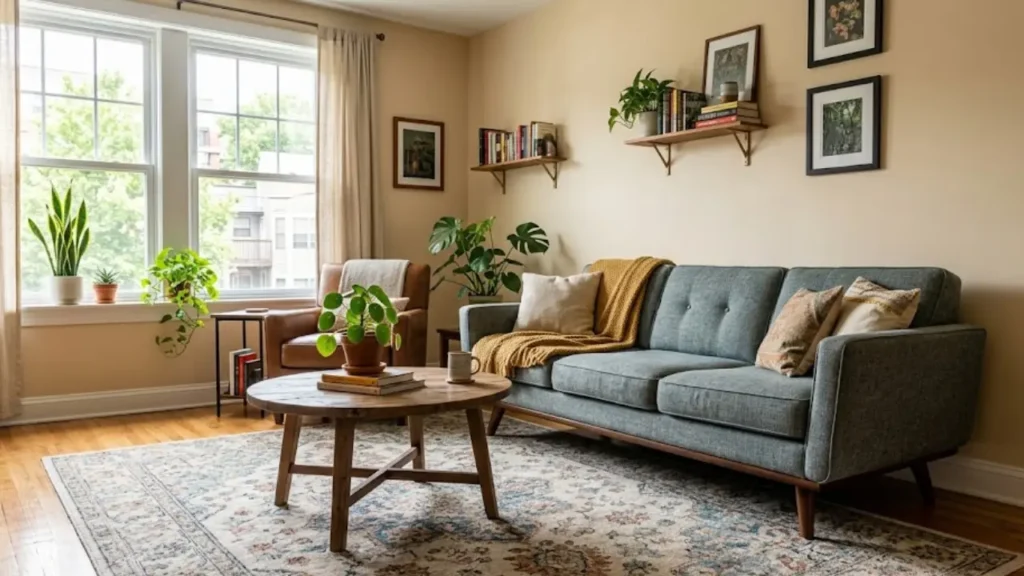
This is the single most counterintuitive piece of advice for small spaces, and the one that consistently gets the best results: stop pushing everything against the wall.
When you float your sofa a few inches (or even a foot) away from the wall, it creates a sense of depth and makes the room feel designed rather than crammed. Interior designers do this almost universally. The reason it feels wrong is because it seems like it should make the room smaller — in practice, it almost never does.
You don’t need much. Even 4–6 inches off the wall changes the visual weight of the room significantly.
Create a Clear Traffic Path
In a small living room, you should be able to walk from the entrance to any seating area without navigating around furniture. The minimum clear path is 30–36 inches. If your current layout doesn’t allow that, it needs to change — no matter how much you love the way things look.
Quick test: Walk from your front door (or the main entry into the living room) to the farthest seating spot. Did you have to turn sideways? Step over anything? That’s your layout problem right there.
Anchor Everything to a Rug
A rug is often the missing piece in small living room arrangements. Without one, furniture feels scattered. With one, everything becomes a cohesive zone.
Rug sizing in small spaces: Go bigger than you think. The most common mistake is buying a rug that’s too small — it ends up looking like a bath mat in the middle of the room. In a small living room, all four legs of the sofa should be on the rug, or at minimum, the front two legs. A 5×8 is usually the minimum; 8×10 is ideal if the room allows it. And if you’re unsure about color, this guide on what color rug goes with a grey couch breaks it down really well — even if your sofa isn’t grey, the color-matching logic applies across the board.
Think in Zones, Not Rooms
Even in a tiny space, you can define a “conversation area” (sofa + chairs facing each other), a “media area” (TV + console), and if needed, a “reading nook” (single chair + lamp). Zones make a room feel purposeful. The secret is that you define them visually — with a rug, with the angle of furniture, with lighting — not with walls.
Color and Visual Tricks That Add Space
Light Walls Are Good — But Not the Only Option
Yes, painting walls white or a warm off-white makes rooms feel bigger. Light reflects, dark absorbs, and that’s just physics. But “paint everything white” has become such a default small-space tip that it ignores context entirely.
A warm greige (gray-beige) can work beautifully in a room that gets good natural light. A dusty sage or muted terracotta on a single accent wall can make the space feel cozy and intentional rather than cramped and dingy. The key isn’t the specific color — it’s the value (light vs. dark) and the undertone (warm vs. cool, matched to your light source).
What actually matters more than wall color: ceiling color. Paint your ceiling the same color as your walls or slightly lighter, and the room immediately feels taller. If you have a low ceiling — common in older apartments — this one trick does more than any furniture swap.
Monochromatic Doesn’t Mean Boring
One reason small apartments feel visually busy is too many competing colors. If your sofa is charcoal, your throw pillows are mustard, your curtains are navy, your rug is patterned in rust and cream — the eye has nowhere to rest.
A more cohesive approach: anchor the room in one main color family (say, warm neutrals) and add texture and pattern variation within that same range. A cream sofa, a sand-toned rug, warm wood tones, linen throw pillows in different textures — same color family, but layered and interesting.
This approach also photographs beautifully, which matters if you want to create Pinterest-worthy content for your space or just want your living room to look good in photos. If you’re still figuring out your palette, I’ve got a full breakdown of living room color ideas for rental apartments that walks through specific combinations that work in low-light and bright spaces alike.
Mirrors: Strategic Placement Over Volume
Most small-space guides tell you to add mirrors. That’s correct, but vague. A mirror only works as a space-amplifier when it reflects something worth seeing — a window, light, greenery, an interesting part of the room. A mirror that faces a blank wall or a cluttered shelf just doubles the clutter.
Where to place a mirror in a small living room:
- Opposite or adjacent to the largest window
- On the wall facing natural light, at eye level
- Leaning against the wall behind the sofa to extend the visual depth of the room
Large format is better than multiple small mirrors. A single 24×36 or larger mirror does more work than three small ones grouped together.
Vertical Space: Your Most Underused Asset
Most people decorate to eye level and stop there. In a small apartment, the space above your head is some of the most valuable real estate in the room — and most of it goes completely unused.
Floor-to-Ceiling Storage
If you have bookshelves, wall storage, or entertainment units, extend them as high as possible. IKEA’s KALLAX and BILLY systems, for example, can be extended with add-on units and topped with crown molding to look built-in. The visual effect is dramatic: the room feels taller, and you’ve gained storage without using any additional floor space.
Store what you use daily at eye level and below. Store rarely-used items on higher shelves. Keep the very top shelf intentionally sparse — a plant, a decorative box, a piece of art — to give the eye somewhere to rest.
Floating Shelves Done Right
Floating shelves are one of the most popular small-space solutions, and one of the most frequently done wrong. The mistake: too many shelves, too many things on each shelf, no breathing room.
The rule of thirds for shelf styling: Fill about two-thirds of the shelf space with actual items. Leave one-third open. This makes the shelves feel curated rather than cluttered, and it’s much easier to maintain.
What works on floating shelves: A mix of books (stacked and upright), a small plant, one piece of art or a small sculpture, and one personal item. That’s usually enough for one shelf.
Curtains That Trick the Eye
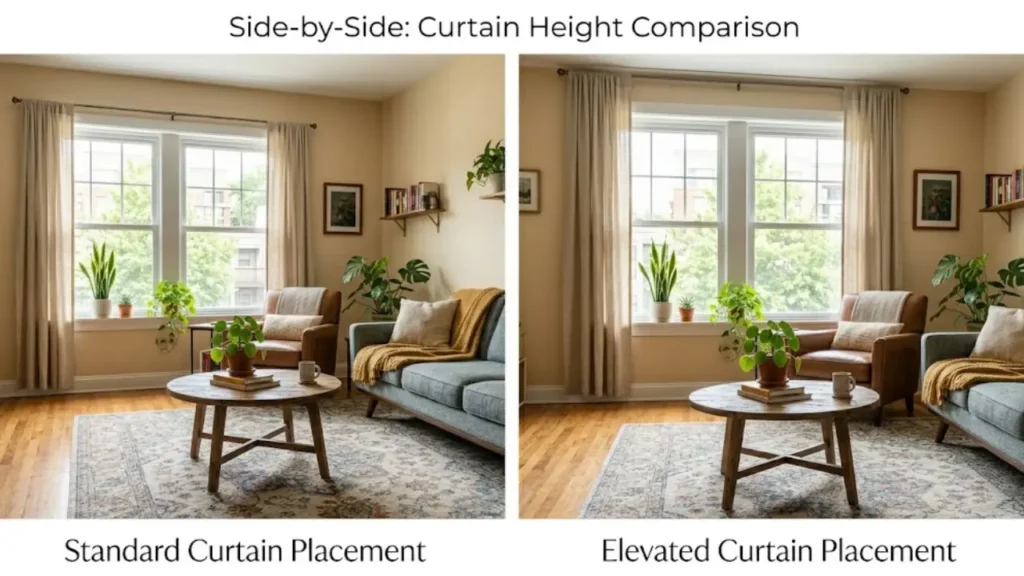
Hang curtain rods as close to the ceiling as possible — ideally 2–3 inches below the ceiling line — and let curtains drape all the way to the floor. This is one of those tricks that sounds subtle but looks dramatic in practice. Curtains that start at the window frame and end above the floor make rooms look squat. Curtains that run from near the ceiling to the floor make them look tall and elegant.
Width matters too: your curtains should extend 8–12 inches beyond each side of the window frame when drawn open, so the fabric stacks on the wall rather than blocking the glass. More light, taller look, bigger room.
Lighting: The Underrated Space Transformer
Here’s something I didn’t understand until I spent too much money on furniture trying to fix what was actually a lighting problem: the right light can make a room feel warm and spacious, and the wrong light can make even a large room feel oppressive.
Layer Your Light Sources
Most apartments come with a single overhead light, and stopping there is a mistake. Overhead lighting alone creates flat, unflattering light that emphasizes shadows and makes rooms look smaller.
The three-source rule: Aim for at least three light sources in your living room at different heights:
- Ambient — overhead or ceiling (your existing fixture)
- Task — floor lamp or table lamp near a seating area
- Accent — string lights, a small table lamp, LED strips behind the TV or under a shelf
The third source is often the one people skip. It’s also the one that does the most for atmosphere and perceived space.
Tall Floor Lamps Draw the Eye Up
A floor lamp that reaches 60–70 inches tall does double duty: it provides reading light and it draws the eye upward, making the ceiling feel higher. Arc floor lamps are especially good for small apartments — they reach over a sofa or chair and provide directed light without requiring a side table.
Warm Bulbs Always
In a living room, you almost never want cool white (5000–6500K) bulbs. They make spaces feel clinical and harsh. Warm white (2700–3000K) bulbs create the kind of light that photographs well, relaxes the eye, and makes a small room feel intentionally cozy rather than accidentally small.
Budget-Friendly Upgrades With Big Impact
Not every small apartment living room idea requires new furniture or a paint job. Some of the highest-impact changes cost very little.
Declutter First, Decorate Second
This sounds obvious, and yet — it’s the step most people skip. Before any decorating decision, remove everything from the room that you wouldn’t miss if it disappeared. Be ruthless. The coffee table books you haven’t opened in two years. The extra throw pillows that mostly end up on the floor. The side table that exists only to hold stuff you haven’t figured out where to put yet.
A small room with 80% of what you currently have in it will almost always look better than the same room with all of it. Editing is a design skill.
Change the Textiles First
If your budget for improvement is small, start with textiles — they have an outsized impact on how a room looks and feels. A new rug, a pair of curtains in a better color, or a set of throw pillows in a coherent palette can transform a room’s feel for a few hundred dollars or less.
Textiles also add texture, and texture is what makes monochromatic rooms feel layered and interesting rather than flat. If you’re working with a tight budget overall, my guide on how to decorate a rental apartment on a budget has a full section on where to prioritize spending — textiles rank near the top for good reason.
A Single Piece of Intentional Art
Most small apartment living rooms either have no art or have a collection of small, mismatched pieces that compete with each other. One large, well-chosen piece of art (24×36 or bigger) anchors a wall, creates a focal point, and makes a room look finished in a way that ten smaller pieces can’t.
You don’t need to spend a lot. Printable art on Etsy, oversized posters professionally framed, even a gallery-wrapped canvas from a big-box store — if the image resonates with you and the size is right, it will do the job.
Pro Designer Tips That Beginners Overlook
Use Odd Numbers
When grouping decor items — on a shelf, on a coffee table, on a console — odd numbers (3, 5, 7) look more natural and balanced than even numbers. Three items at varying heights feels intentional. Two items feels incomplete. Four items feels symmetrical in a way that reads as rigid.
The “Squint Test” for Arrangement
Step back from your arrangement and squint until the room blurs. You should see a rough visual balance — not necessarily symmetry, but balance. If one side of the room looks dramatically heavier than the other in your blurred view, the arrangement isn’t working yet.
Don’t Match Everything
Matching furniture sets feel dated and small. When every piece in a room comes from the same collection — same finish, same legs, same upholstery — it reads as catalog-staged rather than lived-in. Mix materials (wood, metal, fabric, glass), mix eras (a mid-century chair with a more contemporary sofa), mix tones within the same general family. The resulting room feels layered and collected, which is always more appealing in a small space than perfectly matched.
Greenery Works Harder Than Most Decor
A real plant (or a high-quality faux if you’re not a plant person) adds something no inanimate decor object can: life. It draws the eye, adds a contrasting organic shape against straight-line furniture, and in the case of real plants, literally improves the air. Even one large plant — a fiddle leaf fig, a bird of paradise, a large pothos in a tall pot — does more for a small living room than most decor purchases twice its price.
Common Mistakes That Make Small Apartments Feel Smaller
1. Buying Furniture That’s Too Dark
Dark upholstery and dark wood can look dramatic and sophisticated in a large room. In a small apartment living room, they absorb light and make the space feel heavier. This doesn’t mean you can’t have dark pieces — but limit them to one or two and balance with lighter elements.
2. Blocking Windows With Furniture
Any furniture placed directly in front of or blocking a window is stealing your most valuable light source. Even moving a bookshelf six inches away from a window edge to let more light into the room makes a visible difference.
3. No Defined Focal Point
A living room needs one thing the eye goes to first: a fireplace, a large piece of art, an accent wall, a significant piece of furniture. Without a focal point, the eye wanders and the room feels unresolved. If your room doesn’t have an obvious one, create one — even an arrangement of art above a console can serve this purpose.
4. Rugs That Are Too Small
Already mentioned this, but worth repeating because it’s so common: a rug that’s too small makes furniture look like it’s floating in space. Always size up.
5. Over-Accessorizing
In small spaces, editing is everything. Every decorative object needs to earn its place. If you can’t answer “why is this here?” about a piece of decor in two seconds, it probably shouldn’t be there. The rooms that feel effortlessly styled are usually the most edited, not the most filled.
Your Game Plan for Small Apartment Living Room Ideas
Knowing where to begin is half the battle. If you’re staring at a small living room and feeling overwhelmed, use this order:
Step 1: Clear everything out and deep clean. Fresh start, fresh eyes.
Step 2: Identify the best light source (usually the largest window) and orient your furniture arrangement around it.
Step 3: Place your sofa first — this is your anchor. Float it slightly from the wall.
Step 4: Add your rug. Size up. Make sure it extends under at least the front legs of all seating.
Step 5: Choose your focal point — art, a TV gallery wall, a styled console — and style it.
Step 6: Layer in lighting (add a floor lamp or two table lamps if you only have overhead).
Step 7: Add greenery. One large plant or two smaller ones.
Step 8: Edit accessories down to what genuinely adds to the room.
Take it one step at a time and live with each change before adding the next. Small rooms often need less than you think.
A small apartment living room isn’t a limitation — it’s a constraint, and constraints make you more creative. Some of the most beautiful, magazine-worthy living rooms I’ve seen have been under 200 square feet. They work because every choice was intentional, the furniture was scaled correctly, and the light was used well.
You don’t need a bigger apartment. You need to work smarter with the one you have. Start with layout and light, then layer in everything else. The transformation will surprise you. And once the bones are in place, the next step is making it actually feel like yours — which is exactly what this guide on how to make a rental apartment feel like home is about.
FAQ: Small Apartment Living Room Ideas
How do I make my small apartment living room feel bigger?
The most effective changes are layout-based, not decorative. Float your sofa 4–6 inches from the wall, choose furniture with visible legs, use a correctly-sized rug (bigger than you think), and add at least two light sources beyond your overhead fixture. These four changes alone will transform how spacious the room feels.
What size sofa works best in a small apartment living room?
A loveseat (54–68 inches wide) or a compact three-seater under 84 inches works best for most small apartment living rooms. Look for sofas with legs elevated 4–6 inches off the floor — the visible floor underneath makes the room read as more open. Avoid floor-skimming bases and oversized sectionals.
What color should I paint a small apartment living room?
Light, warm neutrals (warm white, off-white, soft greige) are the most reliable choice for small living rooms because they reflect light and recede visually. More important than wall color: paint your ceiling the same color or slightly lighter to make the room feel taller. Avoid cool whites if your room gets limited natural light — they can feel clinical.
What’s the best rug size for a small apartment living room?
In most small apartment living rooms, an 8×10 rug is ideal. At minimum, a 5×8 if the room is very compact. The front two legs of your sofa and chairs should rest on the rug — furniture floating off the rug entirely makes the arrangement look disjointed and actually makes the room feel smaller.
How do I decorate a small living room without making it look cluttered?
Edit ruthlessly before adding anything new. Remove any decorative items you can’t immediately justify, then decorate in odd numbers (3 or 5 objects per grouping), choose one large piece of art over many small ones, and stick to a cohesive color palette with varied textures. Greenery adds life without visual noise. Less is almost always more in a small space.


Pingback: What Size Rug Goes Under a Sectional Sofa
Pingback: How to Place a Rug in a Living Room the Right Way
Pingback: Best Couch Colors for Small Living Rooms
Pingback: How to Decorate a Small Living Room Without Clutter | 9 Proven Ways