
Most people spend a long time picking the right rug. They compare colors, scroll through hundreds of options, read reviews, measure twice. And then they bring it home and something still feels off — the room doesn’t look put together the way they imagined. The rug is fine. The furniture is fine. But the whole thing just isn’t working.
Nine times out of ten, the problem isn’t the rug itself. It’s how the rug is being used.
Living room rug mistakes are incredibly common, and they’re sneaky because they don’t announce themselves. Your room just quietly feels smaller, more cluttered, or visually heavy — and you can’t quite put your finger on why. I’ve seen this happen in rooms of every size and style, from tiny studio apartments to generous open-plan spaces.
This article goes through the most common rug mistakes in detail — not just naming them, but explaining exactly what’s happening visually when you make them, and what to do instead. By the end, you’ll be able to look at any living room rug situation and immediately diagnose what’s wrong.
Mistake 1: The Rug Is Too Small
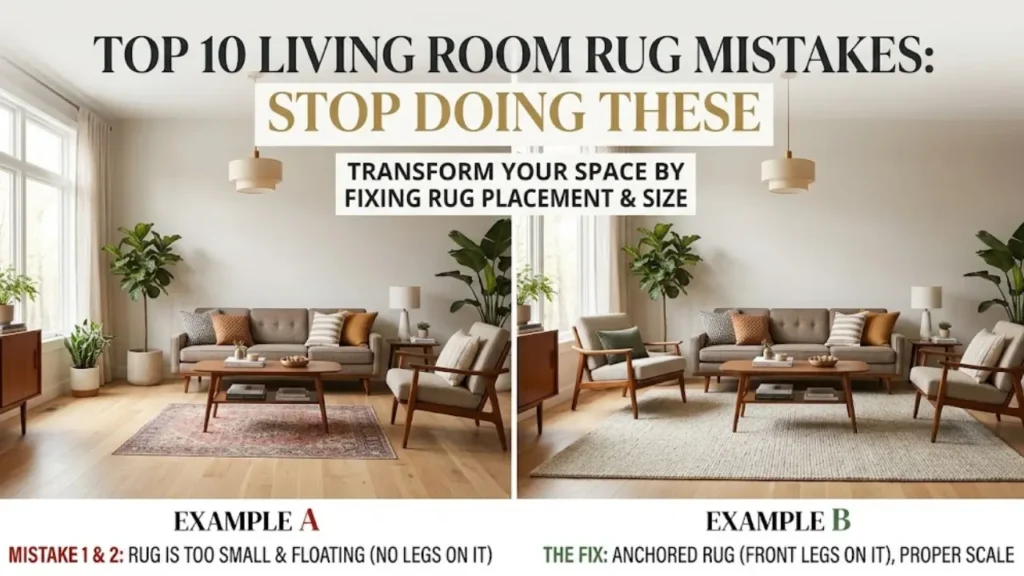
This is the single most common living room rug mistake, and it’s probably the one doing the most damage in the most homes right now.
A rug that’s too small for the seating area does something visually counterintuitive — it makes both the rug and the furniture look bigger and heavier than they actually are. When there’s no visual anchor tying the furniture together, every piece of furniture looks like it’s just floating in the room. The sofa looks bulkier. The chairs look disconnected. The whole arrangement reads as “furniture dropped into a space” rather than “a designed room.”
Why People Buy Rugs That Are Too Small
The most common reason is cost. Larger rugs cost more, and when you’re shopping, an 8×10 looks impressive on a website next to a 5×8. But scale only makes sense in context, and a 5×8 rug in a room with a full-sized sofa and chairs is almost always going to look like an island in the middle of the floor — not a foundation for the seating arrangement.
The second reason is caution. People think smaller is safer, because if they get it wrong, at least they didn’t spend as much. But a rug that’s too small is just as wrong as one that’s too big, and it actively works against the room rather than helping it.
The Minimum Size Rule
For a living room with a standard sofa and two chairs, a 8×10 rug is typically the minimum that works — and only if you use front-legs-on placement, where the front two legs of every piece of seating touch the rug. Anything smaller than that and the furniture loses its visual anchor entirely.
For larger arrangements or open floor plans, 9×12 is usually the right call. If you’re working with a sectional sofa, the sizing math changes slightly — there’s a full breakdown in the article on what size rug goes under a sectional sofa that covers every scenario in detail.
The tape test is your friend here. Before you buy anything, mark out the rug dimensions on your floor with painter’s tape and live with it for a day. Walk around it, sit on your furniture, look at it from different angles. That fifteen minutes of prep work will save you from returning a rug.
Mistake 2: The Floating Rug — No Furniture Legs on It at All
This is a close cousin of the too-small mistake, and it happens when the rug is placed in front of the furniture rather than underneath it. The sofa is behind the rug, the chairs are behind the rug, and the rug just sits in the middle of the room like a decorative mat with no job to do.
This is what designers call a “floating rug” — and it creates a visually confusing space because the eye can’t figure out the relationship between the furniture and the rug. Are they in the same zone? Are they separate? The room feels unresolved.
What Should Actually Happen
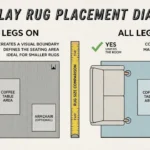
There are two correct approaches to rug placement in a living room, and both of them require furniture legs to make contact with the rug:
Front-legs-on placement is the most versatile option. The front two legs of every seating piece — sofa, chairs, chaise — sit on the rug, while the back legs remain on bare floor. This is the easiest way to create a unified seating area without needing an enormous rug, and it works well in most standard living rooms.
All-legs-on placement creates a more defined, formal look — like a room within a room. Every piece of furniture sits fully on the rug. This requires a larger rug (usually 9×12 or bigger) but creates a very polished, intentional feel. It works especially well in open floor plans where the rug needs to define a specific zone.
What doesn’t work is having all the furniture sitting behind the rug with nothing touching it. If you’re currently in that situation, try sliding the rug forward so the front legs of your sofa sit on it. The change in how the room reads is usually immediate and significant.
For detailed guidance on exactly how to position different rug types in a living room, the how to place a rug in a living room article walks through every placement scenario with specific measurements.
Mistake 3: Choosing a Dark Rug in an Already Small or Dark Room
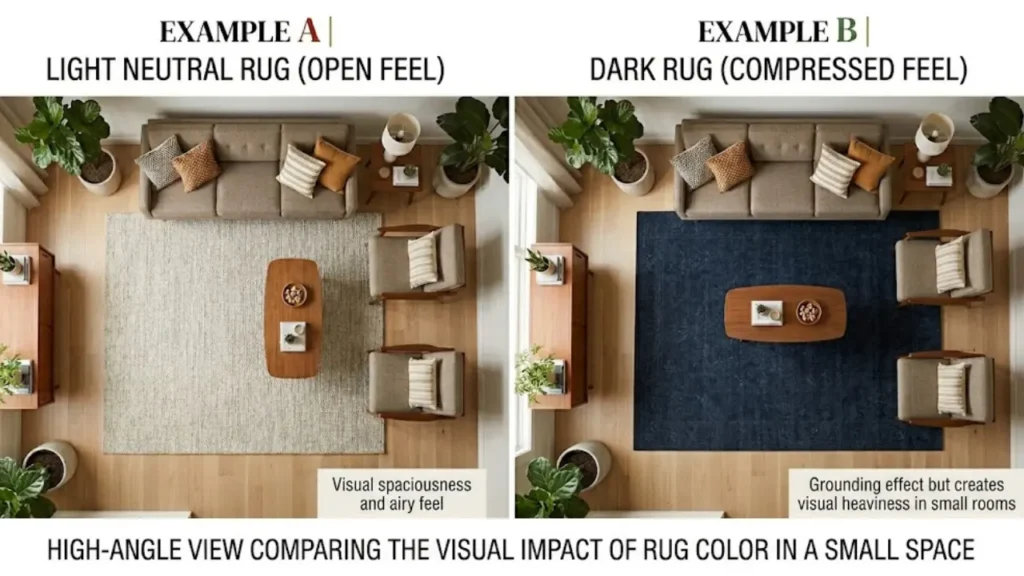
Dark rugs are genuinely beautiful. A deep charcoal, navy, forest green, or espresso rug can add incredible richness and warmth to a room — but only when the room has enough light and space to absorb it. In a small living room, or a room that already struggles with low natural light, a dark rug actively shrinks the space.
Here’s what’s happening visually: dark colors absorb light and pull the eye downward. In a well-lit, spacious room, that grounding effect is luxurious. In a smaller or darker room, it creates a heavy, cave-like feel that compresses the space. The floor starts to feel like it’s closing in.
When Dark Rugs Work (and When They Don’t)
Dark rugs work well in rooms with high ceilings, generous natural light, and lighter walls. The contrast between a dark floor anchor and bright upper walls creates a balanced, dramatic look that feels intentional rather than heavy.
In small or low-light rooms, lighter rugs almost always serve the space better. Cream, warm white, light gray, natural jute, oatmeal — these colors reflect light back into the room and make the floor feel more expansive. The room breathes.
That said, if you love a dark rug and your room is small, there’s a middle ground: go with a rug that has a dark ground color but an open, lighter pattern. The pattern breaks up the darkness visually and prevents it from feeling oppressive.
Rug color doesn’t exist in isolation — it has to work with your sofa and the rest of the room’s palette. If you’re navigating this with a grey couch specifically, the article on what color rug goes with a grey couch covers exactly which rug tones work well and which ones fight with grey.
Mistake 4: Using the Wrong Rug Shape for the Room
Most people default to rectangular rugs without thinking about it, and most of the time that’s fine. But rug shape is actually a meaningful design decision, and using the wrong shape can make a room feel awkward in ways that are hard to diagnose.
Round Rugs in Rectangular Rooms
A round rug in a rectangular living room can work beautifully — but only under specific conditions. It works well under a small accent chair grouping, in an entryway with a round table, or as a layering element over a larger neutral rug. What it doesn’t work well for is anchoring a full rectangular sofa-and-chairs arrangement.
The geometry fights itself. A rectangular sofa over a round rug creates a visual tension that the eye keeps trying to resolve. The rug wants to be centered, but the sofa is linear. The result usually looks like someone placed furniture on top of a decorative element rather than designing a cohesive space.
Runner Rugs in the Wrong Rooms
Runner rugs belong in hallways, narrow kitchens, and occasionally at the foot of a bed. Using a runner as the primary rug in a living room — unless the room is itself unusually narrow — almost never works. The proportions are wrong for a seating arrangement.
The Shape Rule of Thumb
Match rug shape to room shape and furniture arrangement. Rectangular room with a rectangular sofa arrangement: rectangular rug. Circular dining table: round rug. Curved sectional: round or oval rug. When shapes harmonize, the room reads as intentional. When they clash, the room reads as assembled without a plan.
Mistake 5: Poor Alignment — The Rug Isn’t Centered on the Seating Arrangement
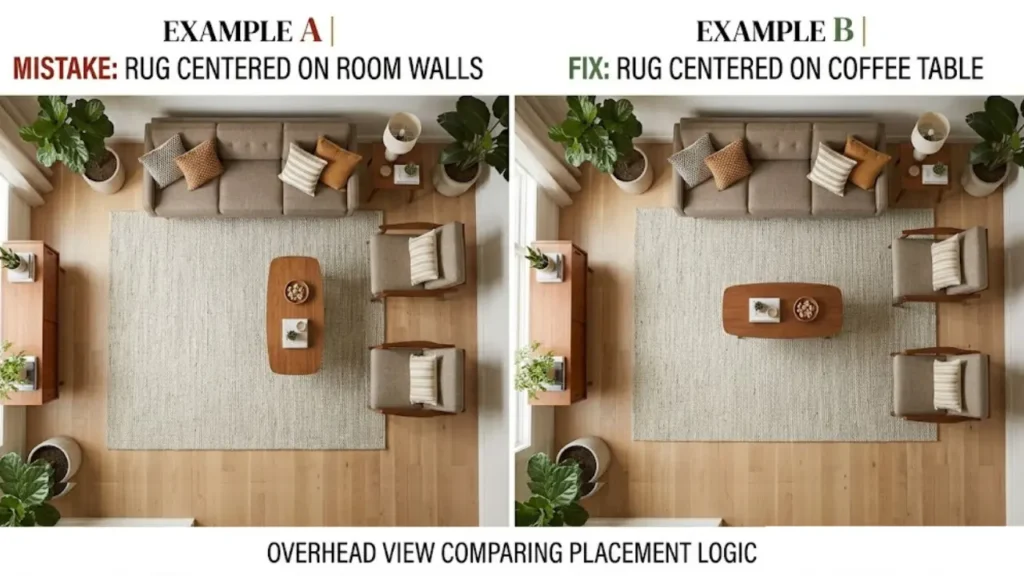
This is one of those mistakes that looks subtle in a photo but feels immediately wrong when you’re sitting in the room. The rug is fine, the size is fine, but it’s been centered on the room walls rather than on the furniture arrangement — and the two don’t always line up.
This happens especially often in L-shaped rooms, open floor plans, or any space where the furniture arrangement is offset from the geometric center of the room. When you center the rug on the walls, part of the seating arrangement falls off the rug while the other part has too much rug coverage. The whole thing looks lopsided.
The Fix
Center the rug on your coffee table, not on the room. The coffee table sits at the heart of the seating arrangement — whatever it’s centered on will read as the visual anchor. Pull the rug so its center point aligns with the center of the coffee table, and then check that the front legs of the surrounding furniture are making contact with the rug edges.
In most cases, this shift is small — just a few inches in one direction — but the visual difference is significant. The seating arrangement suddenly looks like it belongs together.
Mistake 6: Too Much Exposed Floor Between the Rug and the Walls
This is the flip side of using a rug that’s too big. When the rug is too small, it leaves a large strip of bare floor between its edges and the walls — and that exposed floor creates a visual gap that makes the room feel fragmented.
The ideal amount of exposed floor on the wall-facing sides of a rug is 12 to 18 inches in most rooms. This gives the floor space to breathe and frames the rug as an intentional centerpiece. Less than 10 inches of exposed floor and the rug starts competing with the walls. More than 24 inches and the rug starts looking small relative to the room.
In smaller living rooms, you can go slightly tighter — 8 to 12 inches is acceptable. In very large rooms or open floor plans, you might want to push toward 18 to 24 inches to keep the rug from feeling like it’s covering the entire floor.
The important thing is consistency. If you have 8 inches on one side and 30 inches on the other, the room looks off even if the rug size itself is technically fine. Even, balanced clearance on all sides makes the layout look considered.
Small living room layout decisions are deeply interconnected — rug placement, mirror placement, and furniture arrangement all talk to each other. If you’re working on a small living room overall, the piece on how to make a small living room look bigger with mirrors is a natural companion read, because mirrors and rugs do similar visual work in small spaces.
Mistake 7: Ignoring Rug Texture in Favor of Just Pattern or Color
Most people shop for rugs by looking at color first, pattern second, and texture almost never. But texture has a significant impact on how a room feels — and choosing the wrong texture for your room’s existing materials can make the space feel either sterile or cluttered.
High Pile in High-Traffic Areas
Thick, high-pile rugs are luxurious underfoot, but they’re difficult to maintain in high-traffic living rooms and they can visually overwhelm smaller spaces. Furniture legs sink into high-pile rugs and can look unstable, and the rug itself holds onto pet hair, dust, and debris in ways that lower-pile rugs don’t.
For most living rooms — especially smaller ones — a low to medium pile rug is more practical and visually cleaner. It lies flat, doesn’t compete with furniture, and reads as a polished design choice rather than a comfort choice.
Natural Fiber Rugs (Jute, Sisal, Seagrass)
Natural fiber rugs are having a genuine moment, and for good reason. Jute and sisal rugs add incredible warmth and organic texture to a room, they photograph beautifully, and they work with almost every color palette. The caveat is that they’re not soft underfoot and they don’t handle moisture well — so in a living room where people are barefoot or where spills are likely, they need a rug pad and some realistic expectations.
Used as a base layer in a layered rug situation — with a smaller, softer rug on top — natural fiber rugs are exceptional. They add the visual warmth without requiring you to commit to them as the sole texture.
Mistake 8: Skipping the Rug Pad
A rug without a pad slides. It bunches. It creates trip hazards. And on hard floors, it scratches the surface underneath over time. Skipping the rug pad is the kind of corner-cutting that creates ongoing annoyance — and it’s especially frustrating because rug pads are inexpensive relative to the rug itself.
Beyond safety, a rug pad makes the rug feel better underfoot by adding a small amount of cushioning. It also keeps the rug lying flat, which matters for how the room looks. A rug that’s bunched or curled at the edges looks unkempt even if it’s a beautiful rug.
The pad should be cut to about one inch smaller than the rug on all sides — you don’t want the pad visible from any angle. For hard floors, a felt-and-rubber combination pad works best. For carpet, a thinner rubber pad prevents slipping without adding too much bulk.
According to the National Floor Covering Alliance, rug pads also extend the life of area rugs significantly by reducing the friction and stress that occurs when rugs shift against hard flooring. It’s one of those small investments that quietly pays for itself.
Mistake 9: Buying a Rug That Fights the Room Instead of Completing It
A rug that’s technically the right size and placed correctly can still feel wrong if it’s working against the room’s existing palette or furniture. This usually shows up in one of two ways: the rug is so bold that it overpowers everything else, or it’s so similar to everything else that it disappears entirely.
When the Rug Overpowers
A rug with a very bold pattern or a very saturated color in a room that’s otherwise neutral and calm will dominate the space. Every time you walk into the room, the rug demands attention first. That can be a deliberate, beautiful design choice — but it needs to be intentional. If you want the rug to be the focal point, everything else in the room needs to be dialed back to let it breathe.
When the Rug Disappears
The opposite problem — a rug so similar in tone and texture to the floor that it provides no visual contrast — is more common than people realize. A cream rug on light hardwood in a room with light walls and a light sofa can effectively vanish. The layering that rugs are supposed to provide just doesn’t happen.
The fix is to ensure the rug has enough contrast with the floor to be legible as a separate design element. It doesn’t need to be dramatic — even a warm cream rug on a cooler gray floor reads as intentional contrast.
If your living room has a brown sofa, the color relationships shift again. Brown furniture has warm undertones that need a rug to either complement or counterbalance. The article on decorating a living room with a brown sofa covers these color dynamics in a way that connects directly to rug selection.
Mistake 10: Treating the Rug as an Afterthought
This is the meta-mistake that underlies most of the others. The rug gets chosen last — after the sofa, after the curtains, after the paint color — and by that point, the options are constrained and the budget has been spent elsewhere. The rug ends up being whatever works given what’s already in the room.
The problem is that rugs do foundational work in a living room. They define zones, anchor furniture, add warmth, absorb sound, and often set the color temperature for the whole space. When the rug is chosen last, it’s trying to do all of that work while also conforming to decisions that were made without it in mind.
A Better Approach
Experienced interior designers often recommend choosing the rug before or simultaneously with the sofa — not after. Start with the rug, pull colors from it for the rest of the room, and let the rug set the tone. This is a more confident approach to designing a room, and it tends to produce more cohesive results.
If the room is already furnished and you’re working backward, the key is to identify the dominant colors in your existing furniture and find a rug that either picks up one of those tones as a ground color or provides a neutral base that doesn’t compete. What you want to avoid is a rug that introduces an entirely new color family into a room that has no other place for that color to land.
For rental spaces where wall colors are fixed and furniture choices may be limited, this rug-first mindset is especially useful. If you’re working within those constraints, how to make a rental apartment feel like home covers how to use rugs and other flexible elements to make a rented space feel genuinely personal.
A Quick-Reference Fix List
If you’ve read through all of these and you’re trying to figure out which mistakes apply to your room, here’s a fast checklist:
Rug too small? Check: are any furniture legs touching the rug? If no legs are on it, the rug is almost certainly too small or misplaced.
Floating rug? Check: slide the rug forward until at least the front legs of your sofa are on it. See if the room immediately reads differently.
Dark rug in a small room? Check: does the room have abundant natural light and light-colored walls? If not, a lighter rug will almost always serve the space better.
Wrong shape? Check: does the rug shape match the furniture arrangement geometry? If you have a rectangular sofa arrangement and a round rug, try a rectangle.
Off-center? Check: is the center of your rug aligned with the center of your coffee table, not the center of the room walls?
Too much floor exposure? Check: measure the gap between the rug edge and the nearest wall. More than 24 inches on any side means the rug might be too small for the room.
Common Questions: Living Room Rug Mistakes
What is the most common living room rug mistake?
Buying a rug that’s too small is the most common mistake by far. A rug that doesn’t reach the front legs of the sofa and chairs leaves all the furniture looking like it’s floating — and makes both the furniture and the room feel heavier and smaller. For most standard living rooms, an 8×10 rug is the minimum size that works, with front legs of all seating touching the rug.
Should furniture legs be on or off the area rug?
At minimum, the front two legs of every piece of seating should sit on the rug. This is called front-legs-on placement and it’s the most common approach in standard living rooms. All legs on the rug is also correct — it creates a more formal, defined look — but it requires a larger rug. What doesn’t work is having all legs off the rug entirely, which leaves it floating.
What does a “floating rug” mean in interior design?
A floating rug is a rug that has been placed in front of the furniture with no legs touching it. The rug sits in the middle of the floor with the sofa and chairs sitting behind it, which creates a disconnected, unresolved look. The fix is to slide the rug forward so the front legs of the seating arrangement make contact with it.
How much floor should show around a living room rug?
Ideally, 12 to 18 inches of bare floor should be visible between the rug’s edges and the walls. This frames the rug as an intentional design element and gives the room visual breathing room. Less than 10 inches and the rug starts to feel like it’s covering the whole floor. More than 24 inches and the rug starts looking too small for the room.
Final Thoughts: Living Room Rug Mistakes
Rugs are one of the most powerful tools in a living room, and they’re also one of the easiest to get wrong. The mistakes in this article are all fixable — most of them don’t require buying a new rug, just repositioning the one you have or making a different choice next time.
The biggest shift is moving from thinking about rugs as decoration to thinking about them as structure. A well-placed, correctly sized rug with the right amount of contrast and the right texture doesn’t just look good — it makes the furniture around it look better, the room feel larger, and the whole space feel like it was designed rather than assembled.
If you’re starting fresh and want to build a living room that feels genuinely put together, getting the rug right is one of the highest-return decisions you can make.