

Introduction: How to Place a Rug in a Living Room
There’s a rug sitting in the middle of your living room. It looks… off. You’re not sure why. The couch is fine. The coffee table is fine. But something about the whole picture feels unfinished — like the room forgot to make a decision.
Nine times out of ten, it’s the rug placement.
I’ve rearranged rugs in more living rooms than I’d like to admit — my own included. And the thing I’ve learned is that most people don’t get it wrong because they have bad taste. They get it wrong because nobody actually taught them the rules. You pick a rug you love, you put it down somewhere that feels reasonable, and then you spend the next six months wondering why the room still feels awkward.
That ends today. In this guide, I’m going to walk you through the three main rug placement styles, the designer sizing rules that change everything, and the specific mistakes that make even beautiful rugs look wrong. Whether you’re working with a sectional, a small apartment living room, or a wide open floor plan, you’ll leave here knowing exactly how to place a rug — and why it works.
Let’s get into it.
Why Rug Placement Matters More Than the Rug Itself
Here’s something a lot of people don’t realize: an average rug placed correctly will look better than a stunning rug placed wrong. Placement is that powerful.
When a rug is positioned well, it does three things at once. It grounds the furniture, making everything feel intentional and pulled together. It defines the conversation zone, signaling to the brain that this area is a distinct space within the room. And it controls the visual scale of the room — a rug in the right position can make a small room look larger, or a too-large room feel warm and intimate.
When a rug is placed wrong, none of those things happen. Instead, you get the opposite: furniture that looks like it’s floating with no relationship to each other, a room that feels unfinished even when it’s fully decorated, and a space that never quite settles into itself.
This is especially true in living rooms, where the sofa is typically the largest piece and the rug has to work in relationship to it. The rug isn’t just a decorative object — it’s a spatial tool.
If you’ve been struggling to make your living room feel cohesive, I’d encourage you to check out some of the small apartment living room ideas I’ve covered before. You’ll notice that in every room that feels right, the rug is doing real work — not just sitting there looking pretty.
The Role of Proportion
Before we get into the placement styles, let’s talk about proportion, because it underpins all of them. Interior designers think about rugs the way architects think about negative space: what’s not covered matters as much as what is.
A general principle that holds across most living room layouts is this — you want 18 to 24 inches of bare floor visible between the edges of the rug and the walls of the room. This gives the room “breathing space.” Too little and the rug overwhelms. Too much and it floats like a postage stamp in the center of the room.
Keep that principle in mind as we get into the specific placement styles, because it’ll help you evaluate what’s working and what isn’t.
The 3 Main Rug Placement Styles (And When to Use Each)
There is no single correct way to place a rug in a living room. There are three legitimate approaches, each with a different visual effect. What matters is understanding what each one does — so you can choose the right one for your room instead of guessing.
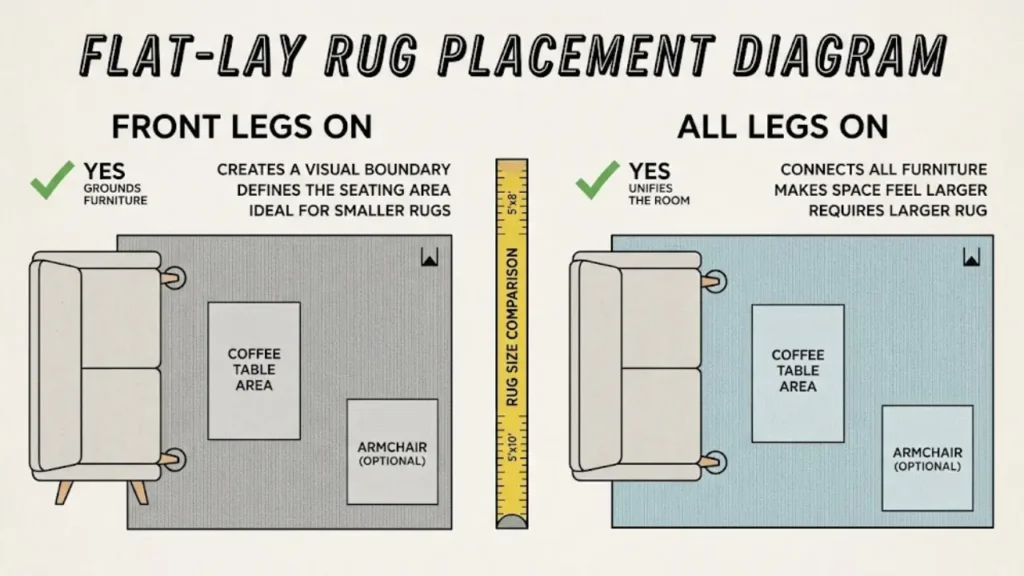
Style 1: Front Legs On the Rug
This is the most common placement style, and when done correctly, it’s also the most flexible. In this arrangement, only the front two legs of the sofa (and sometimes front legs of chairs and other seating) sit on the rug. The back legs stay on the bare floor.
What it does visually: it anchors the furniture to the rug just enough to create a connected, unified grouping — without requiring a rug large enough to fit underneath all four legs of a full-sized sofa. It’s a practical choice, which is probably why it’s so popular.
When it works best: standard rectangular living rooms, apartments where rug size is limited by budget or doorways, and rooms where you want a slightly airier, less “furnished” feel.
What to watch for: the rug still needs to be large enough that the front legs actually land on it with some breathing room. If the front legs are right on the edge of the rug, it looks accidental. You want at least 6 to 8 inches of rug visible in front of the sofa legs, so the furniture appears to be choosing to be on the rug — not barely making it.
In my experience, this style is the best starting point for most people working with a limited budget or a room where they’re still figuring out the layout. It’s forgiving without looking lazy — as long as the rug is the right size.
Style 2: All Legs On the Rug
This is the more formal, “pulled-together” look that you see in professionally styled rooms and design magazines. Every piece of furniture in the conversation area — sofa, chairs, coffee table — sits entirely on the rug. All four legs, fully on.
What it does visually: it makes the seating area feel like a distinct room within the room. This is especially powerful in open floor plans, where there are no walls to define the living space. The rug literally draws the boundary of the zone.
When it works best: larger living rooms, open-concept layouts, formal or high-end aesthetics, and spaces where you want maximum visual cohesion.
The trade-off: you need a much bigger rug. We’re typically talking 9×12 or larger for a standard sofa-plus-two-chairs arrangement. If the rug isn’t large enough to actually fit all four legs of every piece comfortably, this style backfires — it just looks like a rug that’s trying too hard and coming up short.
Budget note: large area rugs at this size get expensive quickly. This is often why the “front legs on” approach is more popular — it achieves a similar connected feel at a smaller rug size.
Style 3: The Floating Rug (And Why It Usually Fails)
This is the approach where the rug sits entirely in the center of the room with no furniture touching it at all. The sofa, chairs, and tables are arranged around it, but none of their legs sit on the rug.
I’ll be honest with you: this rarely works in living rooms. It can work in dining rooms, where the rug sits under the table and chair legs land on and off it as people pull chairs in and out. But in a living room seating area, a rug with no furniture touching it tends to look like it got left there by accident — or like it belongs in a different room entirely.
The fundamental problem is that it doesn’t serve the grounding function. It doesn’t tie the furniture together. It just sits there, and the furniture sits around it, and the two never have a real relationship.
The only scenario where floating can work is when the rug is extremely large — large enough that it covers the central zone while the furniture perimeter is around it, and the visual result looks intentional. But in most home setups, that either isn’t possible or requires a rug so big it’s cost-prohibitive.
My honest recommendation: unless you have a very specific reason, skip the floating rug in living rooms. Start with front legs on, assess how it feels, and size up if you want the all-legs look.
The Designer Rule That Changes Everything: Rug Extension Beyond the Sofa
Here’s the thing most guides don’t tell you, and it’s probably the single most useful rule I know: your rug should extend 6 to 12 inches beyond the sides of your sofa.
According to interior design guidelines from sources like Architectural Digest or HGTV, a rug should extend…
Not the legs. The sides. The full width of the sofa.
This rule exists because of how we perceive visual balance. When a rug stops at the exact edge of the sofa — or worse, when the sofa is wider than the rug — it creates an awkward, cramped feeling. The rug looks like it got squeezed under the furniture rather than chosen to complement it. It undermines the whole purpose of having a defined seating zone.
When the rug extends 6 to 12 inches beyond each side of the sofa, something clicks. The sofa looks like it belongs on the rug. The extra border of rug on each side creates visual breathing room, making the room feel considered and spacious even if it isn’t large.
How to Apply This When Shopping
Before you buy a rug, measure your sofa’s full width. Then add 12 to 24 inches (6–12 inches per side). That’s your minimum rug width.
For example: if your sofa is 84 inches wide, your rug should be at least 96 to 108 inches wide — meaning an 8×10 or 9×12 depending on your specific layout.
Most people are shocked when they do this math and realize the rug they were considering is actually too small. This is also why the number one rug mistake is buying a rug that’s too small — which we’ll get to later.
Rug Placement Rules for Small Living Rooms
If you’re working in a smaller space, rug placement becomes even more important — because the wrong choice doesn’t just look bad, it actively makes the room feel smaller.
Never Size Down to Avoid the Rug Looking Big
This is counterintuitive, but a bigger rug in a small room almost always looks better than a smaller rug. A small rug in a small room makes the room feel scattered and busy. A larger rug that takes up most of the floor area makes it feel curated and intentional.
The rule of thumb for small living rooms: your rug should cover at least two-thirds of the visual floor area in the seating zone. If that feels like a lot, it’s probably exactly right.
Use Placement to Trick the Eye
In a small room, rug placement can actively create the illusion of more space. A few things that help:
Place the rug to extend toward doorways. This draws the eye outward and suggests the room continues beyond its actual walls.
Choose a rug that runs parallel to your longest wall. This reinforces the room’s longest dimension, making it feel more elongated and spacious.
Use light colors or low-contrast patterns. Heavy, dark rugs in small rooms shrink the space visually. A light neutral — ivory, warm beige, soft grey — will make the floor feel like it extends.
I’ve written about using mirrors in the same way — the idea is always to redirect the eye rather than letting it stop at the nearest wall. If you haven’t read through how to use mirrors to make a small living room look bigger, it pairs really well with what we’re covering here.
The One Rug Mistake That Kills Small Room Design
The thing I see more than anything else in small living rooms: the rug centered on the room rather than centered on the furniture. The rug is placed geometrically in the middle of the floor, with furniture arranged around it — but nothing is actually touching the rug.
It’s the floating rug problem I described earlier, but in a small room it’s even more pronounced. The result is a room that looks like a hotel hallway. Don’t do it. Center the rug on the furniture grouping, not on the room itself.
Rug Placement with a Sectional Sofa
Sectionals add a wrinkle that standard straight sofas don’t have: they’re L-shaped, which changes the rug geometry completely.
The general rule for sectionals: your rug needs to be large enough that the front legs of both arms of the sectional sit on it. Since sectionals are wider and typically deeper than straight sofas, you almost always need a 9×12 or larger. In many cases, a 10×14 is the right call.
If the sectional has a chaise, the rug should extend at least to the front legs of the chaise end. If it doesn’t reach, the chaise looks disconnected from the rest of the sectional — which defeats the whole purpose of the L-shape as a unified piece.
The most common mistake with sectionals: using a rug that fits the “main” part of the sectional but ignores the return. The rug ends midway through the L, and the result looks like an unfinished thought.
For a deeper look at rug sizes specifically for sectionals — including how to calculate the right dimensions for your specific sectional measurements — I’ve put together a full guide on what size rug goes under a sectional sofa. It covers exact calculations that go beyond what I can cover here.
Shape Considerations for Sectionals
Most sectionals work best with a rectangular rug, since the L-shape of the sofa itself creates angular geometry and a rectangular rug echoes that. Round rugs can work under a sectional in specific layouts — usually when the sectional wraps around a central coffee table — but they require careful sizing and tend to look unintentional if too small.
What Color Rug Works Best in a Living Room?
I’d be leaving something important out if I only talked about placement without touching on color — because even perfectly placed, the wrong color rug can undermine a room.
The principle: your rug should relate to the room without matching it. A rug that perfectly matches your sofa tends to look flat and boring. A rug that clashes with everything creates visual chaos. You want a relationship — shared undertones, complementary colors, or a pattern that picks up two or three colors already in the room.
If your sofa is grey, for example, you have a lot of flexibility. Warm rugs (terracotta, rust, mustard) will add life and contrast. Cool rugs (navy, slate, sage) will maintain a calm, monochromatic feel. I’ve covered the grey sofa situation in detail over in what color rug goes with a grey couch — it’s one of the most common questions I get, and there are more good options than most people think.
Pro Designer Tips Most Guides Won’t Tell You
Let’s get into some of the less obvious advice — the kind that separates rooms that look professionally decorated from rooms that look like they were assembled by committee.
Layer Rugs for Texture and Depth
If you love a natural fiber rug (jute, sisal, seagrass) but find them too rough or plain, layer a smaller, softer rug on top. A jute base rug with a vintage Persian or wool accent rug layered in the center of the seating area is one of the most effortless ways to add warmth and texture. The layered look is particularly effective in boho and eclectic living rooms, but it works in transitional and even contemporary spaces when the colors are clean.
This also solves the budget problem. A large jute rug is significantly cheaper than a large high-quality patterned rug. You get the size coverage from the jute, and the style from the smaller (more affordable) accent piece on top.
Rotate Your Rug Seasonally
Rugs wear unevenly under furniture legs. Every six to twelve months, rotating the rug 180 degrees distributes that wear and extends the rug’s life significantly. It also gives you the opportunity to check what’s underneath — which is a good habit for flooring health in general.
Don’t Match the Rug to the Sofa — Match It to the Room
Here’s my honest take: when people buy a rug and sofa at the same time in matching colors, the result almost always looks sterile. The rug and sofa become one visual blob instead of two distinct, complementary elements.
A better approach: treat the rug as part of the room, not as a sofa accessory. Pull in a color from your window treatments, your throw pillows, or even your wall art. The rug should feel like it belongs to the whole room — not like it was ordered alongside the couch.
Common Rug Placement Mistakes to Avoid
Even with the best intentions, these are the errors I see most often — and they’re all fixable.
Mistake 1: Rug Too Small This is the most common mistake. People go smaller because small feels safe — a large rug seems like a big commitment. But a too-small rug creates exactly the awkwardness you’re trying to avoid. It makes the furniture look like it’s hovering above it rather than connected to it. When in doubt, size up.
Mistake 2: Centering the Rug on the Room Instead of the Furniture Your rug should be centered on the furniture grouping, not on the floor of the room. These are often two different things — especially in rooms with asymmetrical layouts or off-center focal points (like a fireplace that isn’t quite in the middle of the wall). The furniture is the anchor; the rug follows it.
Mistake 3: Wrong Rug Shape for the Layout Rectangular rooms generally call for rectangular rugs. But people sometimes choose round rugs in rectangular rooms because they look interesting — and then end up with a shape that fights the architecture. Round rugs work beautifully in certain spots (under a round dining table, in an entryway, in a reading nook), but in a standard living room with a rectangular sofa, rectangular is almost always the right call.
Mistake 4: Pushing the Sofa Against the Wall This isn’t strictly a rug mistake, but it changes rug placement significantly and it’s worth mentioning. When a sofa is pushed flat against the wall, the rug often ends up either too far from the sofa (with a big gap) or wedged underneath it awkwardly. Floating the sofa 6 to 12 inches from the wall opens up the room and gives the rug space to do its job properly. It also makes the room look larger, which I realize seems counterintuitive.
Mistake 5: Ignoring Rug Pad Thickness A rug pad is non-negotiable — it prevents slipping, protects the floor, and keeps the rug from bunching. But thick rug pads can raise the rug enough to catch chair and table legs awkwardly. Use a pad that’s 1/4 inch thick or less for most setups, and cut it slightly smaller than the rug (about an inch on all sides) so the edge of the pad isn’t visible.
FAQ: How to Place a Rug in a Living Room
Should all sofa legs be on the rug or just the front legs?
Both are correct approaches — it depends on the look you want and your rug size. Front legs on the rug is the more common and budget-friendly option; it anchors the furniture without requiring a very large rug. All legs on the rug creates a more formal, pulled-together look, but requires a significantly larger rug (typically 9×12 or larger for a standard sofa-plus-chairs setup). Neither approach is wrong — what matters is that the rug is large enough to make the placement look intentional, not accidental.
How far should a rug extend past the sofa?
A rug should extend 6 to 12 inches beyond the sides of your sofa. This creates visual breathing room and makes the sofa look like it belongs on the rug rather than fighting it for space. Measure your sofa’s full width, add 12 to 24 inches total (6–12 inches per side), and use that as your minimum rug width when shopping.
What size rug is best for a small living room?
In a small living room, a 5×8 is the typical minimum, but a 6×9 or even an 8×10 will almost always look better. A larger rug in a small room makes the space feel more intentional and can actually create the illusion of more floor space. The most common mistake in small living rooms is choosing a rug that’s too small — which makes the room feel scattered rather than put together.
Can a rug be too big for a living room?
Yes, but it’s much less common than a rug being too small. A rug is too big if it leaves less than 18 inches of bare floor visible between the rug edge and the room walls — this eliminates the “breathing space” that keeps the room from feeling claustrophobic. In practice, most people need to size up, not down. When in doubt about a rug being too big for your specific layout, the 18-inch bare floor rule is a reliable test.
The Final Verdict: How to Place a Rug in a Living Room?
Let me give you a direct answer by room type, because I know you want one.
Small apartments and compact living rooms: Go with front legs on the rug, and size the rug as large as your space allows. The goal is to make the seating area feel defined without overwhelming the room. A 5×8 is usually the minimum; a 6×9 or 8×10 will almost always look better.
Medium-sized living rooms (the most common scenario): Front legs on works beautifully here, but if your budget allows, the all-legs look elevates the room noticeably. Use the 6 to 12 inch extension rule to find your minimum rug width, and don’t be afraid to go bigger than feels comfortable at first.
Open floor plans: All legs on is the clear choice here. In an open plan, the rug has to define the living zone in the absence of walls. A rug that doesn’t quite contain the furniture grouping in an open plan just looks lost. Invest in the larger size — a 9×12 at minimum, a 10×14 if the space is generous.
Sectionals: Size up, always. Refer to the sectional rug size guide I mentioned earlier, measure both arms of the sectional, and make sure front legs of both sides land on the rug. Rectangular almost always beats round for L-shaped sectionals.
One last thing: whatever you choose, commit to it. Move the furniture so the placement is deliberate. Smooth the rug so there are no ripples. Add the rug pad. And then live with it for a few weeks before deciding it’s wrong — sometimes the “off” feeling at first is just newness, and the room needs a moment to settle into itself.
You’ve got this.
This post contains affiliate links. If you make a purchase through one of my links, I may earn a small commission at no extra cost to you. I only recommend products I genuinely believe in.

Pingback: Living Room Rug Mistakes That Make Rooms Look Small
Pingback: How to Choose a Rug for a Small Living Room
Pingback: How to Make a Small Apartment Feel Bigger: 18 Proven Ways
Pingback: How to Layer Rugs in a Living Room: 10 Tips That Work