
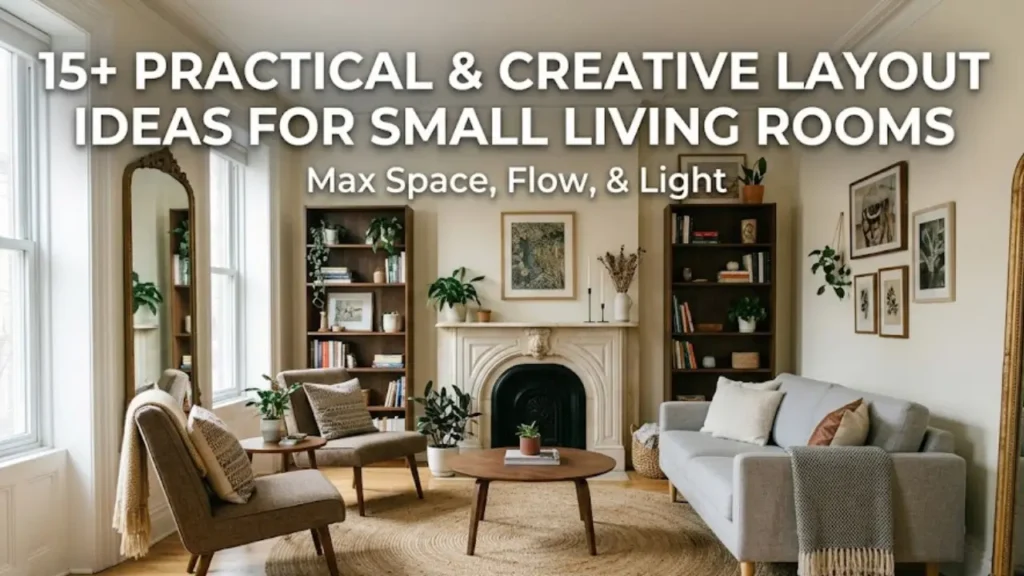

Introduction: Small Living Room Layout Ideas
A lot of small living room advice sounds great on paper and falls apart in reality. You read about “floating furniture” and “creating zones” but nobody tells you what to do when your room is 10 feet wide, your sofa is inherited, and one wall is eaten up by a doorway that opens the wrong way.
I’ve been there. And the more I’ve experimented with tight spaces, the more I’ve realized that small room layouts aren’t about following one golden rule. They’re about knowing which ideas apply to which situation, and why.
These 15 layout ideas come from real experience with small apartments and compact living rooms. Some of them will immediately fit your space. Others will make you rethink an arrangement you’ve lived with for years without questioning. All of them are practical, specific, and honest about when they work best.
Let’s start from the ground up.
Why Layout Matters More Than Decor in a Small Living Room
Before getting into the ideas, it’s worth saying this plainly: in a small living room, a good layout beats good decor every single time. You can have beautiful throw pillows, a great rug, and stylish furniture, but if the traffic flow is blocked or the seating is awkwardly proportioned, the room will feel uncomfortable no matter how nice everything looks.
Layout is also the thing people change least often because it involves heavy lifting (literally). So most people arrange their furniture once when they move in, feel vaguely dissatisfied, and live with it for years. These ideas are worth the effort of rearranging, because getting the layout right creates an immediate, dramatic shift in how the space feels to live in.
The other reason layout matters: it affects natural light. A sofa or bookshelf placed in front of a window doesn’t just block the view, it cuts off natural light to the rest of the room. In a small space, that single mistake can make a room feel two sizes smaller than it actually is. Understanding how furniture placement affects light is just as important as understanding how it affects traffic flow.
One foundational thing to know before you start rearranging: your primary walkways (the routes people take through the room every day) need at least 36 inches of clear space. Secondary pathways need 24 inches. These numbers aren’t flexible. If any of the layout ideas below would compromise those clearances in your specific room, modify or skip them. For a deeper breakdown of traffic flow and clearance rules, the guide on how to arrange furniture in a small living room covers this in detail.
1. Float Your Sofa Away From the Wall
This is the layout idea that surprises people the most, because it feels counterintuitive. If the room is small, why would you pull the sofa away from the wall instead of pushing it against it?
Here’s the logic. When every piece of furniture is pressed against a wall, the center of the room becomes a large, awkward empty zone. The seating feels disconnected. The room reads like a waiting room. Pulling the sofa even 6 to 8 inches away from the wall adds depth behind it and makes the seating arrangement feel purposeful rather than just stored.
In rooms that are genuinely tiny, even 4 inches of breathing space behind the sofa makes a visual difference. The sofa looks placed rather than jammed. If you want to use the narrow gap behind the sofa, a slim console table works perfectly there as a display surface or a landing zone for keys and bags.
This idea works best in rooms that are at least 11 to 12 feet deep, so there’s still a usable walkway in front of the sofa after you float it. In a 9-foot room, floating may not be possible, and that’s okay.
2. Face the Seating Toward a Focal Point (Not Toward Each Other)
Every living room layout needs an anchor, something that all the seating naturally faces. In most rooms, that’s a TV, a fireplace, or a large window. In rooms without an obvious focal point, you can create one with a gallery wall, a large mirror, or a well-styled console.
The mistake people make in small rooms is arranging chairs to face each other directly, as if the room is a conference room. This works in large spaces where the chairs are far enough apart to feel cozy. In a small room, two chairs facing each other across a 6-foot gap feel interrogative, not intimate.
Instead, orient all seating toward the focal point and angle chairs slightly inward at the edges. This creates the sense of a gathered, cohesive space without the stiffness of a face-off arrangement.
If your room’s focal point is unclear or awkward (a TV on a side wall, for example), consider whether repositioning it is possible before reorganizing your furniture around a location that doesn’t serve the room well.
3. Try an L-Shape Layout for Better Traffic Flow
The L-shape layout is probably the most traffic-friendly option for a small living room. A sofa on one wall and a chair or loveseat on the adjacent wall creates an L configuration that leaves two sides of the seating area completely open for movement.
This layout works especially well in rooms with multiple doorways or pass-through spaces, because the open ends of the L don’t interrupt any natural walkway. People can move through the room without cutting across the seating area.
The key to making an L-shape feel intentional rather than accidental is the coffee table placement. A round or square coffee table centered in the crook of the L ties the two sides of seating together visually. Without that center piece, the L can read as two separate furniture groupings that happen to share a corner.
For more on how specific layout configurations like L-shapes, U-shapes, and parallel arrangements work in different room sizes, the article on small living room layout mistakes walks through the most common errors people make with each one.
4. Use a Loveseat Instead of a Full Sofa
This one sounds obvious, but it’s surprising how many people in small rooms are working with a sofa that’s simply too big for the space, because they bought it for a larger apartment and never questioned whether it still made sense.
A standard sofa runs 84 to 96 inches wide. A loveseat is typically 52 to 64 inches. That’s a difference of 2 to 3 feet, which in a small room is enormous. Swapping to a loveseat (or a smaller sofa in the 72-inch range) can free up enough space on either side for a side table, a floor lamp, and actual breathing room along the wall.
The trade-off is seating capacity, which matters if you regularly have three or four people over. A good workaround: pair a loveseat with one or two accent chairs rather than going for a full sofa plus chairs. The total seating capacity is similar, but the floor footprint is distributed more evenly and the room feels less dominated by a single large piece.
5. Place Your Rug Correctly to Define the Zone
A rug doesn’t just add softness and color. In a small living room, it actively defines where the seating zone begins and ends. When all the front legs of your seating pieces rest on the rug, the grouping reads as one cohesive area rather than individual pieces scattered across the floor.
The most common rug mistake in small rooms is going too small. A rug that only fits under the coffee table looks like a place mat. It disconnects the furniture rather than tying it together, and it can actually make the room feel smaller because it creates a fragmented visual.
The right size for most small living rooms is a 5×8 or 6×9 rug. The front legs of the sofa and chairs should sit on it, with the rug extending past the sides of the seating group by a few inches. This creates a contained, intentional zone that reads as “living area” even when the rest of the floor is open.
If you’re unsure which rug size works for your specific room shape and furniture arrangement, the guide on how to choose a rug for a small living room breaks it down by configuration.
6. Go Vertical With Storage and Shelving
In a small living room, the floor is your most precious resource. Every piece of furniture that sits on the floor is competing with everything else for limited square footage. The solution is to move storage upward.
Tall bookshelves (72 inches and above) use vertical space that would otherwise go completely unused. A 6-foot bookshelf with a 12-inch depth holds a significant amount of books, decor, and storage bins while taking up less than 2 square feet of floor space. The same storage in a low credenza would take up three or four times that footprint.
There’s a secondary benefit too. Tall shelves draw the eye upward and create a sense of ceiling height. In rooms with standard 8-foot ceilings, a bookshelf that reaches close to the ceiling makes the room feel taller than it is, which directly affects how spacious the space feels overall.
Float shelves on empty wall sections above furniture (above the sofa or beside the TV console) for additional storage and display without adding any floor furniture at all.
7. Choose a Round or Oval Coffee Table
Sharp corners are the enemy of small living rooms. When you’re navigating around a rectangular coffee table in a tight space, you’re constantly aware of every corner, physically and visually.
A round or oval coffee table eliminates that problem. It softens the room visually, it’s physically safer to move around, and it actually improves traffic flow because there’s no corner to avoid or catch on. In a conversation area, a round table also equalizes access, since every seat is roughly the same distance from the center.
Size-wise, the coffee table should be about two-thirds the length of the sofa and positioned 14 to 18 inches from the front edge of the cushions. A round table with a diameter of 30 to 36 inches works for most small living rooms paired with a sofa in the 72 to 84-inch range.
If floor space is extremely tight, consider nesting tables or a small C-shaped side table that slides under a sofa arm instead. These take up almost no floor space and can be pulled out when needed.
8. Create a Conversation Area That’s Separate From the TV
In many small living rooms, the TV dictates everything. The sofa faces it, the chairs angle toward it, and the whole room becomes a home theater setup whether you want it to or not.
This works fine if watching TV is the primary use of the room. But if you want the space to also function well for conversation, reading, or working from home occasionally, it’s worth designing the seating to do more than face a screen.
One approach: place the TV on a side wall or in a corner rather than centered on the main wall. This frees up the primary seating arrangement to face a different focal point. Chairs can swivel slightly toward the TV when needed without the whole layout being dictated by it.
Another option is a small secondary seating corner, a single chair with a floor lamp and a side table in a corner of the room. This creates a quiet reading or working spot without taking up much space, and it gives the room a sense of having multiple functional zones rather than being purely a TV room.
9. Use Mirrors to Expand the Layout Visually
A well-placed mirror is probably the most powerful visual tool in a small living room, because it literally doubles what you see. A large mirror on the wall opposite a window reflects natural light back into the room and makes the space look twice as wide.
For layout purposes, mirrors work best on walls that don’t have furniture pushed against them, where the reflection has something interesting to show (a window, a lamp, a styled corner) and where the size of the mirror is proportionate to the wall. A small mirror in a large wall frame reads as decoration; a large mirror that fills most of the wall reads as architecture.
The most effective placement for expanding a small living room visually is on the wall directly opposite natural light. This bounces daylight into the space and makes the room feel genuinely brighter and more open, not just bigger in a superficial way. For specific placement strategies and mirror sizes for different room types, the article on using mirrors to make a small living room look bigger goes into the details.
10. Keep One Wall Completely Clear
In a small room, visual rest is as important as functional space. When every wall has furniture against it, shelves on it, and decor covering it, the room feels relentlessly busy. Your eye never lands anywhere calm.
Leaving one wall completely clear (or nearly clear, with just one piece of simple art) gives the room breathing room. It sounds counterintuitive to “waste” a wall in a small space, but the visual payoff is significant. The clear wall acts as a visual pause, and that contrast makes the rest of the room feel more curated and less cluttered.
In practice, the best wall to leave clear is usually the one without the TV, fireplace, or main entry door. If that wall has a window, even better: windows plus clear wall space create the most open feeling in a small room.
11. Arrange Furniture Across the Width in Long Narrow Rooms
Long narrow living rooms have a specific layout problem: the instinct to run furniture along the length of the room creates a tunnel effect. You walk in and see a corridor with seats at the end. It feels cramped, and the traffic flow runs down the center in a straight line that emphasizes just how narrow the room is.
The fix is to arrange the seating across the width of the room instead of along its length. Place the sofa on one of the long walls (facing another long wall, perpendicular to how you might normally think about it) and create a conversation area that runs side to side rather than front to back. This breaks the tunnel and uses the width of the room to your advantage.
Pair this approach with a large mirror on one of the short walls and light, leggy furniture (pieces with visible legs) to keep the floor plane visible, which further reduces the narrow feel.
12. Use Accent Chairs Instead of a Second Sofa
The two-sofa living room is a classic setup in larger spaces. In a small room, it almost never works, because two sofas eat up too much floor footprint and leave almost no walkable space between them.
Two well-chosen accent chairs do the same seating job at roughly half the floor cost. A pair of chairs positioned to complete a conversation area gives you comfortable seating for four people, a sense of visual variety in the room, and significantly more open floor space than a sofa-plus-loveseat arrangement would.
For maximum space efficiency, choose accent chairs with slim arms, tapered legs, and a compact seat profile. An average accent chair is about 28 to 32 inches wide, compared to a loveseat at 52 to 64 inches. The width difference alone justifies the switch in a small room.
13. Use the Wall Behind the Sofa Purposefully
Most people leave the wall behind a sofa completely empty, which is a missed opportunity in a small room. That wall is doing nothing visually, and the space between the top of the sofa back and the ceiling is dead zone.
A gallery wall, a set of floating shelves, or a large piece of art centered above the sofa turns that blank wall into the room’s most visually interesting feature. It draws the eye upward, creates height, and anchors the sofa so the seating area feels like a proper zone rather than furniture that just happens to be near a wall.
If you’ve floated your sofa (idea 1 above), there’s also the option of a slim console table behind it. This gives you a surface for a lamp, plants, and small objects without adding any additional furniture footprint to the room’s floor area. The console sits in the gap between the sofa and the wall, essentially invisible from the front, but functional from the back.
14. Prioritize Furniture With Visible Legs
This idea sounds like a styling detail, but it has a real spatial effect. Furniture with visible legs (even just 4 to 6 inches of clearance above the floor) allows the eye to see the floor beneath it, which makes the floor plane read as larger and more continuous than it actually is.
Compare a sofa with a floor skirt (fabric that goes all the way to the floor) to a sofa on tapered wooden legs. The skirted sofa looks heavy and grounded. The legged sofa looks light and less space-consuming, even if the two pieces are identical in size. This effect compounds across multiple pieces: a sofa, two chairs, and a coffee table all with visible legs make a room feel noticeably more open than the same pieces with floor-level bases.
This principle also applies to storage pieces. An open-bottomed console or a TV stand on legs reads as lighter than a closed-bottom cabinet sitting flat on the floor.
This is something interior designers recommend for small spaces consistently, because the visual effect compounds across multiple pieces in the room.”
15. Design for How You Actually Use the Room
This last one isn’t a specific arrangement tip; it’s a principle that makes every other tip more useful. The best layout for your living room is the one that matches how you actually use the space, not the one that looks best in a photo or matches what you saw in a design blog.
If you watch TV every evening, the TV placement is the most important decision. If you work from home occasionally, a small desk setup in the corner earns its space. If you regularly have four people over, seating capacity matters more than open floor area. If it’s just you most of the time, optimizing for your own comfort makes more sense than designing for hypothetical guests.
I’ve seen small living rooms arranged beautifully in photos that were completely miserable to actually live in, because they prioritized visual symmetry over function. The goal is a room that works for your daily life. Start there, and the aesthetics will follow.
A good layout also works alongside your color choices. The wall color, sofa color, and rug can either reinforce or undermine how spacious a well-arranged room feels. If your layout is solid but the room still feels heavy, it might be worth looking at small living room color ideas or revisiting best wall colors for small living rooms to see whether a color adjustment could do what furniture rearrangement alone can’t.
Bringing It All Together: Small Living Room Layout Ideas
You don’t need to apply all 15 of these ideas at once. Most small living rooms respond dramatically to two or three well-chosen changes, and overdoing it can lead to a room that feels over-engineered rather than naturally comfortable.
A good starting point: float your sofa (idea 1), get the rug size right (idea 5), and switch to a round coffee table if you have a rectangular one (idea 7). Those three changes alone can transform how a small living room feels to sit in and move through, and none of them require buying anything new.
From there, look at your vertical space (idea 6) and whether your focal point is clear (idea 2). These tend to be the next biggest leverage points in most small rooms.
The common thread through all 15 ideas is intention. Small rooms don’t punish you for having furniture; they punish you for having furniture without a plan. Once you understand why each placement decision matters, you stop guessing and start making choices that actually stick.