
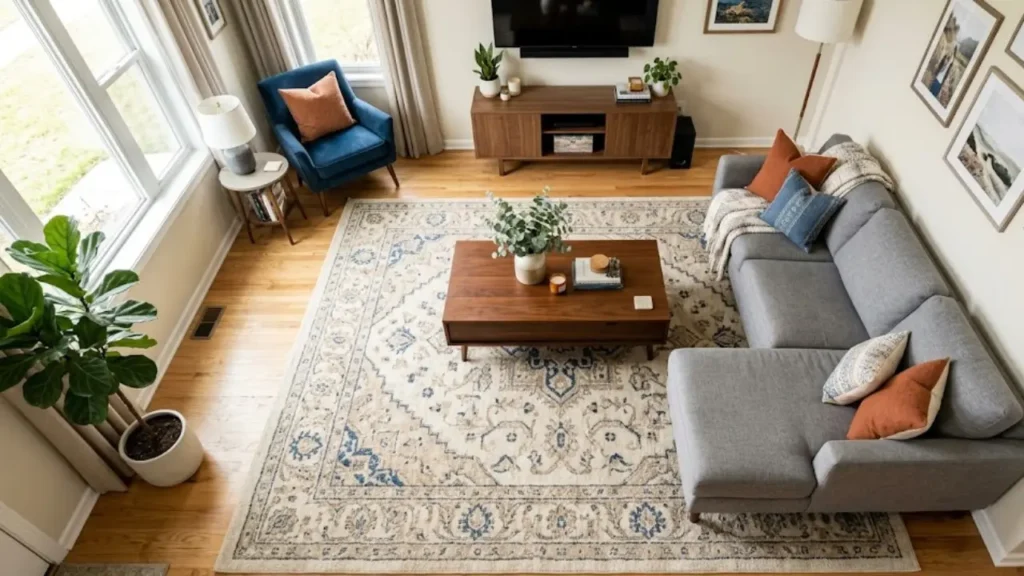

Introduction: What Size Rug Goes Under a Sectional Sofa
Getting a sectional sofa is exciting. It fills the room, anchors the seating, and finally gives everyone a place to stretch out. Then the rug question hits you — and suddenly a decision that should take ten minutes turns into three hours of second-guessing yourself on Google.
The problem isn’t that sectional rugs are complicated. The problem is that most of the advice out there treats all sectionals the same way, like a 95-inch L-shape in a small apartment needs the same rug as a 140-inch U-shape in an open floor plan. It doesn’t. Not even close.
I’ve helped a lot of people figure out their living room layouts, and the rug question under a sectional is probably the one that trips people up most consistently. So let’s go through this properly — room size, sectional shape, placement style, and the specific numbers that actually work.
By the end of this, you’ll know exactly what size to look for, what to avoid, and how to check if a rug will work in your space before you buy it.
Why Rug Size Matters More with a Sectional Than a Standard Sofa
With a regular sofa, you have one straight piece of furniture and a fairly predictable footprint. A sectional changes everything. The L-shape or U-shape creates two or three distinct “arms” of seating, which means your rug has to do more visual work. It has to pull the whole seating area together into one cohesive zone — or the room starts to feel like furniture just scattered around.
When a rug is too small under a sectional, the sectional looks like it’s floating. The chaise end especially tends to drift visually off the rug, which makes the whole arrangement feel unbalanced. You end up with this weird situation where part of your sofa is “anchored” and part of it isn’t, and the eye doesn’t know where to land.
Too big, and the rug starts competing with the room itself. In smaller living rooms especially, an oversized rug flattens the space and makes it feel like wall-to-wall carpet. That’s not the layered, intentional look anyone is going for.
The goal is to find a size that includes most of the sectional’s footprint while leaving enough exposed floor on the sides and the far walls to let the room breathe. Interior designers typically recommend leaving at least 12 to 18 inches of bare floor between the edge of your rug and the wall — sometimes more in larger rooms.
If you’re still figuring out the overall layout of your living room, it’s worth reading how to make a small living room look bigger with mirrors alongside this, because the two decisions — rug size and mirror placement — work together to shape how spacious or cramped a room feels.
The Actual Rug Sizes That Work for Most Sectionals
Standard area rugs come in set sizes, and that limits your options more than people realize. You can’t just pick any dimensions — you’re working with what’s available. Here’s how the common rug sizes line up with different sectional situations:
8×10: The Most Common Recommendation (and When It’s Not Enough)
An 8×10 rug is the most frequently suggested answer when people ask what size rug goes under a sectional sofa, and it works well for sectionals on the smaller end — typically anything under 100 inches on the long side. In a room that’s roughly 12×14 feet, an 8×10 often hits that sweet spot where the front legs of the sectional sit on the rug, the chaise is partially covered and you still have visible floor on the sides.
That said, I’d push back on defaulting to 8×10 without actually measuring. A lot of people buy it because it sounds right, bring it home, and find that it barely clears the front of the sectional. If your sofa’s chaise section is more than about 60 inches long on its own, an 8×10 will probably look too small underneath it.
9×12: The Sweet Spot for Most Mid-Size Sectionals
For sectionals in the 105 to 130 inch range — which covers a huge portion of what you’ll find in stores — a 9×12 rug is usually the right call. It gives you enough coverage to bring the full seating arrangement together, and it still works in rooms that aren’t enormous.
In my experience, the 9×12 is the size that most people should be considering but end up avoiding because it sounds big. It’s not too big for a standard living room. It just requires the room to be at least 13×15 feet for the floor clearance to look right. If you’re in that range, go with 9×12 and don’t look back.
10×14: For Large Sectionals and Open Floor Plans
A 10×14 is less common in stores but worth seeking out if you have a large U-shaped sectional or an open concept living area where the room is essentially bigger than a defined “living room.” This size works well when you want all the furniture legs on the rug — a placement style that creates a very defined, lounge-like feel.
If you’re working with an open layout where the living area flows into a dining or kitchen space, you can check out small apartment living room ideas for how other people have handled zoning an open floor plan with rugs and furniture placement.
Round Rugs Under Sectionals: Usually Not the Right Move
Round rugs tend to look awkward under L-shaped sectionals because the geometry fights itself. The sectional has hard corners and a very directional shape — a round rug underneath it creates a visual conflict that rarely resolves well. The exception is if you have a curved sectional, in which case a large round rug (8-foot diameter minimum) can be genuinely beautiful.
For most standard L-shaped sectionals, stick with rectangles.
How to Measure Your Sectional Before You Buy a Rug
This is the step most people skip, and it’s the reason so many rugs get returned. Measuring takes about five minutes and saves a lot of frustration.
Step 1: Map Out the Full Footprint
Stand back and look at your sectional from above — or at least imagine it from above. Measure the total width of the longest section (usually the sofa portion) and the total length of the chaise or shorter arm. Write both numbers down.
Step 2: Decide on Your Placement Style First
There are two main ways to position a rug under a sectional, and they require different rug sizes:
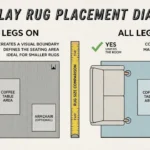
Front legs on the rug: The rug sits under the front two-thirds of the sectional, with only the back legs off the rug. This is the most common placement for L-shaped sectionals and is the easiest to pull off in medium-sized rooms. It requires a smaller rug than full coverage.
All legs on the rug: The entire sectional sits on top of the rug. This creates a more formal, defined look — like a room within a room. It works beautifully in larger spaces or open floor plans. It requires a bigger rug, usually at least 9×12, often 10×14.
Neither option is wrong. It depends on your room size, your style, and how much floor you want to show. I personally lean toward the front-legs-on style for most average living rooms because it gives you flexibility with smaller rug sizes and still looks very intentional.
Step 3: Add Your Buffer
Once you know your placement style, add the appropriate buffer. For front-legs-on placement, the rug should extend at least 6 to 8 inches beyond the front of the sectional and at least 12 inches beyond each open side. For all-legs-on placement, add 12 to 18 inches on all sides.
These numbers give you your minimum rug size. Round up to the nearest standard size — don’t round down.
Step 4: Check the Room Clearance
Subtract the rug size from your room dimensions and make sure you have at least 12 inches of exposed floor on each wall-facing side. If that check fails, either go down one rug size or reconsider your placement style.
This process sounds more involved than it is. Most people can work through it in under ten minutes and walk away with a specific size to shop for rather than a vague guess.
Rug Placement Rules for L-Shaped Sectionals Specifically
An L-shaped sectional has a unique challenge that straight sofas don’t: the inside corner. That inside corner is where the two sections of the sectional meet, and it’s where a lot of rug placements go wrong.
The most common mistake is centering the rug on the room rather than on the sectional. When you center it on the room, the rug often ends up shifted away from the inside corner of the L, which means one section of the sofa has its legs on the rug and the other section doesn’t. The whole thing looks misaligned.
Instead, center the rug on the seating arrangement itself. The middle of the rug should land roughly at the center of your coffee table — which, for an L-shaped sectional, is usually offset toward the inside corner. This small shift makes a significant visual difference.
For related guidance on how rugs interact with other furniture choices, the article on what color rug goes with a grey couch covers how rug color and positioning work together, especially in neutral-palette rooms where the rug is doing a lot of the visual work.
Room Size Guidelines: What Works Where
Here’s a practical breakdown by room size to make this more concrete:
Small Living Room (Under 12×14 feet)
A sectional in a small living room is already a bold choice. If you’re making it work, you probably have a smaller sectional — something in the 90 to 100 inch range. In this case, an 8×10 rug is your most realistic option. Position it with front legs on the rug and accept that the chaise will hang off the edge slightly. That’s okay. The room is small — the rug doesn’t need to cover everything.
What you want to avoid in a small room is a rug that’s so small it looks like an afterthought. A 5×7 or 6×9 under a sectional in any room looks wrong. If 8×10 feels tight, it’s still the better choice than going smaller.
Medium Living Room (12×15 to 14×18 feet)
This is where most people live. A 9×12 rug works very well here with front-legs-on placement, and you can often get away with all-legs-on if your sectional isn’t at the larger end of the range. The room has enough space to handle either approach.
Large Living Room or Open Floor Plan (15×20 feet and up)
In a larger space, a 9×12 can start to look small if your sectional is also large. A 10×14 is worth serious consideration. In open floor plans specifically, the rug is essentially defining where the living room ends — so it needs to be big enough to do that job. A rug that’s too small in an open plan just makes the furniture look like it’s camping in the middle of a large empty space.
If you’re dealing with an open plan where the living area flows into other zones, take a look at living room color ideas for rental apartments — it covers how to define separate visual zones in open layouts using color, furniture, and rugs together.
The Tape Test: Do This Before You Buy Anything
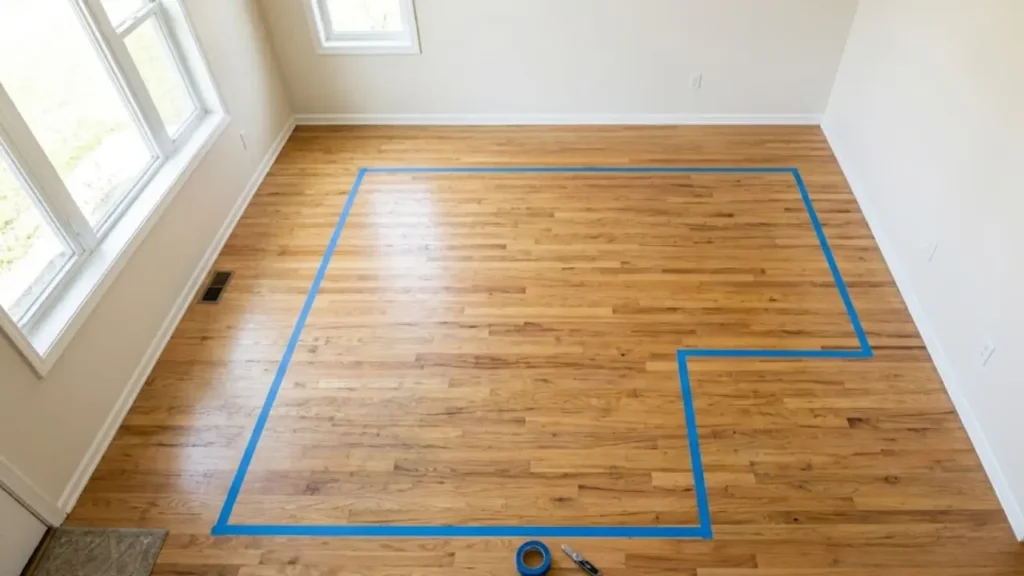
This is the single most useful thing you can do before purchasing a rug, and almost nobody does it. Get a roll of painter’s tape and mark out the exact rug dimensions on your floor. Leave it there for a day.
Walk around it. Sit on your sectional and look at it. Walk past it from the hallway. Sit at your coffee table. See how it feels in the morning light and the evening light.
This test has saved countless people from buying the wrong size — and from buying a rug that technically fits but doesn’t feel right in the space. Dimensions on paper never tell the full story. The tape test does.
The American Society of Interior Designers references this approach in their living room layout guidance as one of the most reliable low-cost methods for previewing furniture and rug arrangements before committing.
Common Mistakes People Make When Rugging a Sectional
Going Too Small Because It Seems “Safer”
This is the most common one. People assume smaller rugs are a safer bet because if they’re wrong, at least the rug wasn’t expensive. But a small rug under a large sectional doesn’t just look off — it actively makes the sectional look bigger and the room look smaller. The lack of grounding makes everything feel heavier.
If you’re genuinely uncertain between two sizes, go with the larger one.
Centering the Rug on the Room Instead of the Furniture
Covered this earlier, but it’s worth repeating. The rug should serve the seating arrangement, not the room geometry. Center it on your coffee table, not on the walls.
Ignoring the Chaise End
The chaise on an L-shaped sectional is where the rug tends to come up short — literally. When you’re measuring and planning, make sure the rug at least partially covers the front edge of the chaise. If the chaise is completely off the rug, the layout looks like two separate pieces of furniture rather than one cohesive arrangement.
Buying a Round Rug for an L-Shape
Already mentioned this, but it’s common enough to include here. Round rugs and L-shaped sectionals clash visually in most rooms. Save the round rug for a curved sectional or a smaller accent seating area.
Not Accounting for Traffic Paths
A rug that’s perfectly sized for the sectional can still be wrong if it blocks a natural walkway through the room. Always check that people can comfortably walk along the sides of the rug without stepping on it constantly or having to awkwardly avoid it.
What Interior Designers Actually Recommend
Most interior designers use a simple rule of thumb: the rug should be large enough that at minimum the front two legs of every seat in the arrangement touch it. For a sectional, that means the front legs of both the sofa section and the chaise section should make contact with the rug.
Beyond that minimum, the guidance shifts based on the room. In formal spaces or larger rooms, all legs on the rug creates a more finished look. In casual spaces or smaller rooms, front-legs-on is totally acceptable and actually preferred by many designers because it keeps the space from feeling over-furnished.
The other thing designers consistently push back against is matching rug size to sofa size instead of room size. The rug has to work with the whole room — floor clearance, furniture arrangement, traffic flow — not just with the dimensions of the sectional it’s sitting under. A 9×12 rug under a 95-inch sectional in a 12×14 room might be too big even though the proportions of sofa-to-rug look fine on paper.
For anyone rethinking the overall bedroom or living room arrangement — not just the rug — the piece on small bedroom storage ideas is a good companion read for how to think about furniture placement in rooms where space is genuinely limited.
A Quick Reference: What Size Rug Goes Under a Sectional Sofa
Here’s a straightforward guide you can use as a starting point:
Sectional under 95 inches (long side): Start with 8×10. Check room clearance.
Sectional 95 to 115 inches: 8×10 with front-legs-on placement, or 9×12 if the room allows.
Sectional 115 to 130 inches: 9×12 is the right call in most rooms.
Sectional over 130 inches (large L or U-shape): 9×12 minimum, 10×14 if the room is large enough.
Curved sectional: Large round rug, 8-foot diameter minimum.
These are starting points, not hard rules. The tape test is still the only way to know for sure what works in your actual space.
Layering a Second Rug Under a Sectional
Rug layering under a sectional is less common than layering in other parts of the room, but it can work well if you do it deliberately. The most effective approach is a large natural fiber rug — jute or sisal — as the base layer, with a smaller, softer rug layered on top in the center of the seating area.
This works best in rooms with a relaxed, collected aesthetic. The base layer should be bigger than you’d normally go — a 10×14 jute rug under a sectional with a 6×9 layered on top creates a really nice sense of depth without looking cluttered.
If you’re exploring the layered look more broadly, the texture and warmth it adds to a room is very much in the spirit of the cozy, collected interior style — the kind that makes a space feel genuinely lived-in rather than staged. This pairs naturally with the approaches covered in how to make a bedroom feel cozy.
So What Size Rug Goes Under a Sectional Sofa
The right rug size for your sectional sofa comes down to three things: your sectional’s actual footprint, your room’s actual dimensions, and your placement style. None of those can be guessed — they have to be measured.
For most people with a mid-size sectional in a standard living room, a 9×12 rug with front-legs-on placement is going to be the answer. But do the tape test first. Spend five minutes with painter’s tape on your floor before you spend money on a rug, and you’ll walk into that purchase with real confidence instead of crossed fingers.
Rugs are one of the highest-impact, most reversible decisions in a living room. Getting the size right means everything else in the space — the sectional, the coffee table, the lighting — finally has something to unify around.


Pingback: How to Place a Rug in a Living Room the Right Way
Pingback: Living Room Rug Mistakes That Make Rooms Look Small