
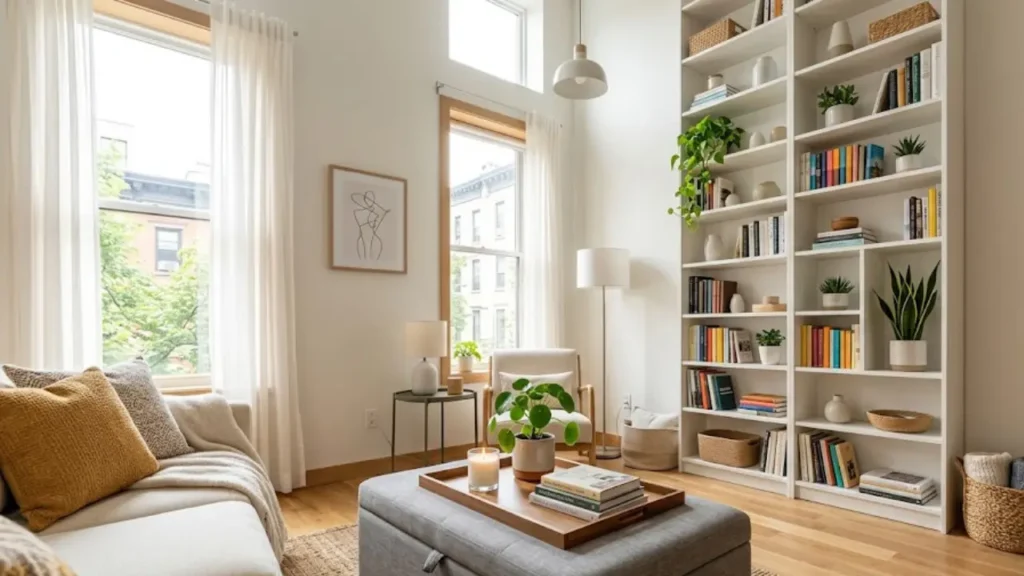

Most home organization advice assumes you have somewhere to put things. A mudroom for bags and shoes. A pantry for dry goods. A linen closet for towels and extra blankets. In a small apartment or compact home, you often have none of these, and the generic advice that fills most organization guides doesn’t acknowledge that.
What actually works in small spaces is different from what works in large ones, not because the underlying principles are different, but because the margin for error is so much smaller. In a large home, a disorganized drawer or a cluttered counter is one small mess among many spacious rooms. In a small apartment, that same drawer or counter is visible from three other areas of the home, and it affects how the entire space feels.
I’ve organized more small apartments than I care to count, including a studio where the kitchen, living room, and sleeping area all shared the same 400 square feet. What worked wasn’t buying more storage products. It was developing a system that made putting things away easier than leaving them out. These 15 ideas reflect what actually holds up over time, not just on the day you implement it.
The One Principle That Changes Everything
Before getting into specific ideas, there’s a foundational principle that underlies all of them: in a small space, organization works when putting something away takes less effort than leaving it out. The moment a system requires more steps than just setting something down on the nearest surface, the nearest surface wins, every time.
This sounds obvious, but it’s the reason most organization systems fail within a few weeks of being set up. The system was designed for how the space should ideally be used, not for how it’s actually used when you’re tired, distracted, or in a hurry. Every idea in this guide is filtered through that lens, because a system that works on the best day of the week but collapses on the worst one isn’t really a system.
Living Room Organization
1. Define Zones Before Buying Any Storage
The fastest way to make a small living room feel more organized isn’t buying more storage. It’s defining where different activities happen before deciding where things belong. A living room that functions as a TV area, a reading corner, and a remote work setup needs each of those activities to have a defined home, otherwise items from each activity bleed into the others and the room permanently feels unresolved.
Defining zones doesn’t require physical dividers or new furniture. It can be as simple as deciding that the left side of the sofa is the reading area (lamp, book, blanket within reach) and the right side is the TV-watching area (remote, charging cable, coaster). Once zones exist, the question of where something belongs has an obvious answer, which makes maintaining the organization easier day to day.
The layout itself plays into this too. A living room arranged without clear zones tends to accumulate clutter faster than one where the furniture placement already signals what happens where. The guide on how to arrange furniture in a small living room covers how furniture arrangement creates these functional zones naturally, which is worth understanding before deciding on any storage solutions.
2. Use a Storage Ottoman as Your Coffee Table
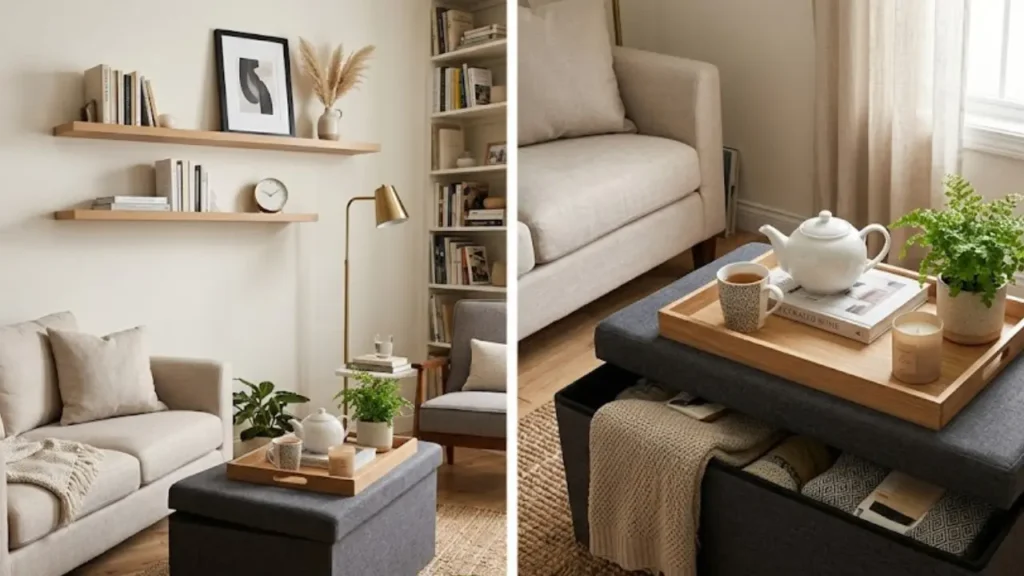
A storage ottoman that functions as a coffee table is one of the highest-return multipurpose furniture choices available in a small living room. It provides a surface (with a tray on top), comfortable seating for extra guests, and hidden storage for blankets, remotes, magazines, or anything else that tends to accumulate without a home.
The visual bonus is that an ottoman takes up the same floor space as a traditional coffee table while doing three jobs instead of one. In a small living room where every square foot needs to work hard, that kind of efficiency matters more than it would in a room with space to spare.
3. Keep Visible Surfaces Edited, Not Empty
This is a nuance that gets lost in a lot of minimalist organization advice. The goal in a small living room isn’t to have zero items on visible surfaces. It’s to have only intentional items on visible surfaces, things that are there because they serve a purpose or because they genuinely add something to the room visually.
A coffee table with a tray, a candle, and one small plant reads as styled. The same table with a remote, three chargers, a half-read magazine, two cups, and a tangled pair of headphones reads as chaotic, even though it has fewer “decorative” items than the styled version. The difference is intention, not quantity.
This same principle, applied to the living room’s tendency to accumulate clutter over time, is covered in more depth in how to decorate a small living room without clutter, which focuses specifically on the habits and small decisions that keep a small living room feeling edited rather than overwhelming.
4. Use Vertical Wall Space for Storage and Display
In a small living room where floor space is scarce, walls are underused storage. Floating shelves, a tall narrow bookshelf, or wall-mounted hooks near the entry point of the room all move storage off the floor and onto surfaces that would otherwise contribute nothing to the room’s function.
Tall bookshelves specifically draw the eye upward, which creates a sense of ceiling height that a small room benefits from. This is particularly useful in rooms with standard 8-foot ceilings that feel low and boxy. A bookshelf that reaches close to the ceiling makes the wall feel like an architectural feature rather than just background, while simultaneously holding a significant amount of items in a minimal floor footprint.
If your small living room also doubles as a rental space where permanent wall modifications aren’t possible, the ideas in decorating a rental apartment on a budget cover freestanding vertical storage options that achieve the same visual effect without drilling.
Kitchen Organization
5. Treat Counter Space as Premium Real Estate
In a small kitchen, counter space is the scarcest resource, and how it gets used determines how functional the kitchen feels to cook in every day. A counter covered in appliances, accumulated mail, and miscellaneous items is a counter that can’t actually be used for food preparation, which means cooking becomes more frustrating than it needs to be.
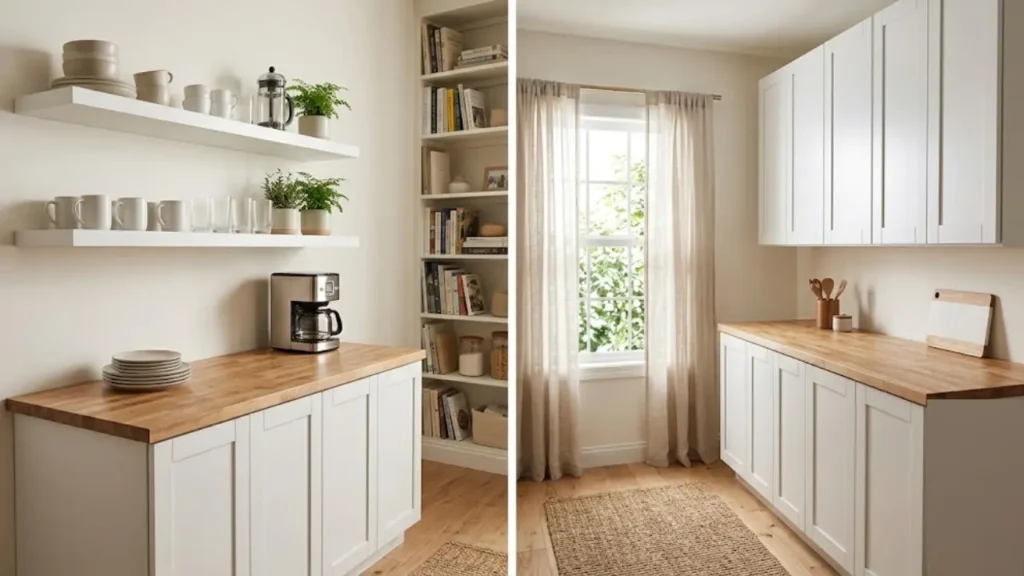
The rule that works in small kitchens: only items used daily earn counter space. A coffee maker used every morning stays out. A blender used twice a month goes into a cabinet. A toaster used on weekends can live in a lower cabinet and be pulled out rather than permanently occupying counter real estate.
Keeping counters clear of clutter while still making them visually interesting, rather than just empty and clinical, is the specific challenge covered in how to decorate kitchen counters without clutter, which gets into the exact balance between functional accessibility and visual calm.
6. Open Shelving for Everyday Items, Cabinets for Everything Else
Open shelving in a small kitchen works best as a strategy rather than a style. The items displayed on open shelves should be things you reach for daily, everyday dishes, a few frequently used glasses, cooking oils, and spices used in most meals. Everything else, the rarely used bakeware, the serving dishes for special occasions, the appliances used occasionally, belongs behind a cabinet door.
This approach keeps open shelves functional rather than decorative, which prevents them from becoming a clutter display. It also reduces the visual weight of a small kitchen, since closed cabinetry above eye level can feel oppressive in a tight space, while a mix of open and closed storage creates visual breathing room.
The specific ways open shelving can be used to organize and visually open up a small kitchen, including which items display well and which don’t, are covered in detail in kitchen open shelving ideas.
7. Organize Cabinets by Frequency, Not Just by Category
Cabinet organization in a small kitchen follows the same frequency-of-use logic that applies to bedroom closets. Items used daily go in the easiest-to-reach cabinet locations: the shelf at eye level, the drawer nearest the prep area, the cabinet directly above where you most often work. Items used less often move to higher shelves, lower cabinets, or the back of deeper drawers.
This seems straightforward but goes against how most people naturally organize, which tends to be by category (all baking items together, all canned goods together) regardless of how often any individual item is actually used. A small kitchen organized by frequency feels easier to use every day than one organized by category alone, because the things you reach for most are always within reach without reorganizing the cabinet to access them.
The specific techniques for making this work in cabinets with limited space and awkward configurations are covered in how to organize kitchen cabinets on a budget.
Bedroom Organization
8. Make Under-Bed Storage Intentional, Not a Last Resort
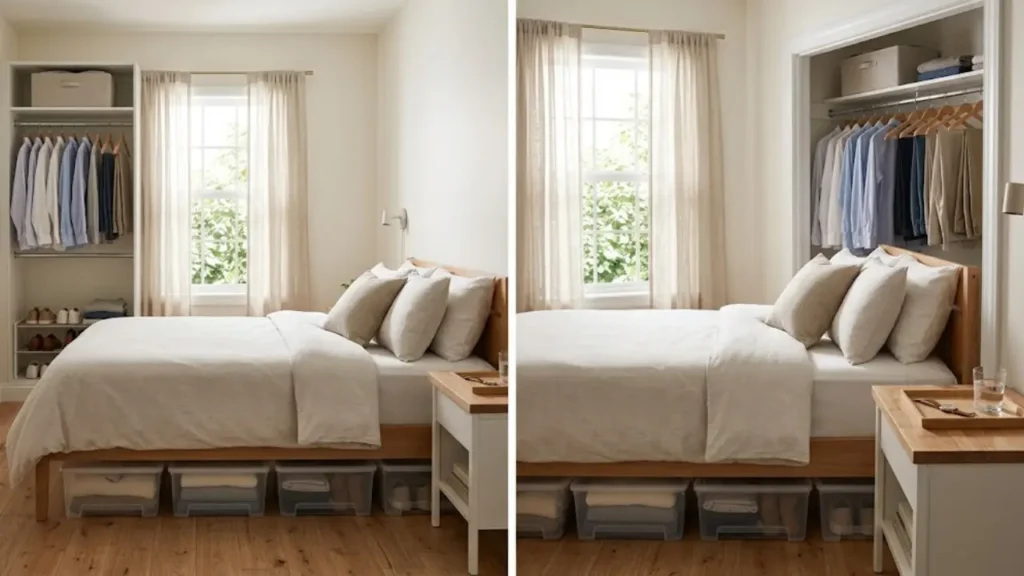
Under-bed storage is often treated as a dumping ground for things that don’t fit anywhere else, which defeats much of its organizational value. When under-bed storage is planned rather than reactive, specifically when it’s assigned to a clear category of items like seasonal clothing, extra bedding, or off-season shoes, it becomes one of the most efficient storage zones in a small bedroom.
The key is using proper storage containers with lids, rather than just sliding boxes and bags under the bed. Flat, lidded bins keep contents dust-free and stackable. Clear bins let you see contents without pulling them all out. Labeled opaque bins achieve the same result when clear bins aren’t available. This level of intentionality makes the difference between under-bed storage that stays organized and a space that gradually turns into a pile of miscellaneous items.
9. Double the Closet’s Capacity Before Adding Any New Furniture
One of the most common bedroom organization mistakes is buying additional dressers or storage units before maximizing the closet’s actual capacity. A standard reach-in closet with a single hanging rod and one shelf is often using less than half of its available vertical space.
Adding a second hanging rod below the existing one for shorter items like shirts and folded pants can roughly double hanging capacity without any new floor furniture. Shelf dividers prevent folded stacks from toppling, keeping that storage usable over time rather than clean only on the day it was organized. The full set of techniques for recovering unused closet space, including over-the-door storage and seasonal rotation, is covered in small bedroom closet organization ideas.
10. Give Every Surface One Job and Keep It to That
A nightstand that functions as a charging station, a reading surface, a water glass holder, a jewelry dish, and an overflow paperwork area is a nightstand that works against the room. Giving each surface in a bedroom one primary job and editing everything else off it keeps the room feeling calm rather than accumulated.
A nightstand does best with one lamp, one small tray for frequently needed items (phone, glasses, lip balm), and one book at most. A dresser top does best as a display surface with one mirror, a couple of considered objects, and nothing else. This level of editing is a habit more than a purchase, and it’s one of the more impactful small bedroom organization decisions precisely because of how much visual real estate bedroom surfaces occupy in a compact room.
11. Lay Out the Bedroom’s Furniture to Support, Not Fight, the Organization System
This is an often-missed connection between layout and organization: a bedroom arranged with furniture blocking the closet, or with no clear landing zone near the door for bags and shoes, will generate clutter in predictable locations regardless of how well the closet itself is organized. The layout creates the conditions for where things land.
A bag hook near the bedroom door, a small tray or catchall near the most-used entry point, and a clear path to the closet all reduce the daily friction that leads to items accumulating in the wrong spots. The connection between furniture placement and how a bedroom actually gets used every day is covered more fully in how to arrange furniture in a small bedroom, which approaches layout specifically through the lens of daily function rather than aesthetics alone.
Whole-Home Organization
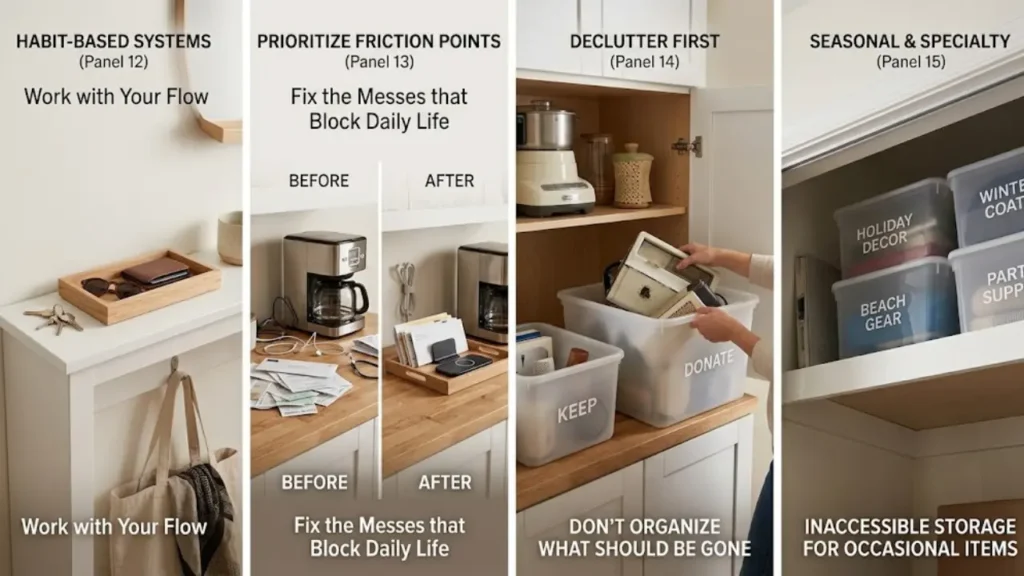
12. Build a System Around Your Actual Habits, Not Your Ideal Habits
This principle is broad but it’s the one that determines whether any specific organization system lasts past the first month. An organization system built around how you actually move through your home every day, where you actually set things down, which surfaces you actually pass most often, will outlast a more elaborate system built around how you wish you used the space.
If you always drop your keys on the kitchen counter when you come in, the solution isn’t to force yourself to use a hook by the front door. It’s to put a small tray on the kitchen counter where the keys already land, making that habit tidier without requiring it to change entirely. This kind of acceptance-plus-improvement approach is harder to photograph than a complete organizational overhaul, but it’s far more likely to still be working six months later.
13. Use Before-and-After Thinking to Prioritize What to Fix First
Not all small-space organization problems are equally disruptive. Some are daily friction (a cluttered counter you navigate around every morning) and some are occasional annoyances (a storage area that’s hard to access but used infrequently). Fixing daily friction first produces the most immediate improvement in how the home feels to live in.
A useful exercise: walk through your home on a typical morning, from waking up to leaving (or starting work), and note every moment where you have to work around something. Those friction points are the organization problems worth solving first, because eliminating them makes the daily experience of the home noticeably better in a way that organizing a rarely-used cabinet never will. The specific before-and-after impact of targeted small space changes, including how seemingly minor fixes compound in a compact home, is illustrated in before and after small space changes.
14. Don’t Organize What Should Be Donated or Discarded
This is the organization principle that saves the most time and money, and it’s the one most often skipped. Organizing items that don’t need to be kept at all is just moving clutter into better containers. It takes time, it costs money (storage products), and it creates a system that’s heavier and more complex than necessary.
Before investing in any new shelving, bins, or closet systems, it’s worth doing an honest pass through any space you’re planning to organize and removing anything that doesn’t actually belong there. Items that could be donated, items kept out of vague obligation rather than actual use, and duplicates of things that only need one version, are all organizational overhead that no storage product can fix.
15. Keep Seasonal and Occasion-Specific Items Completely Separate
Holiday decor, special occasion serveware, seasonal clothing, and gear for activities done only a few times a year all compete with everyday items for limited storage space in a small home. Keeping these categories physically separate from everyday storage, in labeled bins in a higher closet shelf, under the bed, or in less-accessible storage, prevents them from contaminating the organization of the spaces you use daily.
The seasonal clothing rotation specifically deserves its own system in a small bedroom: heavy winter clothing stored during summer, lightweight summer clothing stored during winter. This single habit frees up meaningful closet space during each season without requiring the closet to somehow hold everything year-round. For small apartments specifically where every inch of storage competes with living space, the broader approach to making a compact rental feel genuinely comfortable and organized is covered in how to make a rental apartment feel like home.
The Honest Truth About Home Organization Ideas for Small Spaces
Here’s something worth saying plainly before closing: no organization system, however well-designed, will make a small space feel large. What good organization actually does is remove the daily friction and visual noise that makes a small space feel smaller than it has to be.
A well-organized small apartment still feels small. But it feels calm, functional, and intentional in a way that a disorganized small apartment never does, regardless of how nicely it might be decorated. The square footage doesn’t change. The experience of living in it changes considerably.
The ideas in this guide work best when they’re implemented a few at a time, starting with whatever is generating the most daily friction, rather than all at once. A complete overnight overhaul is satisfying in the moment but hard to maintain, because it doesn’t give the new system time to prove itself against how you actually live. Small, deliberate improvements made in order of daily impact tend to stick in a way that wholesale reorganizations rarely do.
If you’re starting with the bedroom because that’s where the clutter problem feels most acute, a set of slim velvet hangers is one of the lowest-cost, highest-impact first steps available: switching an entire closet to matching slim hangers frees up meaningful rod space while making the closet look immediately more organized, before a single other system is in place.
FAQ: Home Organization Ideas for Small Spaces
What is the best way to organize a small home?
Build the system around how you actually live rather than how you’d ideally live. The most common reason small space organization fails is that the system requires more effort than just leaving things out. Start by identifying daily friction points, moments where you have to work around something during a typical day, and fix those first.
How do you maximize storage in a small apartment?
Focus on vertical space before adding new furniture. Tall bookshelves, floating wall shelves, over-the-door organizers, and a second hanging rod in the bedroom closet all add meaningful capacity without taking up any additional floor space. Under-bed storage, when used intentionally with labeled containers rather than as a catch-all, is one of the highest-capacity storage zones in a small bedroom.
How do you keep a small space from feeling cluttered?
Keep visible surfaces intentional rather than empty. The goal isn’t a showroom with nothing on any surface. It’s having only items on visible surfaces that are there because they serve a purpose or because they add something genuine to the space. A tray that contains the items that would otherwise spread loose across a coffee table or nightstand is often all the difference between a surface that reads as styled and one that reads as cluttered.
Should you use open or closed storage in a small home?
Both, in the right places. Open storage works best for items used daily, since visibility and accessibility matter more than concealment for frequently used things. Closed storage is better for items used occasionally, since hiding visual variety behind cabinet doors simplifies the room’s appearance. A small home that’s all open storage tends to look busy; one that’s all closed storage can feel cold and clinical.
What should you organize first in a small space?
Whatever is generating the most daily friction. Walk through the space on a typical day and note every moment where you’re working around something, navigating past a pile, hunting for an item, or avoiding a surface because it’s too cluttered. Those friction points are the organization problems that, when solved, make the biggest difference in how the home feels to live in every day.


Pingback: How to Make a Small Kitchen Look Bigger: 14 Real Tricks
Pingback: How to Style Bookshelves in a Living Room: 11 Real Tips