
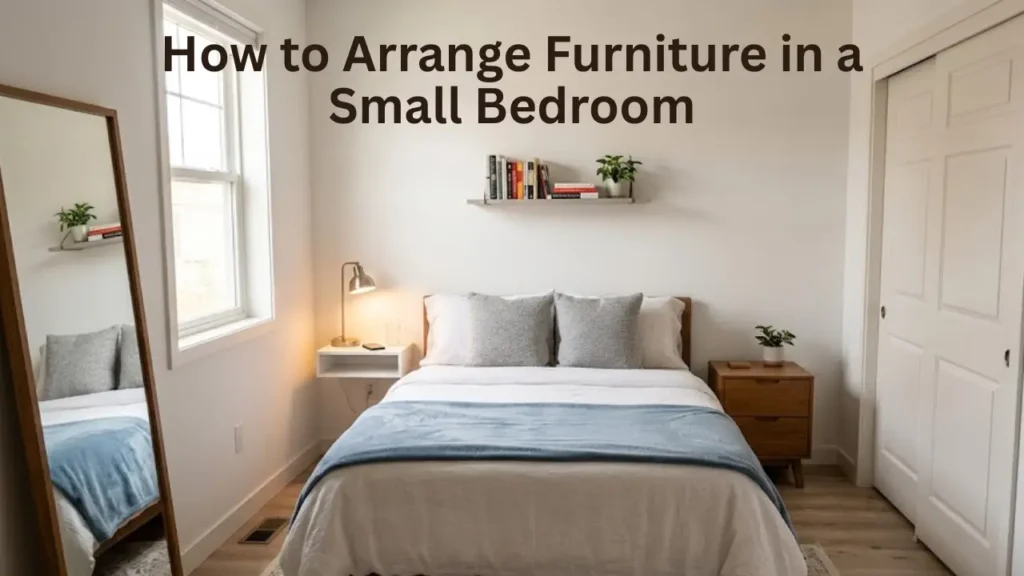

If you’ve ever stood in a doorway trying to figure out how to arrange furniture in a small bedroom without blocking the closet or squeezing past the bed every morning, you already know the problem isn’t decor. It’s geometry.
A small bedroom has one constraint a small living room doesn’t: the bed. It’s usually the biggest single piece of furniture in the entire home, and it has to go somewhere before anything else can be decided. That’s what makes small bedroom furniture arrangement feel so much more restrictive than other rooms. There’s less room to experiment once that one piece is placed.
I’ve lived in a few apartments where the bedroom barely fit a full-size bed and a single nightstand. What actually worked, after a lot of trial and error, was learning that bed placement decides everything else. Get that right, and the rest of the small bedroom furniture layout tends to follow naturally. Get it wrong, and you’re squeezing past a dresser for the next two years.
This guide walks through nine ways to arrange furniture in a small bedroom, starting with the decision that matters most and working through storage, walkways, and the small adjustments that make a tight room feel calm instead of cramped.
Why Bed Placement Comes Before Anything Else
Before getting into the specific ideas, it helps to understand why bed placement is the first decision in any small bedroom furniture arrangement, not an afterthought once the dresser and nightstands are settled.
A queen bed is roughly 60 inches wide and 80 inches long. A full is 54 inches wide. In a small bedroom, that single piece can occupy a third or more of the total floor area. Every other decision, where the dresser fits, whether there’s room for a chair, how wide the walkways end up being, depends on where the bed lands first.
This is different from a living room, where the furniture arrangement might start with a focal point like a TV or fireplace. In a bedroom, the bed is both the largest object in the room and its natural focal point, so locking in that placement before anything else just makes the rest of the process easier.
The Clearance Numbers Worth Knowing
A few measurements come up constantly when arranging furniture in a small bedroom:
- At least 24 inches of clearance on each side of the bed you walk around regularly. Less than this feels tight every single day.
- 30 to 36 inches at the foot of the bed if that area doubles as a walkway to a door or closet.
- 12 inches minimum between the bed and a dresser or wall, on a side that isn’t a walking path.
If a room genuinely can’t fit a queen bed with these clearances, that’s useful to know early. A full-size bed with real breathing room often feels better day to day than a queen squeezed in with only 14 inches on each side.
1. Keep the Bed Out of the Door’s Direct Sightline
This is one of the most overlooked parts of small bedroom furniture arrangement. When a bed sits directly in the sightline of the door, the room feels smaller the instant you walk in, because the bed becomes the first and most dominant thing your eye registers.
Where the layout allows it, position the bed so it isn’t the very first thing visible when the door opens, and so entering the room doesn’t mean immediately stepping around the foot of the bed. Often this means placing the bed against the wall furthest from the door, even if that isn’t the most obvious wall based on window placement.
In rooms where the door swings directly into a tight layout, this one adjustment can change how spacious the whole room feels, without altering a single inch of actual square footage.
2. Center the Bed on Its Wall Instead of Tucking It Into a Corner
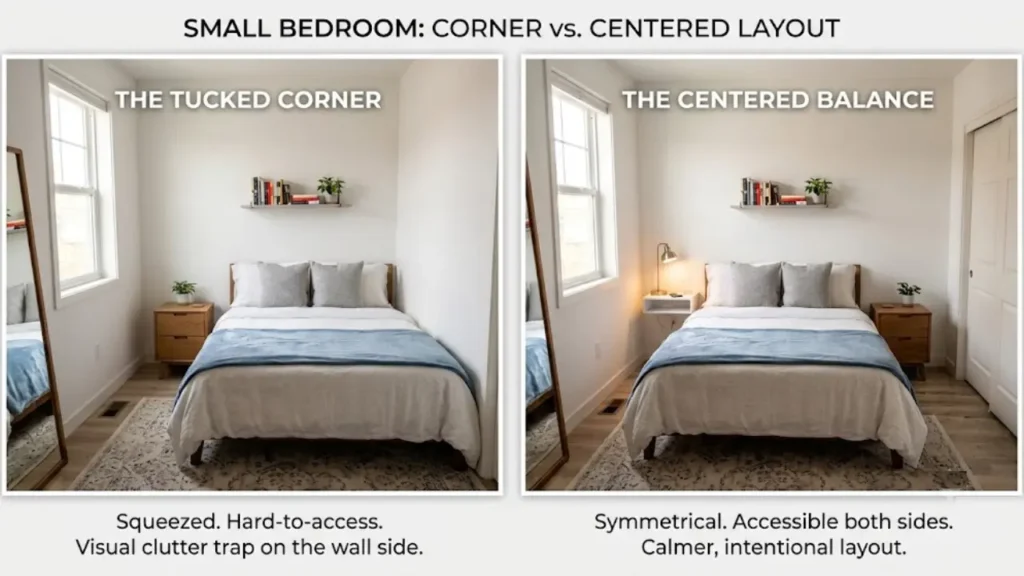
A bed jammed into a corner, accessible from only one side, is a common compromise in small bedrooms. Sometimes it’s the only option. But it comes with real downsides: only one person can get in or out easily, that pinned-in side often becomes a clutter trap because it’s hard to reach, and the room can feel visually lopsided.
Centering the bed on its longest available wall, with space on both sides, creates symmetry and makes a small bedroom layout feel calmer overall. Even tight spacing on both sides (18 to 24 inches) usually beats generous space on one side and none on the other.
If centering isn’t possible because of a window, radiator, or door swing, keep at least one side at the 24-inch minimum and accept that the other side may have to be narrower.
3. Use the Wall Above the Bed for Storage, Not Just Decor
In most small bedrooms, the wall above the headboard is the single most underused vertical space in the room. Floating shelves there can hold books, small plants, or a lamp without taking up any floor space, which matters when floor space is the scarcest resource you have.
This works especially well as a nightstand substitute in tight layouts. A narrow floating shelf at roughly bed height plus a few inches can hold a lamp, a phone, and a glass of water just as functionally as a nightstand, while taking up zero floor footprint.
This kind of vertical thinking matters even more in bedrooms with sloped ceilings or unusually tight floor plans, where tall, narrow storage almost always outperforms low, wide furniture. If you’re working through a room with more serious storage constraints than just nightstand space, small bedroom storage ideas goes deeper into vertical solutions like this one, including options for closets, under-bed storage, and wall-mounted systems.
4. Swap the Nightstand for Something Slimmer When Space Is Tight
A traditional nightstand with drawers runs 18 to 24 inches wide and 16 to 18 inches deep. In a genuinely small bedroom, that footprint on one or both sides of the bed can eat into the clearance you need just to walk past comfortably.
A few alternatives that work well:
Wall-mounted shelves, as covered above, remove the floor footprint entirely.
Narrow stools or slim side tables, around 12 to 14 inches wide, give you a surface for a lamp and a phone without the bulk of a full nightstand.
A floating ledge with a small basket underneath combines a flat surface with light storage, useful if you need somewhere for glasses or a book but don’t need full drawers.
If only one side of the bed has room for a proper nightstand, it’s usually better to put a real nightstand there and use a slimmer option on the other side, rather than compromising both sides equally.
5. Protect the Path to the Closet Before Anything Else
This mistake is easy to make without noticing. A dresser or a bench at the foot of the bed gets placed somewhere that technically fits, but ends up partially blocking the route to a closet door.
Closet doors need their full swing radius, or sliding clearance, plus enough room to actually stand and access what’s inside. A path that’s technically open but only 18 inches wide makes getting dressed every morning mildly annoying in a way that adds up over months and years.
Before settling on a final small bedroom furniture layout, walk through your actual morning routine: opening the closet, grabbing clothes, moving to a mirror or dresser. If any of that feels tight or requires turning sideways, it’s worth fixing before you finalize the arrangement, even if a piece of furniture ends up somewhere slightly less ideal visually.
6. Let One Piece of Furniture Do Two Jobs
In a small bedroom, any piece of furniture that does only one job is using space inefficiently. A dresser is the clearest example: at the right height, it can double as a stand for a small TV or a surface for a mirror, instead of adding a separate console that takes up more floor space.
The same logic extends elsewhere. A bench at the foot of the bed can serve as seating and as a spot to fold laundry temporarily. A storage ottoman can work as a small seat while also holding extra blankets, removing the need for separate linen storage somewhere else in the room.
The fewer single-purpose items in a small bedroom, the more functional the whole layout feels, because every square foot is working harder than it would in a larger room.
This kind of dual-purpose thinking shows up consistently in small bedroom layout tips from designers, especially when floor space is genuinely limited
7. Check Every Door’s Swing, Not Just the Main One
Bedrooms often have more doors than people account for when planning a layout: the entry door, a closet door, sometimes a door to an attached bathroom. Each one needs clear swing space, and it’s easy to forget a secondary door while focusing on the main furniture arrangement.
A common mistake is placing a dresser or bench in a spot that seems fine until the closet door is actually opened all the way, at which point it bumps into the furniture. Map every door’s full swing path before finalizing where things go, not just the main entry.
If a door swing conflicts with the only realistic spot for an essential piece, it’s worth knowing that some closet doors can be converted to sliding or bifold styles, which removes the swing radius problem entirely. Not always practical in a rental, but useful to know for the long term.
8. Use a Mirror to Open the Room Up Visually
A bedroom mirror does two jobs at once. It’s functional, since you need one to get dressed, and it genuinely affects how spacious a small bedroom feels. A mirror placed opposite a window bounces natural light back into the room, and a mirror on an otherwise quiet wall adds a sense of depth.
In a tight layout, a mirror leaned against a wall, rather than mounted, or mirrored closet doors can do this without adding any furniture footprint to the floor. If closet doors need replacing anyway, mirrored sliding doors are worth considering specifically for the visual expansion they create.
Placement matters here. Most people prefer a mirror that doesn’t face the bed directly, so positioning it to reflect a window or open part of the room, rather than the bed itself, tends to work better both functionally and visually.
9. Leave One Wall Alone
This last point is more of a principle than a specific furniture decision, but it matters as much as anything else on this list. In a small bedroom, there’s a pull to use every wall for something, since none of the space feels like it should go to waste.
In practice, a bedroom with one wall left intentionally simple, just the headboard wall, or a window with nothing crowding beneath it, feels calmer than a room where every surface is doing something. Bedrooms benefit from this kind of visual rest more than almost any other room, since the room’s entire purpose is rest.
If you’re working with white walls and trying to add warmth without overcrowding the space, decorating a bedroom with white walls covers how to layer in color and texture thoughtfully, which pairs well with this idea of keeping at least one surface quiet.
A Simple Order of Operations for Arranging a Small Bedroom
Here’s the sequence that produces the best results when figuring out how to arrange furniture in a small bedroom from scratch:
Step 1: Decide on bed size based on clearance math (24 inches minimum on walkable sides), not just on what size feels like the expected upgrade.
Step 2: Place the bed, ideally centered on its wall and out of the direct sightline from the door.
Step 3: Map every door swing (entry, closet, attached bathroom) and keep those paths clear.
Step 4: Add nightstands or slimmer alternatives based on the clearance available on each side.
Step 5: Place the dresser somewhere that doesn’t interrupt a walkway or door swing, combining functions where it makes sense.
Step 6: Use vertical space, shelves above the bed, tall narrow storage, before adding more floor furniture.
Step 7: Add a mirror, positioned to reflect light rather than face the bed directly.
Step 8: Leave at least one wall or surface intentionally simple.
Step 9: Walk through your actual morning routine in the finished layout and adjust anything that feels tight.
A Real Example: Fitting a Queen Bed Into a 10 by 11 Room
One of the tightest bedrooms I’ve personally arranged was just under 10 by 11 feet, and the goal was fitting a queen bed without turning the room into an obstacle course.
The bed went against the longer 11-foot wall, centered as closely as the door position allowed, which left about 20 inches on one side and 26 on the other. A slim wall-mounted shelf replaced the nightstand on the tighter side, and a small two-drawer nightstand went on the wider side.
The dresser went on the wall perpendicular to the foot of the bed, positioned so it didn’t interfere with the closet door’s swing. A mirror leaned against the wall near the window, angled to bounce daylight back into the room instead of facing the bed.
The room was still genuinely small after all of this, no arrangement creates square footage that isn’t there, but it felt calm and functional rather than cramped, because every clearance was respected and nothing required squeezing past anything else.
That’s really the goal whenever you’re arranging furniture in a small bedroom. Not creating an illusion of more space than you actually have, but making sure the space you do have works as hard as possible for how you move through it every day. The same logic applies whether you’re working with a queen bed in a tight room or starting fresh in a rental, where the article on how to make a rental apartment feel like home covers how to settle into a temporary space without treating the layout as an afterthought.
FAQ: How to Arrange Furniture in a Small Bedroom
How do you arrange furniture in a small bedroom?
Start with the bed, since it’s the largest piece and dictates everything else. Center it on the longest available wall with at least 24 inches of clearance on each walkable side, keep it out of the direct sightline from the door if possible, then add nightstands, a dresser, and storage around it without blocking any door swings, including the closet.
Where should I place my bed in a small bedroom?
Ideally, center the bed on its longest available wall, positioned out of the direct sightline from the door. This creates symmetry and allows access from both sides where possible. If centering isn’t possible due to a window or door, prioritize keeping at least one side with a full 24 inches of clearance.
What can I use instead of a nightstand in a small bedroom?
Wall-mounted floating shelves are one of the most space-efficient alternatives, holding a lamp and small items without any floor footprint. Narrow stools or slim side tables, around 12 to 14 inches wide, also work well when a full nightstand doesn’t fit the available clearance.


Pingback: 13 Small Bedroom Closet Organization Ideas That Actually Work
Pingback: 12 Small Bedroom Decorating Mistakes Quietly Ruining the Room