
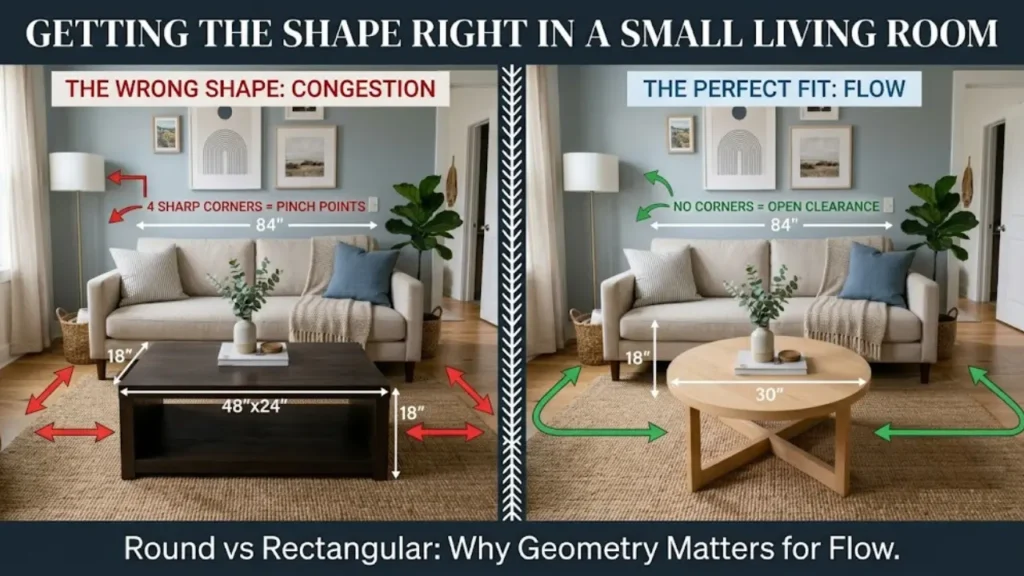

The coffee table might be the most underestimated piece of furniture in a small living room.
People spend weeks choosing the right sofa and then grab whatever coffee table is on sale, assuming it’s just a surface to put things on. But in a small living room, the shape of the coffee table affects traffic flow, visual weight, how the seating arrangement reads, and how large or small the room feels. Get the shape wrong and even a beautifully arranged room feels slightly off. Get it right and the room clicks into place in a way that’s hard to explain until you experience it.
I learned this the hard way in a narrow living room in Nashville. I had a gorgeous rectangular coffee table that I loved on its own. But in that room, it created a bottleneck between the sofa and the TV stand that made the room feel like a corridor rather than a living space. The moment I swapped it for a round table in the same approximate size, the traffic flow opened up and the room suddenly felt generous despite being under 130 square feet.
The shape was everything.
This guide covers the best coffee table shapes for small living rooms in real, practical terms: which shapes work and why, which ones create problems and what those problems are, what sizes make sense for different room dimensions, and how to decide between options when more than one shape could theoretically work. By the end, you’ll know exactly what to look for when you walk into a furniture store or scroll through an online retailer.
Why Coffee Table Shape Matters More in Small Rooms
In a large living room, coffee table shape is mostly an aesthetic decision. There’s enough space that a rectangular table has plenty of clearance, a round table doesn’t crowd anything, and the choice comes down mostly to style preference.
In a small living room, shape is a functional decision first. The wrong shape creates corners that people bump into, walkways that feel too narrow, and visual weight that makes the room feel cramped. The right shape does the opposite: it keeps traffic moving, reduces visual bulk, and makes the seating area feel proportional and intentional.
Here’s what’s specifically at stake with coffee table shape in small spaces:
Corner clearance. Rectangular and square tables have corners. In a small room where people are walking close to the table multiple times a day, corners are a genuine hazard and a source of constant subtle visual tension. Round and oval tables don’t have this problem.
Traffic flow. The shape of the table determines how easy it is to move from one side of the seating area to the other. A table that’s too wide, too long, or positioned wrong blocks the natural path and makes the room feel like an obstacle course.
Visual weight. Solid, rectangular surfaces in dark materials read as heavy and grounding, which can be an asset in a large room and a liability in a small one. Round tables with lighter bases distribute visual weight differently, making them feel less imposing.
Proportion with the sofa. The coffee table should be roughly two-thirds the length of the sofa and sit at or just below the sofa seat height. Shape interacts with these proportions in ways that affect how the whole seating arrangement reads.
Round Coffee Tables: The Best Default for Most Small Living Rooms
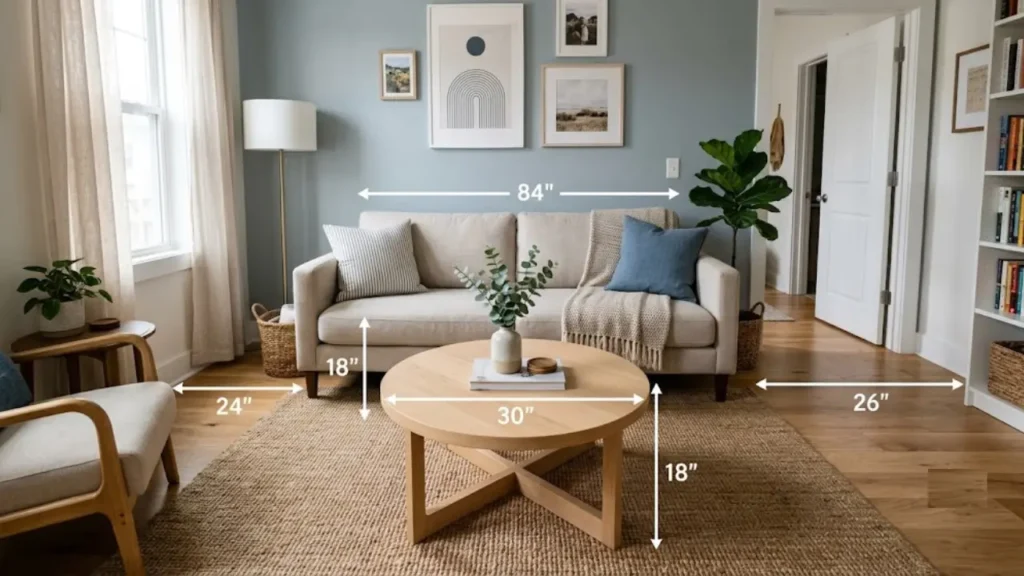
If you’re looking for the simplest possible answer to the question of best coffee table shapes for small living rooms, it’s this: round.
Round coffee tables are the single most reliable choice for small spaces, and the reasons come down to geometry more than aesthetics.
No Corners to Navigate
This is the most immediately practical advantage. Without corners, a round table creates no sharp edges to bump into, no visual interruptions to traffic flow, and no awkward negative space in the corners where people have to step around. The table sits in the space and movement flows naturally around it in every direction.
In a small living room where the path between the sofa and the rest of the room is already tight, this matters enormously. A round table with 18 inches of clearance on all sides feels generous. A rectangular table with the same clearance often doesn’t, because the corners create a psychological sense of tightness even when the physical measurement is identical.
Softer Visual Presence
Round tables have less visual weight than rectangular ones at equivalent sizes. The absence of hard corners softens the form and allows it to sit in a space without dominating it. This is why round tables so often appear in small living rooms in design photographs: the shape is genuinely more forgiving visually.
This is also why a round table can sometimes be slightly larger than feels comfortable in theory without feeling overwhelming in practice. A 36-inch round table in a small living room often reads as less present than a 36-by-24-inch rectangular table, even though the rectangular table has less surface area.
Works in Square and Awkward Rooms
Square rooms are notoriously difficult to arrange well because the geometry is symmetrical in all directions and nothing naturally establishes a dominant axis. A round coffee table in a square small living room softens the room’s boxy quality and creates visual flow without emphasizing the room’s equal proportions.
This is the one situation where a round table is often the better choice even from a purely aesthetic standpoint, not just a practical one.
The Right Size for a Round Coffee Table in a Small Living Room
Sizing matters as much as shape. A round table that’s too small looks like a decorative afterthought. One that’s too large blocks movement and dominates the space.
For most small living rooms with a standard 84-to-90-inch sofa, a round table with a diameter of 30 to 36 inches is the right range. It’s large enough to be functional and proportionally correct relative to the sofa, and small enough to keep the clearance comfortable on all sides.
For smaller rooms or apartment-sized sofas (under 80 inches), a 24-to-30-inch round table works better. These feel deliberately scaled rather than undersized, especially in a well-styled arrangement.
The clearance rule to follow: at least 18 inches between the edge of the table and the sofa, and at least 24 to 30 inches between the table and any walkway or opposing furniture. These numbers come up in every furniture arrangement guide for a reason. They’re the minimum that allows comfortable movement without making the room feel cramped.
Oval Coffee Tables: The Best of Round and Rectangular
If a round table doesn’t feel quite right for your specific sofa length or room shape, an oval table is worth serious consideration. It’s one of the most underrated coffee table shapes for small living rooms.
Why Oval Works So Well
Oval tables combine the softness and corner-free silhouette of a round table with the lengthwise proportions that work better for longer sofas. A 48-inch oval table feels more proportionally correct under a 90-inch sofa than a 36-inch round, and it does so without introducing the corner clearance problem of a rectangular table.
The visual weight of an oval is also well-distributed. The curved ends keep the table from looking like a solid rectangle while the longer dimension fills the space beneath the sofa in a way that a circle often can’t.
For narrow living rooms, specifically, the oval is sometimes the best available option. In a room that’s longer than it is wide, an oval table reinforces the natural axis of the room without cutting off traffic at either end the way a rectangular table can.
Sizing an Oval Table for a Small Living Room
For a sofa in the 84-to-96-inch range, an oval table that’s 42 to 50 inches long and 24 to 28 inches wide is proportionally right. The length tracks with the two-thirds rule relative to the sofa, and the narrower width keeps clearance comfortable on the approach from either end.
The most important measurement is the width, not the length. A narrow oval keeps the path between the sofa and TV or opposite wall clear. An oval that’s too wide becomes functionally identical to a wide rectangle in terms of traffic impact.
Rectangular Coffee Tables: When They Work and When They Don’t
Rectangular coffee tables are the most common shape sold, and they work well in many situations. But in small living rooms, they require more careful sizing and placement than round or oval tables.
When Rectangular Works
A rectangular table works well in a small living room when the room is long and narrow and the layout runs along the length. If the sofa faces a longer wall and there’s a clear walkway along each side of the table, a rectangular table reinforces the room’s natural geometry and feels appropriately scaled.
It also works when the sofa is long (over 96 inches) and a round table of the appropriate diameter would feel awkward or take up too much space in the shorter dimension of the room. In this case, a low-profile rectangular table in a light material with slim legs is often the best practical choice.
The key qualifiers for a rectangular table in a small space: slim legs (not solid panel sides), lighter materials (glass, light wood, white or natural finishes), and dimensions that keep the table surface well under the sofa length. A rectangular table that extends beyond the sofa arms on either side creates visual chaos in a small room.
When Rectangular Causes Problems
Rectangular tables cause specific layout problems in small living rooms when they’re too wide, when the corners create chokepoints in the traffic path, or when the room is roughly square and the table’s directionality fights the room’s geometry.
The corner problem is the most common issue. In a tight space where the sofa-to-table clearance is already close to the 18-inch minimum, the corners of a rectangular table create pinch points that feel uncomfortable to navigate even when the technical measurement is fine. After walking past that corner fifty times in a week, it starts to feel like the room is fighting you.
If you currently have a rectangular table in a small room and the space feels slightly cramped or awkward, try this test: push the table two inches toward the sofa. Notice how much worse it feels. Now imagine that same feeling but from the corners rather than overall proximity. That’s what a too-wide rectangular table does to a small room’s flow.
Square Coffee Tables: The Shape with the Most Limitations
Square coffee tables are less common than the other shapes, and in small living rooms, the reasons become clear quickly.
A square table combines the visual weight of a rectangle with a proportion that works well in only a narrow set of situations: when the seating arrangement is itself roughly square (two sofas at a right angle, for instance) and the room has enough space that the table’s four equal sides don’t create corners in every traffic path.
In a small living room with a standard sofa-and-chairs arrangement, a square table almost always creates more clearance problems than a round or oval table of similar size. The four corners point in four directions, and at least two of them will be in somebody’s way.
There is one situation where a square table can work in a small living room: a small square table used as an accent table between two chairs, rather than as the primary table in front of the sofa. In this context, a 20-to-24-inch square table functions more as a side table than a coffee table proper and its corner issue is minimized because the clearance around it is less critical.
Nesting Tables: The Most Flexible Option for Very Small Rooms
For rooms under 120 square feet, or for living rooms that serve multiple purposes (a living-dining combo, or a room that needs to accommodate guests regularly), nesting tables are worth serious consideration.
A nesting set, typically two or three tables of graduated sizes that tuck under one another, gives you the surface area of a standard coffee table when you need it and the floor space of a smaller footprint when you don’t. This flexibility is genuinely valuable in a very small living room where the furniture arrangement needs to shift depending on how the room is being used.
What to Look for in Nesting Tables for Small Spaces
The best nesting tables for small living rooms share a few characteristics: slim legs that keep the visual footprint light, a round or oval shape on the largest table to minimize corner issues, and a height that works at coffee table level (16 to 18 inches) rather than side table level.
The material matters too. Nesting tables in light-toned wood, marble-look surfaces, or glass tops read as intentional and elevated even in their functional role. Cheap-looking nesting tables, especially in dark laminate or thin metal with no design consideration, tend to make a small room look unfinished rather than cleverly designed.
One practical note: nesting tables work best as a long-term solution only when the tables are actually used in their nested configuration regularly. If they end up separated and permanently spread around the room, they become visual clutter rather than a flexible solution. Be honest with yourself about how you actually use your living room before committing to this option.
Ottoman as Coffee Table: A Genuinely Good Option in Small Spaces
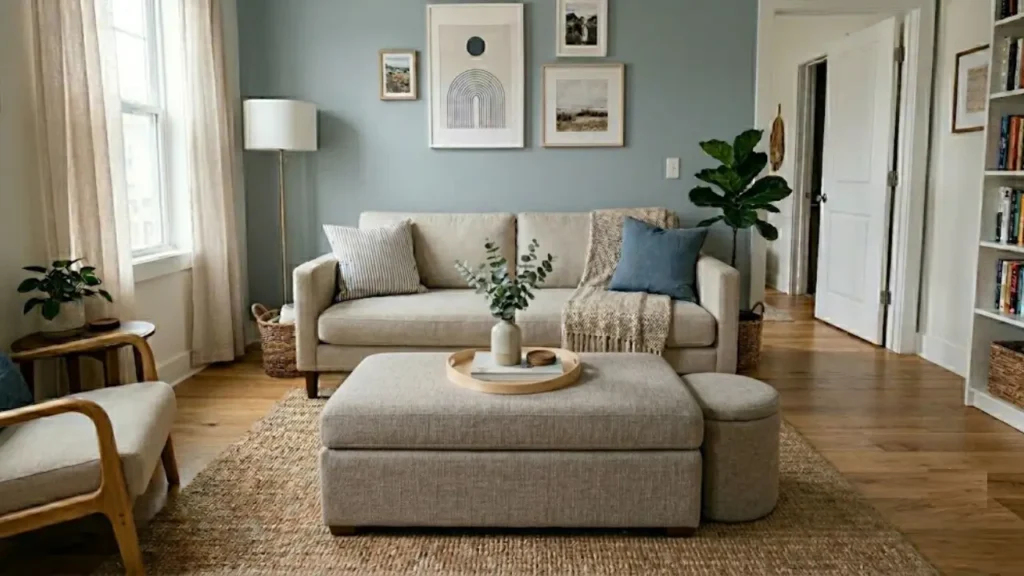
Using an upholstered ottoman in place of a traditional coffee table is one of the most designer-approved choices for small living rooms, and it’s more practical than it might sound.
Why Ottomans Work
An ottoman has no hard edges. This is its primary advantage in a small living room. Where every other coffee table shape creates at least some corner or edge that someone will eventually walk into, an ottoman has none. Movement around it is completely fluid.
An ottoman also provides secondary seating. In a small living room where guest seating is limited, a large firm ottoman can seat two people, which doubles the seating capacity of the room without adding another chair or taking up significantly more floor space.
The surface problem (ottomans don’t have a rigid top for setting drinks) is easily solved with a tray. A wooden, marble, or lacquered tray on top of an ottoman creates a stable surface for drinks, books, and remotes while maintaining the flexibility to remove the tray when you need the ottoman for seating.
Sizing an Ottoman for a Small Living Room
The same proportional rules apply as for traditional coffee tables. The ottoman should be roughly two-thirds the length of the sofa, sit at approximately sofa seat height (16 to 18 inches), and maintain 18 inches of clearance on all sides.
For small living rooms, a rectangular ottoman in the 36-to-48-inch range or a round ottoman with a 30-to-36-inch diameter are both appropriate. The round ottoman has the same clearance advantages as a round coffee table and is generally the better choice for rooms where traffic flow is a priority.
How to Choose the Right Coffee Table Shape for Your Specific Room
With the options covered, here’s how to actually make the decision for your room.
Step 1: Measure First, Browse Second
Before looking at any coffee tables, measure the space. You need three numbers:
The sofa length. The coffee table should be roughly two-thirds of this. For a 90-inch sofa, that’s around 60 inches for a rectangular table or 36 inches for a round one.
The distance from the sofa front to the opposite furniture or wall. Subtract at least 18 inches for sofa clearance and 18 to 24 inches for walkway clearance on the far side. What’s left is the maximum depth of the coffee table.
The width of the seating area. This determines how much lateral space the table can occupy without blocking the routes from one side of the room to the other.
Write these numbers down before you go shopping. A table that looks right in a furniture showroom can be completely wrong in your specific room, and the numbers are the only reliable guide.
Step 2: Identify Your Traffic Problem
Think about the primary movement patterns in your living room. Where do people walk most often? Is the path between the sofa and the TV mostly front-to-back, or do people move laterally across the room frequently?
If the main movement is front-to-back, a rectangular table oriented parallel to the sofa can work. If people move laterally or in multiple directions, a round or oval table handles the varied traffic better.
Step 3: Consider the Room Shape
Square or nearly square room: round or oval table, almost always. The curves fight the room’s boxiness and help the layout feel more dynamic.
Long and narrow room: oval or appropriately sized rectangular table. Reinforces the natural axis of the room.
Irregular or L-shaped room: round or nesting tables. The flexibility and lack of corners works best in non-standard layouts.
Step 4: Factor in Visual Weight
If the room already has a lot of solid, heavy-looking furniture (a deep sofa, dark shelving, substantial accent chairs), a coffee table with a lighter visual presence will help balance the room. Glass tops, slim metal or wood legs, and lighter finishes all reduce visual weight. A solid wood table with thick panel sides in a small room already full of heavy furniture can tip the balance toward cluttered and overwhelming.
Conversely, if the room feels a bit light and floaty, a coffee table with some substance (solid wood, stone top, thicker legs) can ground the arrangement and make the seating area feel more anchored.
For more on how individual furniture choices combine to affect the overall feel of a small living room, the guide on how to make a small living room look expensive covers the visual weight principle in detail, including how to balance heavy and light elements across a seating arrangement.
Coffee Table Height: The Measurement Everyone Forgets
Shape gets most of the attention, but height is the measurement that most often goes wrong.
The standard recommendation is that the coffee table should be the same height as the sofa seat cushions, or up to two inches lower. For most sofas, sofa seat height is between 17 and 19 inches. This means a coffee table in the 16-to-18-inch range is appropriate for most living rooms.
The problem in small living rooms specifically: very low coffee tables (under 14 inches) look stylish in photographs but are uncomfortable to reach in real life, especially when seated on a standard-height sofa. They also disappear visually in a way that can make the seating area feel unanchored.
Very tall coffee tables (over 20 inches) block sightlines across the room, which is particularly problematic in small spaces where the room is already compact. They also feel physically awkward from a seated position, requiring an upward reach rather than a natural downward one.
If you’re unsure, 16 to 18 inches is the reliable range for comfort and proportion in nearly every small living room configuration.
Materials and Finishes: What Works Best in Small Spaces
Shape and size are the primary decisions. Material and finish are secondary but worth thinking through because they affect both visual weight and practical usability.
Glass Tops
Glass coffee tables are one of the most commonly recommended options for small spaces, and the reason is straightforward: transparency reduces visual weight almost to zero. A glass-topped table with a slim metal or lucite frame reads as almost invisible in a room, which keeps the floor plane open and the room feeling less congested.
The practical downsides are real: glass shows every fingerprint, requires frequent cleaning, and is genuinely fragile if you have young children or pets in the home. If those concerns apply to your situation, a light-colored wood or marble-look ceramic top achieves much of the same visual lightness with more durability.
Light Wood
Natural and light-toned wood (oak, ash, maple, pine in a light finish) is probably the most versatile material for small living room coffee tables. It adds warmth, works with almost every furniture palette, reads as natural and organic, and doesn’t carry the visual heaviness of dark wood.
Light wood with slim legs is the combination that works best in small spaces. The slim legs reduce the table’s visual footprint while the light tone keeps it from dominating the room. This combination also tends to age well as interior design trends shift, which matters in a piece of furniture you’ll likely keep for several years.
Dark Wood and Solid Finishes
Dark wood coffee tables can work in small living rooms, but they require more care in the overall palette. A dark coffee table in a room with light walls, a light sofa, and light flooring can look grounded and intentional. The same table in a room where the sofa and flooring are also dark creates a heavy, bottom-heavy arrangement that makes the room feel compressed.
If you love dark wood, keep everything else in the room relatively light. The table becomes an anchor, which is a legitimate design choice. But it only works when the surrounding elements provide enough contrast.
The Most Common Coffee Table Mistakes in Small Living Rooms
Knowing what to avoid is as useful as knowing what to choose.
Too big for the sofa. A coffee table that extends beyond the sofa arms on either side looks disconnected from the seating arrangement. It belongs to the room, not to the sofa. In a small space, this makes the layout feel unanchored.
Too low to be functional. A table under 14 inches looks great in product photos and is awkward to use in real life. Every time you reach for your drink you’ll notice it.
Too high for comfortable reach. Anything over 20 inches breaks the visual continuity between the table and the sofa and requires an upward reach that most people find naturally uncomfortable.
Placed too close to the sofa. Less than 14 inches of clearance between the sofa and the table makes it impossible to sit down without bumping into the table edge. 18 inches is the minimum; 20 to 24 inches is more comfortable.
Wrong shape for the room. A square table in a long narrow room. A rectangular table in a square room. A large solid oval in a room with heavy traffic from multiple directions. Shape and room geometry need to work together.
For the full picture on how the coffee table fits into the broader furniture arrangement, the guide on small living room layout mistakes covers all the positioning errors that affect how a coffee table reads in context, including clearance rules and traffic flow principles that apply directly to table placement.
A Quick Shape Recommendation by Room Type
Standard rectangular room (10×14 to 12×16), sofa on the shorter wall: Round table, 30 to 36 inches. Best traffic flow, most forgiving in the standard layout.
Long and narrow room (9×18 to 10×20): Oval table, 42 to 50 inches long, 24 to 26 inches wide. Reinforces the room’s axis without blocking either end.
Square room (11×11 to 13×13): Round table, 30 to 36 inches, or a small round ottoman. The curves fight the boxy geometry.
Open-plan living area under 150 square feet: Nesting tables or a round ottoman with a tray. Maximum flexibility for a multi-use space.
Room with active kids or pets: Upholstered round ottoman. No corners, no glass, fully soft. Works as overflow seating too.
Minimalist or modern aesthetic: Glass top with slim metal base, round or oval. Lightest possible visual footprint.
The Bottom Line on Coffee Table Shapes for Small Living Rooms
For most small living rooms, a round coffee table in the 30-to-36-inch range is the most reliable starting point. It’s corner-free, visually light, works in most room shapes, and keeps traffic flowing in every direction.
If the sofa is long or the room is narrow, an oval table gives you the same corner-free advantages with better length-to-width proportions. If the room is very small or multi-purpose, nesting tables or an ottoman with a tray offer flexibility that a fixed table can’t.
The measurements matter as much as the shape. Two-thirds the sofa length, 16 to 18 inches high, 18 inches of clearance on all sides. Those numbers are the constraint that shape works within.
Get the shape and the sizing right, and the coffee table becomes the quiet, functional center of the room rather than the thing everyone keeps bumping into. In a small living room, that difference is felt every single day.
If you are building the rest of the room around a new coffee table decision, the guide on how to choose a rug for a small living room is the natural next step since the rug and coffee table sizing decisions are closely linked, and the guide on small apartment living room ideas covers how all the individual elements come together into a cohesive small-space layout.
FAQ: Best Coffee Table Shapes for Small Living Rooms
What shape coffee table is best for a small living room?
Round is the most reliable choice for most small living rooms. Without corners, a round table allows traffic to flow naturally in every direction, reduces visual weight compared to rectangular tables, and works well in both square and rectangular rooms. For longer sofas or narrow rooms, an oval table offers the same corner-free advantages with better proportional length. A 30-to-36-inch round table is the right starting size for most small living rooms.
Should I get a round or rectangular coffee table for a small living room?
Round is generally the better choice in small living rooms because it eliminates the corner clearance problem that rectangular tables create in tight spaces. Corners create physical pinch points and visual tension that make a small room feel more cramped than the actual measurements suggest. A rectangular table can work when the room is long and narrow and the layout runs along its length, but it requires more careful sizing and placement to avoid blocking traffic flow.
What is the right coffee table size for a small living room?
The coffee table should be roughly two-thirds the length of the sofa and sit at 16 to 18 inches in height, which matches most standard sofa seat heights. For clearance, leave at least 18 inches between the sofa and the table edge, and 18 to 24 inches between the far side of the table and any opposing furniture or walkway. For a standard 84-to-90-inch sofa, a round table of 30 to 36 inches or a rectangular table of approximately 48 to 54 inches long is proportionally correct.
Can I use an ottoman as a coffee table in a small living room?
Yes, and it is often one of the best options for small spaces. An ottoman has no hard edges, which makes movement around it completely fluid. It provides secondary seating when guests arrive and a stable surface for drinks and remotes when topped with a tray. A round or rectangular ottoman in the same size range as a traditional coffee table works equally well in terms of proportion.
What is the minimum clearance between a sofa and coffee table in a small living room?
The minimum clearance is 18 inches between the front edge of the sofa seat and the nearest edge of the coffee table. This allows comfortable seated reach and basic movement in and out of the seating position. For a walkway with regular foot traffic on the far side of the table, leave 24 to 30 inches if possible. Clearance below 14 inches makes it physically difficult to sit down without hitting the table and should be avoided regardless of room size.