


Your couch is the biggest piece of furniture in your living room. It takes up the most visual space, anchors the entire layout, and sets the tone for every design decision that follows. Pick the wrong color in a small room, and nothing else you do will fully fix it.
I’ve been through this myself. I once put a deep burgundy velvet sofa in a 280-square-foot studio because I loved how it looked on Pinterest. In real life? That room felt like a submarine. Every time I walked in, the walls seemed an inch closer than the day before.
That experience taught me something: in a small living room, your sofa color isn’t just a style decision. It’s a spatial decision.
Most people overthink sofa color. Lighting matters more. But you still need to start somewhere — so let’s start here.
The one thing I wish someone had told me: If the sofa looks dark in the showroom, it will look even darker in your apartment. Every time.
Quick Answer: Best Couch Colors for Small Living Rooms
If you’re here for the short version:
| Sofa Color | Makes Room Feel Bigger? | Maintenance Level | Best For |
|---|---|---|---|
| Light Gray | Yes | Low | Most homes, any style |
| Warm Beige | Yes | Medium | Warm, cozy interiors |
| Cream / Off-White | Maximum | High | Bright apartments, no pets |
| Soft Sage | Yes | Low–Medium | Natural, earthy aesthetics |
| Dusty Blue | Yes | Low–Medium | Cool, airy spaces |
| Caramel / Tan Brown | Somewhat | Low | Warm, traditional spaces |
| Charcoal | No | Low | Large rooms with great light only |
| Deep Jewel Tones | No | Low | Avoid in small rooms |
These colors reflect light, reduce visual weight, and help small spaces feel more open. Everything after this is the why — and the how.
Why Sofa Color Matters More in Small Rooms
In a large living room, you have breathing space. A dark sofa against a big wall reads as intentional and dramatic — there’s enough room for the eye to rest. In a small living room, there’s no buffer. Whatever color your couch is, it’s going to dominate.
Honestly, this is where small rooms go wrong. People focus on furniture size and layout but ignore color entirely, then wonder why the room still feels cramped after rearranging everything twice.
The Visual Weight Principle
Visual weight is the idea that certain colors and tones read as heavier or lighter to the human eye, regardless of physical size. Dark colors absorb light and pull attention. Light colors reflect light and seem to recede. In a small room, this directly affects how spacious or cramped the space feels.
There’s also the matter of contrast. When your sofa color sharply contrasts with your walls and floor, your brain registers it as a visual boundary — and boundaries make rooms feel smaller. When your sofa shares a similar tonal value with the rest of the room, everything blends together in a way that reads as open and cohesive.
This doesn’t mean you have to go entirely neutral. It means you have to be strategic.
The safest formula: Light sofa + warm rug + soft lighting + natural wood. Everything else is a variation on this.
If you’ve been thinking about how a rug color works alongside your sofa choice, these two decisions are closely linked — the color relationship between your couch and your rug defines the visual floor plan of your entire room.
1. Light Gray: The Safest, Most Versatile Choice
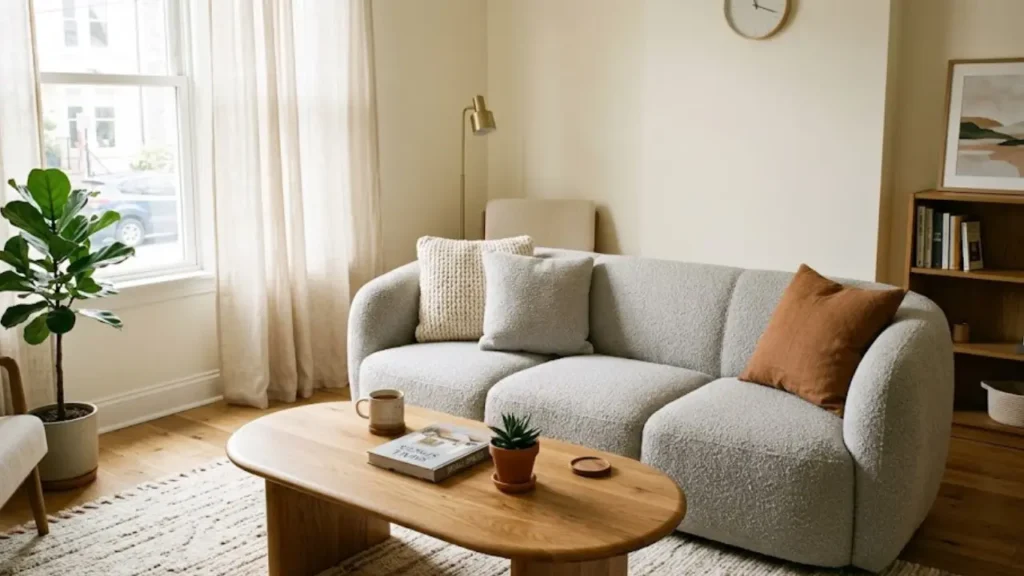
If there’s one sofa color I’d recommend without hesitation for a small living room, it’s light to medium gray. Not charcoal. Not slate. Light gray — the kind that reads almost silver in afternoon light.
Why it works
Reflects light without being stark. Pure white sofas show every crumb and coffee drop. Light gray gives you almost the same spatial benefit while being far more practical.
Genuinely neutral. Gray sits comfortably between warm and cool tones. It works with almost any wall color — white, off-white, sage, dusty blue, terracotta, even a bold navy accent wall. You’re not locked into one aesthetic direction.
Blends with light flooring beautifully. Light hardwood, blonde laminate, light tile — a gray sofa maintains visual continuity so the floor and sofa don’t fight for attention.
Photographs well. I know that sounds shallow. But spaces that photograph well tend to be spaces where light is moving properly. A room that looks spacious in photos usually feels spacious in person too.
What to pair with a light gray sofa
- Warm white or cream walls to soften the cool tones
- A textured rug in oatmeal, blush, or dusty sage
- Throw pillows in mustard, terracotta, or rust for warmth
- A warm wood coffee table to ground the space
Quick rule: The biggest mistake with gray sofas is pairing everything else in cool, blue-toned neutrals. The room ends up cold and clinical. Bring in brass hardware, honey-colored wood, warm white linen curtains — and a gray sofa suddenly feels cozy.
2. Beige and Cream: Warm, Open, Underrated
Beige gets an unfair reputation for being boring.
Beige isn’t boring. Bad lighting is boring.
In a small living room, a beige or cream sofa is one of the smartest moves you can make. Beige is close to the color of light — it doesn’t absorb it. A beige sofa in a room with decent natural light practically glows. The whole space feels warmer and more expansive because the couch isn’t dragging light away.
I’ve helped a few friends style their small apartments around a beige sofa, and every single time the room looked noticeably larger than with their previous darker furniture. One friend switched from a hunter green sectional — the difference was genuinely shocking.
The staining concern: here’s the real answer
Yes, beige shows stains. But modern upholstery fabrics have gotten remarkably stain-resistant. Look for:
- Crypton: highly stain and moisture resistant
- Sunbrella: originally designed for outdoor use, now widely used indoors
- Polyester-blend microfiber: affordable, easy to wipe down
Slipcovers are also worth considering for households with kids or pets. You get all the visual benefit with the practical safety net of machine washing.
What to pair with a beige or cream sofa
- Warm white or ivory walls (avoid stark, blue-toned whites — they clash)
- A patterned rug with warm tones for visual interest
- Dark wood or walnut-tone furniture as grounding contrast
- Green or blush throw pillows for freshness
One thing I love about beige specifically: it makes plants look incredible. The contrast between warm neutral and fresh greenery feels natural and alive in a way that’s hard to replicate with other sofa colors.
3. Warm White and Off-White: Maximum Space, Maximum Commitment
Off-white is technically the most spatially generous sofa color you can choose. It reflects the most light, creates the least visual weight, and makes a small room feel as open as it can possibly be.
The catch? It requires honest self-assessment.
If you live alone or with one other tidy adult — or you genuinely enjoy keeping your home immaculate — an off-white sofa is a beautiful choice. It photographs like a dream and makes a small room feel professionally designed.
If you have kids, dogs, cats, or a tendency to eat dinner on the couch — consider light gray or beige instead. You’ll get 80% of the same spatial benefit without the upkeep anxiety.
Texture is everything with off-white sofas
When your sofa is one neutral color, texture does the heavy lifting. Look for:
- Boucle — everywhere right now, and honestly? I think it’s a little overrated if you have pets. It looks beautiful for six months. After that, maintenance becomes the hobby.
- Linen — natural, slightly rumpled, casually elegant. My personal pick for off-white sofas.
- Velvet in ivory — luxurious and surprisingly practical in lighter tones
A flat off-white sofa in plain fabric can look sterile. The same color in linen looks warm and intentional.
4. Dusty Blue and Soft Sage: Color Without Closing In
Not everyone wants a neutral sofa. That’s completely valid.
The good news: a handful of muted, medium-toned colors work beautifully in small living rooms — if you understand why they work and how to use them.
Dusty blue
One of my personal favorites. It’s not bold enough to feel heavy, but distinct enough to feel intentional. Because it’s muted and sits on the cooler side, it doesn’t visually advance the way a bright or warm color would. Pair it with light walls and natural wood tones, and it feels breezy and considered — not cramped.
Soft sage green
Close enough to neutral that it doesn’t dominate, but brings a sense of life that beige or gray can’t always offer. In a room with white walls and warm wood accents, a sage sofa looks like it belongs in an expensive design magazine.
What doesn’t work: saturated versions
Deep teal, dark forest green, royal blue — beautiful colors, but they carry enough visual weight to make a small room feel enclosed. In 250 square feet, they eat up your space.
Quick rule: Go two or three shades lighter than you think you need to. What looks almost too light in the store will look perfect in your actual room.
If you’re thinking about how all these pieces fit together, the broader strategies in this guide to small apartment living room ideas are worth reading alongside this one — sofa color is one piece of a larger spatial puzzle.
5. Brown Sofas: More Versatile Than You’d Think (But Harder to Pull Off)
Brown sofas have been underrated for the last decade. The all-gray-everything aesthetic of the 2010s pushed brown out of the conversation, but it’s been making a quiet comeback.
That said — I’ll be honest — brown is harder to pull off in a small room than gray or beige. The margin for error is smaller. Get the wall color or the rug wrong and the whole room feels like a 2005 Pottery Barn catalog. But when it works, it really works.
Which browns actually work
In a small living room, brown sofas work best in the lighter, caramel or tan range — not deep mahogany or espresso. A caramel leather sofa reflects light better than you’d expect, especially with a slight sheen. A tan or sand-colored fabric sofa reads almost like beige — warm, light, and spatially generous.
Where people go wrong
Brown plus dark hardwood plus medium-toned walls equals a room that feels very small and very 2003. The fix: keep the walls light. Warm white, cream, or a pale tone like linen or almond. Add one or two genuinely light elements — a cream rug, white curtains — to give the eye somewhere to rest.
The full breakdown on decorating a living room with a brown sofa goes deeper if you’re trying to figure out why yours isn’t coming together.
6. Olive Green and Sage: The Unexpected Small Room Winners
Olive green was having a moment a couple of years ago and hasn’t fully gone away — because it works.
Why it earns its place
These tones sit in the middle of the value scale. Not so light that they disappear, not so dark that they absorb everything. They also read differently in different lighting: in warm afternoon light, an olive sofa looks rich and earthy; in cooler morning light, it reads almost neutral. That adaptability is genuinely useful in small spaces.
How to style it
Olive or sage sofa + warm white walls + natural wood furniture + cream rug + natural light. Add plants — the relationship between green furniture and real greenery is surprisingly harmonious, not visually competing the way you’d expect.
What to avoid: pairing olive or sage with other deep or saturated tones. Dark brown, navy, or forest green alongside an olive sofa in a small room reads heavy and muddy. Let the sofa be the only “colored” element.
7. Cream and Ivory Sofas: The Pinterest-Friendly Favorite (With a Caveat)
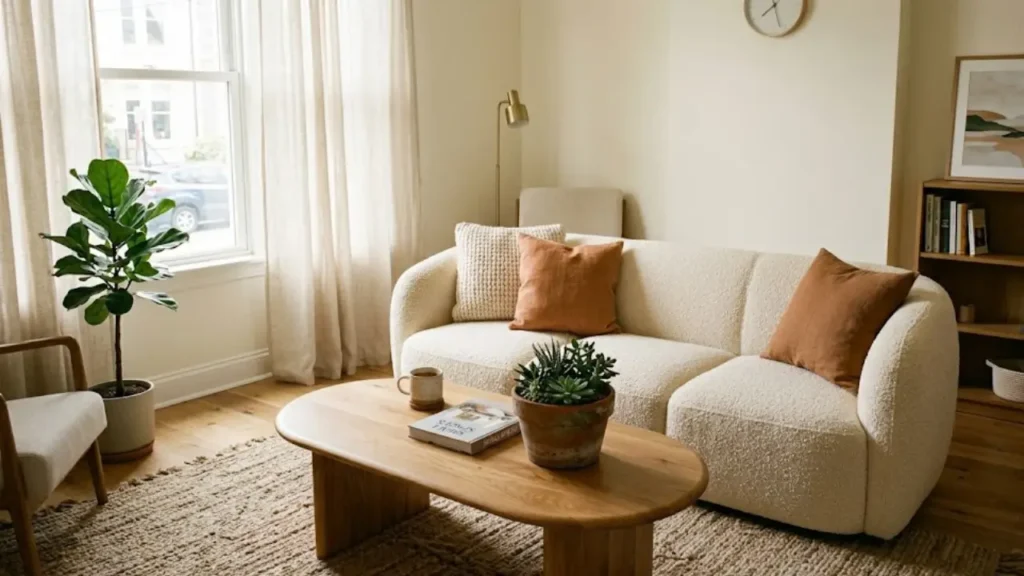
You’ve seen this sofa on every interior design account you follow. The curly boucle in cream. The linen sofa in warm ivory. They look impossibly beautiful.
Here’s the thing: they look that good because those rooms were styled for a photo. Real life is messier. That doesn’t mean you shouldn’t get one — it means you should go in with eyes open.
Cream and ivory sofas share all the spatial benefits of white while reading warmer and more inviting. In a small living room with natural light, a cream sofa practically radiates warmth. The room feels considered without trying too hard.
The pairing that works
Cream sofa + warm or natural wood tones + woven rug in oatmeal or warm tan + warm lighting. That last one is non-negotiable — cool fluorescent light makes a cream sofa look dirty and flat.
Practical note: Boucle fabric in cream shows pet hair dramatically. If you have cats or dogs with light fur, you’ll be lint-rolling daily. Consider performance linen or a tightly woven fabric instead.
Colors That Shrink Small Living Rooms
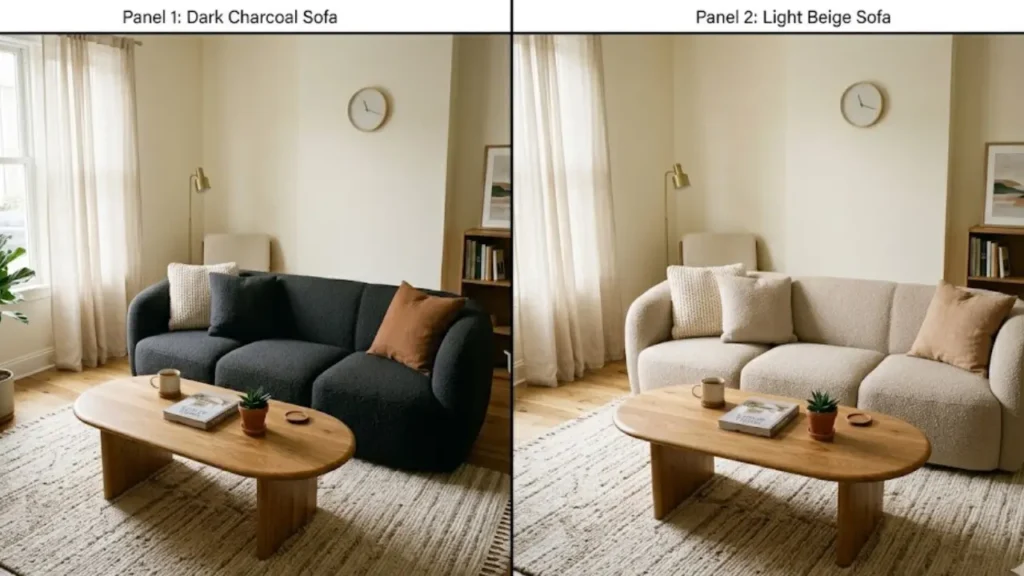
This is the section most articles skip. They tell you what to buy, not what to avoid.
Dark charcoal and near-black
Charcoal is the most common mistake I see in small living rooms. People choose it because it feels sophisticated and hides dirt — and it does look dramatic on showroom floors with 20-foot ceilings and floor-to-ceiling windows. In a small apartment with one north-facing window? It turns your living room into a cave.
When it can work: If your small living room has exceptional natural light — large south or west-facing windows — a charcoal sofa can work if walls are warm white, the rug is medium-toned, and no other furniture is dark. When light is abundant, dark sofas read as dramatic rather than heavy.
Deep jewel tones: navy, burgundy, forest green
These look incredible on Pinterest. They perform terribly in small rooms without abundant light. The problem isn’t the hue — it’s the value. Deep, saturated colors absorb light the same way dark neutrals do.
I’d generally save these for larger spaces where they can breathe.
Terracotta in large doses
Terracotta sofas overwhelm small rooms fast. Full stop.
These tones feel cozy in small amounts — a throw pillow, a ceramic vase, an accent chair. As a full sofa color in a small room, they close in on you. Use terracotta as an accent on a neutral sofa. Don’t make it your sofa.
The Grey Sofa: A Complete Breakdown
Because gray is such a genuinely excellent choice — and because the range of grays is enormous — it deserves its own section.
Light vs. medium vs. charcoal: which to choose
Light gray (silver, pale dove, ash): Best choice for the smallest rooms. Maximum light reflection, most versatile for color pairing.
Medium gray (classic gray, warm greige, French gray): Works well in small to medium rooms. Greige — a gray-beige hybrid — is particularly good because it adapts to whatever light your room is doing.
Charcoal (dark slate, near-black gray): Only works in well-lit small rooms. Avoid in north-facing rooms or apartments with limited natural light.
How to style a gray sofa so it doesn’t feel cold
The trap is going too cool and too monochromatic. If everything in your room is gray and white, you end up with a space that feels sterile despite being technically well-designed.
Warmth is the solution:
- A warm-toned rug — oatmeal, rust, burnt sienna. The rug sits between your sofa and your floor and does enormous work setting the room’s temperature. For specific combinations, the full breakdown on what color rug goes with a grey couch covers every pairing worth considering.
- Wood tones in furniture — walnut or oak coffee table, side tables in warm wood
- Warm throw pillows — mustard, burnt orange, blush, sage
- Warm lighting — bulbs in the 2700–3000K range
One more thing: pay attention to rug placement. A too-small rug under a gray sofa makes the whole setup look like it’s floating. Make sure your rug anchors the seating area properly — rug placement in a living room is worth getting right, because a correctly placed rug makes your sofa color choice look more intentional regardless of shade.
Best Couch Colors by Wall Color
This is a question I get constantly — and most articles ignore it entirely.
White or warm white walls
You have the most flexibility. Almost any sofa color from this list works. Light gray, beige, cream, and sage are all excellent. If you want the most cohesive small-room look, go slightly warm in your sofa choice (beige or warm gray over cool gray) to prevent the room reading too stark.
Gray walls
Avoid a charcoal sofa — stacking similar dark tones in a small room feels cave-like. Go for warm off-white, cream, light beige, or a greige sofa. These provide enough contrast to keep the room from going flat while staying light enough to maintain an open feel.
Beige or greige walls
A light gray sofa creates a beautiful tonal relationship here — similar value, slightly different temperature. Cream and off-white also work very well. Avoid a beige sofa on beige walls in a small room — there’s not enough contrast and the whole thing reads as muddy.
Bold or dark accent walls (navy, forest green, terracotta)
Keep the sofa very light — cream, ivory, or warm off-white. The accent wall is already doing significant visual work. A light sofa gives the eye somewhere to rest.
Best Couch Colors by Lighting Type
Nobody writes about this properly, and it might be the most practically useful section in this entire article.
North-facing rooms (low, cool natural light)
Avoid cool grays and anything in the blue or purple family. These already-cool tones become cold and flat in north-facing light. Go warm: beige, cream, caramel, warm greige, or soft sage. Warm tones counteract the cool quality of north-facing light and keep the room feeling alive.
South-facing rooms (bright, warm natural light all day)
You have the most options. Light gray, dusty blue, soft sage, cream — all work beautifully. South-facing rooms can even handle a medium-toned sofa without losing that open feel, because the abundant light compensates.
East-facing rooms (bright morning light, shadowy afternoons)
Go light. Cream, beige, or light gray. The room will feel great in the morning regardless, but in the afternoon it needs all the help it can get.
West-facing rooms (warm, golden afternoon light, dim mornings)
Warm tones work brilliantly here — beige, cream, caramel. The golden afternoon light makes warm sofas look incredible. Just be aware the room will feel darker in the mornings, so keep walls light.
Low natural light apartments (minimal windows, artificial light dependent)
This is the situation where sofa color matters most. Stick to cream, warm white, or light beige. Avoid anything in the cool-gray family — without warm natural light to activate them, cool grays look institutional. Warm your artificial lighting to 2700K and let the sofa color do the rest.
How to Test a Sofa Color Before You Commit
Choosing a sofa color from a showroom or a product photo is one of the highest-stakes guessing games in home decor. Here’s how to reduce the risk.
Get fabric swatches first
Most furniture retailers send them free or for a small fee. Live with the swatch in your actual room for 48 hours. Look at it in morning light, afternoon light, evening lamp light, and overcast-day light. Colors change dramatically across conditions.
Photograph the swatch in position
Take a photo with the swatch positioned where the sofa will sit. Look at it on your phone screen. This gives a surprisingly accurate preview of how the color will read in the space.
Check the undertones
“Gray” sofas can have blue, green, purple, or brown undertones that only become obvious in your specific lighting. “Beige” can read pink, yellow, or orange in certain lights. Knowing the undertone prevents the “it looked different in the store” surprise.
Consider your floor
Your sofa and your floor are the two largest expanses of color in a small living room. If they contrast sharply, the room feels divided and smaller. If they share similar tonal values, the space reads as more continuous.
If you’ve ever walked into a small room and felt like the furniture was fighting the layout, the issue was often as much about color contrast as actual square footage. The common rug mistakes in living rooms article covers a related principle — the same visual logic applies directly to sofa color selection.
What Interior Designers Actually Do (That Nobody Tells You)
Most designers working on small spaces follow a few rules they rarely explain to clients. Some of these I learned the hard way.
The 60-30-10 rule
60% of the room in a dominant neutral, 30% in a secondary tone, 10% in an accent. In a small living room, the sofa often carries 30% of the visual space. Keep it in that secondary-tone zone — it shouldn’t be the darkest or most saturated thing in the room.
They never match — they coordinate
Your sofa color should relate to your wall color and rug, but never exactly replicate it. The goal is tonal harmony, not matching furniture sets. A gray sofa, greige walls, and an oatmeal rug all occupy the same tonal family without being identical.
They keep contrast in textiles, not furniture
In a small room, the bold pattern or color contrast lives in the throw pillow, the blanket, the rug, the artwork — not the sofa. If you get bored of your mustard cushions, you replace them for $40. If you get bored of a mustard sofa, you’re living with it for the next decade.
They always account for aging
Light sofas often age better in terms of color than dark ones. Dark sofas fade unevenly — and the fading is obvious because there’s so much contrast between faded and unfaded areas. Light sofas fade more gracefully because the starting point is closer to where they’ll end up.
Common Mistakes to Avoid
Choosing based on showroom lighting. Furniture stores use warm, flattering lighting that makes everything look rich and inviting. Your apartment has one overhead light and a north-facing window. What looked like a sophisticated charcoal in the showroom will look like a dark gray lump in your actual room.
Ignoring the undertone. Gray isn’t just gray. Beige isn’t just beige. Every neutral has an undertone, and if yours clashes with your wall color’s undertone, the room will feel “off” and you won’t be able to figure out why.
Going dark to hide dirt. Dark sofas hide crumbs but make your room feel smaller, which affects how you feel in the space every single day. Performance fabrics in lighter colors are a better long-term solution.
Choosing in isolation. Your sofa color needs to work with your walls, your floor, your rug, and your light sources simultaneously. Choosing it before considering these other elements leads to mismatched spaces that are expensive to fix.
Following trends too closely. Trendy sofa colors look great in magazines for one or two years, then look dated. Your sofa is a long-term investment. Classic neutrals with personality in changeable accessories will always serve you better.
The Final Verdict: Best Couch Colors For Small Living Rooms
The simplest answer: Light gray, warm beige, or cream are your three best options for small living room sofas. They’re versatile, spatially generous, and they work with almost any other design decision you make.
If you want personality: Dusty blue or soft sage in a muted, desaturated version. I’d probably go sage if I were choosing today — though I reserve the right to change my mind next year.
If you already have a sofa you’re working with: Focus on the surrounding elements. Light walls, a medium-toned rug, warm lighting, and strategically placed throw pillows can rehabilitate almost any sofa color in a small room. The sofa color matters — but it’s not the only thing that matters. Sometimes it’s not even the main thing.
The real secret to a small living room that feels spacious and considered isn’t any single piece of furniture. It’s the relationship between all the pieces — how they share light, how they complement rather than compete with each other, and how they’re arranged in a space that doesn’t have room for mistakes.
Get those relationships right, and even a small living room can feel exactly like home.



Pingback: Best Wall Colors for Small Living Rooms
Pingback: How to Make a Small Living Room Look Expensive
Pingback: How to Arrange Furniture in a Small Living Room: 7 Ways
Pingback: How to Make a Small Living Room Look Expensive on a Budget