
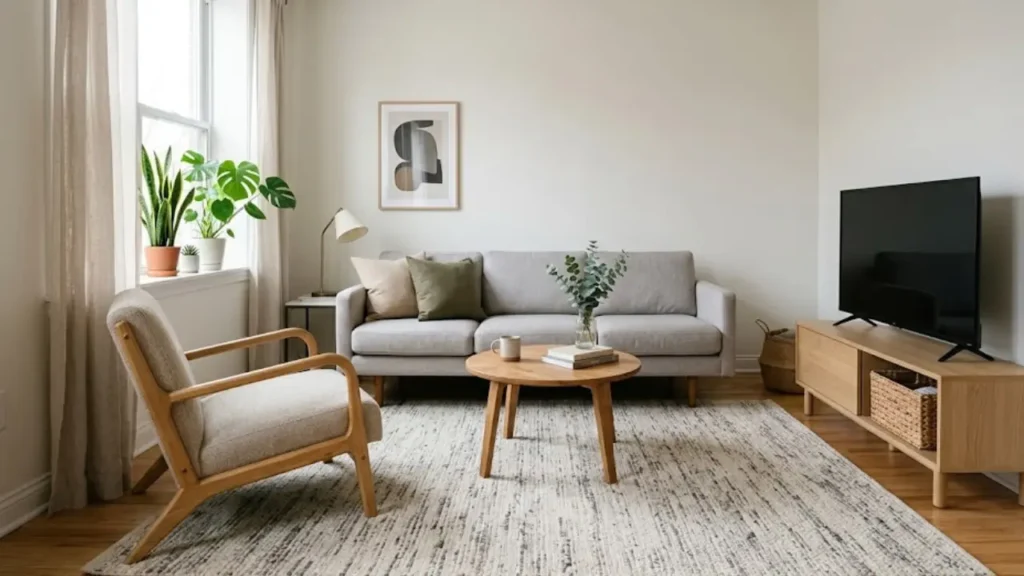

The rug is the one thing most people get wrong in a small living room. And honestly, I was guilty of it too.
My first apartment had a living room that was barely 11 by 12 feet. I thought a smaller rug would be the safe, space-saving choice. So I bought a little 4×6 rug, centered it in front of the sofa, and stepped back to admire my work. The result? The room looked like a postage stamp. Everything felt chopped up and awkward, like pieces of furniture that didn’t belong together. It wasn’t until I swapped it for a much larger rug, one that felt almost too big, that the room finally clicked.
That single swap changed how the entire space looked and felt. No new furniture. No paint. Just the right rug.
If you’re decorating a small living room and staring down the rug aisle feeling completely overwhelmed, this guide is for you. I’m going to walk you through exactly how to choose a rug for a small living room: the right size, the right shape, the right color, and the placement rules that actually work. By the end, you’ll know what to look for and what to avoid, and you’ll feel confident making a choice that makes your room feel bigger, not smaller.
Why the Rug You Choose Matters More Than You Think
In a small living room, every design decision carries more weight than it would in a larger space. A bold sofa can anchor a big room. In a small one, it can dominate it. The same logic applies to rugs, but in reverse. A rug that’s too small shrinks a room visually. A rug that’s chosen thoughtfully? It can make a small room feel intentional, cozy, and even generous.
Here’s why the rug does so much of the heavy lifting in a small space:
It Defines the Seating Zone
In open-plan apartments or multi-use rooms, a rug visually carves out a dedicated living area. Without one, seating can look like it’s just floating in the middle of nowhere. A rug says, “this is the living room,” even if your dining table is six feet away.
It Draws the Eye Horizontally
This is the designer trick nobody talks about enough. When a rug extends outward toward the edges of the room, your eye follows it. That horizontal movement makes the room feel wider. A small rug does the opposite: it draws your eye inward and downward, which emphasizes how small the space actually is.
It Ties the Room Together
Furniture can look like separate, disconnected pieces without a rug beneath them. The rug creates visual unity. When your sofa, chairs, and coffee table all share the same foundation, the room reads as a cohesive, curated space. That perception alone makes it feel more pulled-together and, somehow, larger.
If you’re still deciding on your furniture arrangement before you choose a rug, it’s worth reading about common small living room layout mistakes that can unintentionally shrink your space, because your rug choice and your furniture layout work together, not independently.
The Single Most Important Rule: Go Bigger Than You Think
I’m going to say this once, clearly, and then we’re going to talk about the details.
In a small living room, your rug should almost always be larger than feels comfortable.
This goes against every instinct. When we’re short on space, we think smaller. Smaller furniture, smaller decor, smaller rug. But with rugs, the instinct is wrong. A rug that feels slightly too big will almost always look better than a rug that feels slightly too small.
Here’s the rule of thumb professional designers use: leave 12 to 18 inches of bare floor between the edge of the rug and the wall. That’s it. If your room is 12 by 14 feet and you leave 18 inches on each side, your rug should be roughly 8 by 10 feet, which sounds enormous until you see it in place and realize the room suddenly looks like it has more breathing room, not less.
A 4×6 or 5×8 rug floating in the middle of the room with all furniture legs sitting off it makes the room look like you ran out of budget halfway through decorating. I’ve seen it happen in beautifully furnished apartments. The rug breaks the visual flow, and the eye doesn’t know where to settle.
What Rug Sizes Actually Work in Small Living Rooms
Here’s a practical size reference based on room dimensions:
For rooms 10 x 10 to 11 x 12 feet: A 6×9 rug is the minimum. A 8×10 is ideal if you can fit it while keeping 12+ inches to the wall on all sides.
For rooms 12 x 14 to 13 x 16 feet: An 8×10 works well. A 9×12 is even better and gives you the space to get all furniture legs on the rug, which is the cleanest look for small spaces.
For open-plan layouts with a small defined living area: Go by the seating arrangement, not the full room. The rug should fit underneath the front legs of all major seating pieces at minimum, or ideally under all four legs of the sofa and chairs.
Rug Size Rules: Front Legs On vs. All Legs On vs. None
This debate causes more confusion than almost any other decorating question, so let’s settle it.
There are technically three ways to position a rug relative to your furniture:
All Legs On the Rug
This is the most formal and unified look. Every piece of furniture sits fully on the rug. It requires a larger rug, typically 9×12 or larger, but in a small living room, it creates a strong, clean anchor. The seating group looks intentional and defined.
Front Legs On the Rug
This is the most commonly recommended approach for small spaces. The front two legs of your sofa and chairs rest on the rug, while the back legs float off. It works with a smaller rug (8×10 can pull this off in many layouts), and it still creates the visual connection between furniture pieces. This is my personal go-to for tight spaces because it’s forgiving on budget and room dimensions.
No Legs On the Rug
All furniture sits off the rug, with the rug acting purely as a color/texture element in the center of the room. This can work in some very specific artistic or minimalist settings, but in a small living room, it almost always creates that “orphaned rug” problem. The rug floats, the furniture floats, and nothing coheres. I’d avoid this for small spaces almost universally.
For more detail on placement principles, the full breakdown in this guide on how to place a rug in a living room covers every scenario, including sectionals and awkward layouts.
What Shape Rug Works Best in a Small Living Room?
Shape matters more than most people realize. The wrong shape can make an already-awkward room feel even more disjointed.
Rectangular Rugs: The Safe and Effective Choice
Rectangular rugs are the default for a reason. They match the geometry of most rooms and most furniture arrangements. In a small rectangular room, a rectangular rug emphasizes the natural lines of the space and tends to make it feel longer. This is your best bet in the vast majority of small living rooms.
The key is alignment. Line the rug up parallel to your longest wall. This reinforces the room’s natural dimensions and draws the eye through the space rather than stopping it short.
Round Rugs: Better Than You’d Expect (in the Right Spot)
Round rugs get dismissed too quickly for small spaces. In fact, in the right situation, usually under a round coffee table or in a square room, a round rug adds softness and breaks up the boxy feel that small rooms often have. It creates visual interest without competing with furniture lines.
The catch: a round rug works best as a deliberate design choice, not as a workaround for not finding the right rectangular size. If your living room is long and narrow, a round rug will feel out of place. If it’s a fairly square room with simple furniture, it can be genuinely lovely.
Square Rugs
Square rugs are less common but can work well in square rooms with symmetrical furniture layouts. If your room is 11×12 and your furniture arrangement is fairly balanced, an 8×8 or 9×9 square rug can feel very intentional.
Avoid: Runner Rugs as the Main Rug
Runners are for hallways and kitchens. In a living room, even a narrow one, a runner rug as the primary rug creates a visual dead-end. It signals “this space wasn’t big enough for a real rug,” which is the opposite of the impression you want.
Color and Pattern: The Rules That Actually Expand Space
Here’s where it gets fun. And where a lot of well-intentioned decorating goes sideways.
Light Colors Open a Room Up (Most of the Time)
Light-colored rugs, think ivory, cream, soft gray, warm beige, reflect light and make the floor plane feel more open. This is particularly useful in small rooms with limited natural light. The floor visually “recedes,” and the walls feel farther apart.
That said, I want to push back on the idea that you must always choose a light rug in a small room. A medium-toned rug in the right palette can feel equally airy. What you’re really optimizing for is contrast. A rug that contrasts sharply with dark floors in a dark room will actually draw more attention to the floor and shrink the space. A rug that transitions more gently tends to blend the floor plane with the rest of the room.
If you have a grey couch, choosing the right rug color becomes its own design puzzle. The guide on what color rug goes with a grey couch covers the full palette of options, including which combinations feel airy and which ones inadvertently close a room in.
Dark Rugs: Not the Automatic Enemy
Dark rugs, think charcoal, navy, forest green, deep terracotta, can absolutely work in small living rooms. The key is balance. If your walls are light and your furniture is relatively light-toned, a dark rug can ground the room beautifully without making it feel cave-like. What doesn’t work is dark floors + dark rug + dark furniture. In small rooms, that combination absorbs light and closes everything in.
Pattern: When It Helps and When It Hurts
This is where most people overcorrect. After hearing “small rooms need light, simple rugs,” they avoid pattern entirely. Then they wonder why the room feels bland and unfinished.
Here’s the more nuanced truth:
Geometric patterns with medium scale, think a simple grid, a subtle diamond repeat, or a soft stripe, can actually elongate a small room when oriented correctly. A striped rug running horizontally (parallel to the longest wall) makes the room feel wider.
Large-scale abstract patterns tend to overwhelm small rooms. When the pattern repeat is bigger than the furniture it’s anchoring, the rug becomes the focal point for all the wrong reasons.
Tiny, dense patterns, like a heavily detailed Persian or Oriental rug, can work beautifully in small rooms because the texture reads as texture from a distance, not as busyness. These rugs add richness and warmth without the overwhelming effect of a large abstract pattern.
High-contrast patterns (black and white checkerboard, stark zigzag) are bold choices in any room, and in a small living room, they tend to make the space feel edgier and more modern. That’s great if it matches your style, but not ideal if you’re going for calm and expansive.
Texture and Pile Height: What to Consider for Small Spaces
The texture of a rug affects both how the room looks and how it functions. In small spaces, function matters just as much as aesthetics.
Low-Pile Rugs
Low-pile rugs (think flatweave, Berber, or short-cut pile) are almost always the right choice for small living rooms. They’re easier to move furniture on and off of, they don’t visually bulk up the floor plane, and they’re far easier to keep clean. In a small space where furniture might be moved frequently to accommodate guests or other uses, a low-pile rug is practical as much as aesthetic.
They also read as more “modern” and “clean,” which can make a small room feel more intentional rather than cluttered.
High-Pile and Shag Rugs
I have a complicated relationship with shag rugs in small spaces. They’re undeniably cozy, and coziness is actually a great goal for a small living room. A small room should feel warm and intentional, not apologetic. A high-pile rug adds tactile richness and can feel luxurious.
The problem is that very high pile adds visual bulk to the floor plane and makes furniture look like it’s sinking or hovering. In a room where ceiling height is already limited, a shag rug can make the space feel lower and more compressed. My honest recommendation: if you love texture, go for a medium pile (about 0.5 to 1 inch) rather than a deep shag.
Natural Fiber Rugs (Jute, Sisal, Seagrass)
Natural fiber rugs, jute and sisal especially, have had a major moment in home decor, and for good reason. They add organic texture, pair with almost any furniture style, and their neutral color naturally opens up a space.
The caveat in small living rooms: natural fiber rugs can feel rough underfoot, especially if you tend to sit on the floor or have kids or pets. They’re also less forgiving with spills. If you’re after the aesthetic without the roughness, look for jute-blend rugs, which soften the texture significantly.
The Biggest Rug Mistakes in Small Living Rooms
Let’s talk about what goes wrong, because these mistakes are so common, and so fixable.
Mistake 1: Buying Too Small
Covered this, but it bears repeating. The most common rug mistake in small rooms is choosing a size that’s too small because it “feels right” in the store. Rugs look enormous on the showroom floor. Get in the habit of taping out the rug dimensions on your actual floor before you buy.
Mistake 2: Centering a Small Rug in the Middle of the Room
A small rug centered in the room with no furniture touching it is the design equivalent of a lost island. It doesn’t anchor anything. It makes the room look unfinished. If your rug is too small to go under any furniture, it’s too small full stop.
Mistake 3: Ignoring the Shape of the Room
A round rug in a long, narrow room. A rectangular rug aligned at an angle to the walls. These choices create visual confusion because they fight the room’s natural geometry. Work with the shape of your room, not against it.
Mistake 4: Matching the Rug Color Too Exactly to One Furniture Piece
If your sofa is beige and you buy a beige rug, the two will blend together in a way that makes the room look flat and monochromatic. You want harmony, not camouflage. The rug should complement the sofa, not mirror it.
Mistake 5: Skipping the Rug Pad
This one isn’t about aesthetics. It’s about function and longevity. A rug pad keeps the rug from slipping (especially critical in small rooms where furniture shifts), adds a thin layer of cushioning, and protects both the rug and the floor beneath it. In a small space where people are navigating tight corners frequently, a sliding rug is a real hazard. Always use a pad.
For a deeper look at what goes wrong with rug choices across the board, the full breakdown in this post on living room rug mistakes will save you from the most expensive errors before you buy.
How to Use a Rug to Make a Small Living Room Look Expensive
This is one of my favorite things to talk about, because a rug is genuinely one of the most high-impact, relatively affordable ways to elevate the feel of a small room.
Buy the Best Quality You Can in the Size You Need
Here’s a counterintuitive truth about small living rooms: you can afford to invest in a better-quality rug because you need less square footage than a larger room. A 6×9 rug in a beautiful, dense wool costs less than a 9×12 of the same rug. Use that to your advantage. A high-quality rug with real texture and depth reads as “expensive” in a way that a cheap large rug never will, no matter the size.
Choose a Rug with Subtle Visual Interest
The rugs that photograph beautifully and look most expensive in person tend to have subtle texture, tonal variation, or a tone-on-tone pattern. A solid ivory rug with a slight sheen. A gray rug with a gentle geometric that only becomes visible up close. These details signal quality without screaming for attention.
Layer Your Rug Over a Natural Fiber Base
This is a designer trick that works especially well in small rooms: layer a smaller patterned or textured rug over a larger, simpler jute or sisal base. The larger neutral rug defines the zone, and the layered rug on top adds personality. It also lets you use a smaller decorative rug (which is usually less expensive) while still getting the grounded, layered look.
If you’re thinking about the full picture of how the rug, furniture, and walls work together to make a small space look deliberately styled and expensive, there are some broader strategies worth reading in this guide on how to decorate a small living room without clutter, especially the section on visual weight.
A Room-by-Room Scenario Guide: What to Choose and Why
Sometimes abstract rules aren’t enough. Let me walk through a few specific small living room scenarios.
Scenario 1: Long, Narrow Living Room (10 x 16 feet)
This is one of the trickier layouts. The room already feels like a hallway, and a bad rug choice will emphasize that.
Best rug: 8×10 rectangular, oriented horizontally (the 10-foot side running across the room width). Light-to-medium tone. A subtle horizontal stripe if you want pattern. This draws the eye across the room and fights the tunnel effect.
Avoid: Round rugs, small rugs, dark-toned rugs on dark floors.
Scenario 2: Square Room (12 x 12 feet)
Square rooms can feel boxy. The goal is to break up the rigidity.
Best rug: An 8×10 rectangular rug works, but this is also one of the rare cases where a round or square rug (8×8) could be a genuinely interesting choice. A medium-scale pattern with soft curves softens the room’s boxy feel.
Avoid: Very geometric, high-contrast patterns that reinforce the angular feeling.
Scenario 3: Small Open-Plan Living-Dining Area
When living and dining share one space, the rug defines the boundary between the two zones.
Best rug for the living area: Size the rug to your seating group, not the overall room. All or front legs on, rug sitting clearly within the furniture arrangement. This signals “this is the living room” without requiring a wall to make the division.
Avoid: Letting the rug bleed into the dining zone. Two separate zones need two separate (or clearly distinct) floor anchors.
Scenario 4: Rental Apartment with Light Wood or Laminate Floors
Light floors give you the most flexibility. Almost any rug tone will work without making the room feel dark.
Best rug: A warm-toned rug, think dusty terracotta, warm beige, soft sage, adds color and warmth against light floors without washing out the room. Keep pattern scale medium or smaller.
Avoid: Cool gray rugs on light floors. They can look slightly corporate rather than cozy, especially in a rental where the walls are likely white or off-white.
Pro Tips: What Interior Designers Actually Do
I’ve talked to enough designers (and read enough design books and watched enough renovation shows) to know there are a handful of things the pros do that beginners almost never think of.
They tape the dimensions first. Before any rug purchase, designers tape out the footprint on the floor using painter’s tape. This sounds fussy. It is also the single most useful thing you can do to avoid an expensive return.
They think about the whole room, not just the rug. The rug doesn’t exist in isolation. It connects to the wall color, the sofa fabric, the coffee table finish, the curtain length. Designers pull all these elements before finalizing the rug, not after. If you’re still choosing your wall color, it might be worth getting that locked in first.
They’re not afraid of “ugly” rugs in person. Many of the most beautiful rugs look slightly rough or even underwhelming in the store because they need furniture and light to come alive. Trust the sample, read the reviews, and visualize the context.
They use the rug as the starting point, not the finishing touch. In many design projects, the rug is chosen first, or very early, because it’s the hardest element to match. A sofa in a particular blue can be found. A rug in that exact blue is much harder. Start with the rug if you’re building a room from scratch.
The Final Checklist Before You Buy
Run through these before you click “add to cart” or hand over your credit card:
- Have you taped out the dimensions on your floor?
- Is the rug large enough for at least the front legs of all seating to rest on it?
- Does the rug leave 12–18 inches of bare floor on at least two sides?
- Does the color complement (not exactly match) your dominant furniture piece?
- Is the pattern scale appropriate — not too large for the room size?
- Is the pile height low-to-medium for practical use in a small space?
- Have you ordered a rug pad?
- Have you checked the return policy in case the dimensions don’t work in person?
If you can check every box, you’ve found your rug.
The Bottom Line: How to Choose a Rug for a Small Living Room
Choosing a rug for a small living room comes down to one core principle: bigger anchors, smarter colors, and placement that works with your furniture rather than around it.
The single biggest upgrade you can make is to go larger than feels instinctively “safe.” That one shift, from a too-small rug to a correctly sized one, will do more for the look and feel of your small living room than almost any other change you can make short of painting the walls.
Get the size right first. Then choose a color that opens the room up rather than closing it in. Then think about pattern and texture. In that order.
If you’re building out your small living room step by step, the guide on small apartment living room ideas has a great overview of how rugs, furniture, mirrors, and lighting all work together, especially for spaces under 200 square feet where every decision compounds.
Your rug is waiting. Go find it.

Pingback: How to Make a Small Living Room Look Expensive
Pingback: Small Living Room Layout Mistakes to Avoid
Pingback: How to Make a Small Living Room Look Expensive on a Budget