
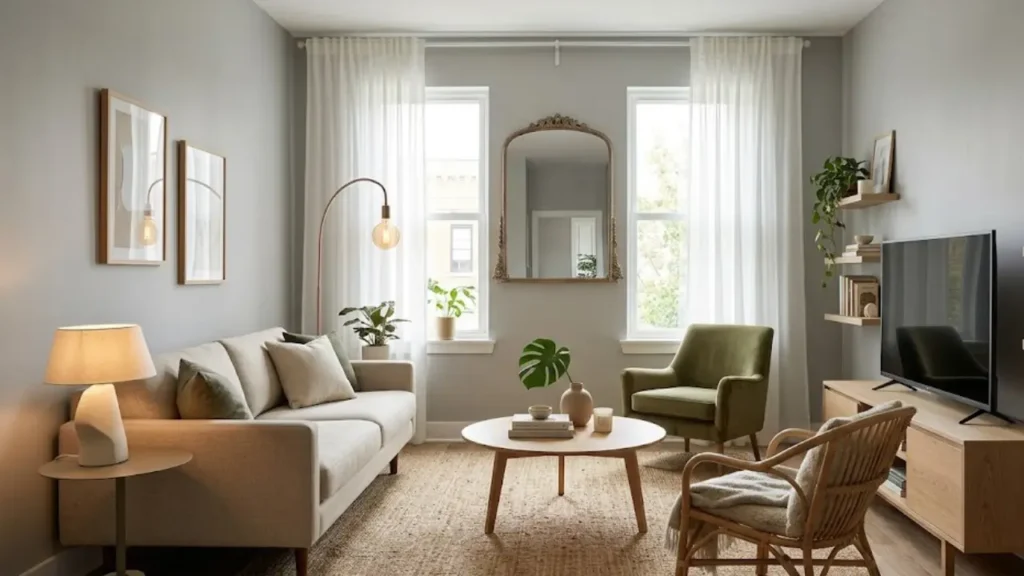

Introduction: Small Living Room Layout Mistakes
Most small living rooms don’t feel small because they’re small. They feel small because of how they’re arranged.
I figured this out in my third apartment, a 10-by-13-foot living room in a city rental that I had convinced myself was just too small to look good. I’d pushed all the furniture against the walls. I’d bought a loveseat instead of a proper sofa to save space. I had a tiny rug in the center and a floor lamp shoved into the corner like an afterthought. The room was always functional, but it never felt right. It felt cramped and awkward no matter what I added to it.
Then I rearranged everything in an afternoon, without buying a single new thing, and the room felt completely different. Bigger. More intentional. Like it had been thought about.
The difference wasn’t the furniture or the square footage. It was the layout decisions I’d been making without realizing they were decisions at all.
If your small living room feels harder to live in than it should, the problem is almost certainly one of the layout mistakes on this list. Some are easy to fix in an afternoon. Some require rethinking a furniture purchase. But all of them are solvable, and identifying them is the first step.
Mistake 1: Pushing All the Furniture Against the Walls
This is the most common small living room layout mistake, and it’s also the one that seems most logical, which is part of why it’s so hard to break out of. If the room is small, push the furniture to the edges and create open space in the center. Makes sense in theory. Almost always backfires in practice.
Here’s why: when furniture is pushed flat against every wall, the room reads as a perimeter with nothing in the middle. The seating looks like it’s waiting for something to happen. The center feels empty and purposeless, not spacious. And the room loses all sense of depth and layering because everything sits on the same plane.
What actually works is floating the furniture. Pull the sofa and chairs a few inches, sometimes as much as a foot or two, away from the wall. This creates a contained seating grouping with actual presence in the room. It looks like a conversation area rather than a waiting room. And the breathing room between the sofa back and the wall creates visual layers that make the room feel more dimensional, not smaller.
The first time you try this it will feel wrong. The sofa will seem like it’s too far out. Give it a few days. Almost everyone who tries floating their furniture in a small room ends up preferring it within a week.
Mistake 2: Buying Furniture That’s Too Small “To Save Space”
This is the logic trap that gets more people than almost any other decorating decision. The room is small, so the furniture should be small. Get a loveseat instead of a sofa. A tiny coffee table. A narrow side table. Petite accent chairs.
The result almost always looks worse, not better.
Small furniture in a small room emphasizes the room’s size. Everything looks shrunken and slightly pathetic, like the furniture is apologizing for being there. A properly scaled sofa in a small room does the opposite. It gives the room confidence. It says this is a living room, not an afterthought.
The rule for small rooms is to choose fewer pieces, not smaller pieces. One well-proportioned sofa and one good chair will almost always look better than a loveseat, two accent chairs, and a side table all competing for attention at the wrong scale.
The exception is depth, not width. A sofa with a shallower seat depth (around 32 to 34 inches rather than the standard 38 to 40 inches) genuinely helps in a small room because it takes up less floor space without shrinking the visual presence. That’s a scale adjustment worth making. Buying furniture that’s too narrow, too short, or too light in visual weight is not.
Mistake 3: Using a Rug That’s Too Small
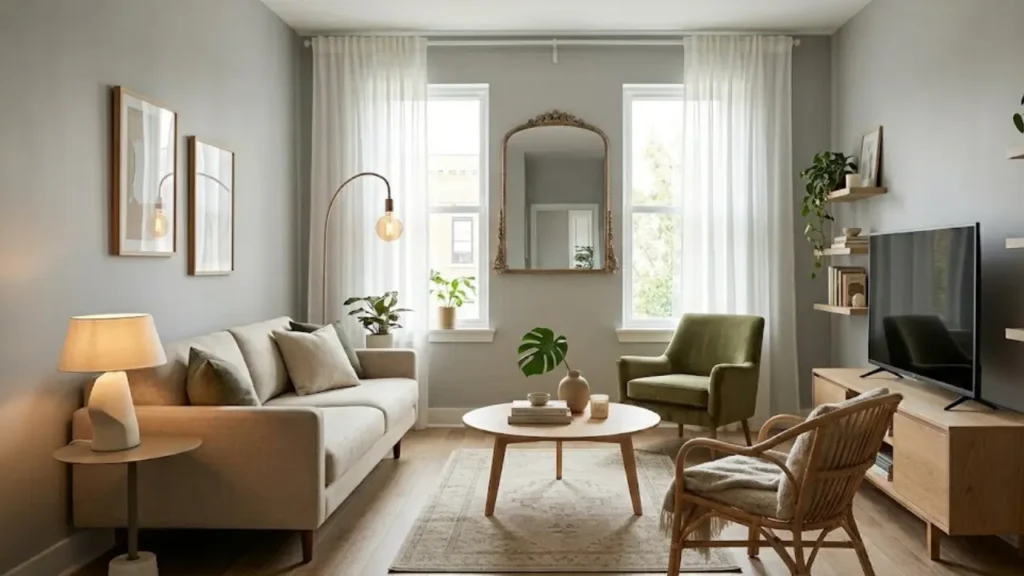
If there’s a single layout mistake that visually shrinks a small living room more than any other, it might be this one.
A rug that’s too small does something specific and damaging to a room’s layout: it cuts the visual connection between furniture pieces. The sofa is on the sofa. The chairs are on the floor. The coffee table is on the rug. Nothing belongs to anything else. The room looks like individual pieces of furniture happened to end up in the same space rather than a designed room.
The rug is the foundation that unifies the seating arrangement. When it’s large enough, everything that sits on or near it becomes part of a coherent grouping. The room has a center of gravity.
For most small living rooms, the rug needs to be an 8-by-10 at minimum. In rooms with enough space, a 9-by-12 is better. The standard used by most designers is to get at least the front two legs of every major seating piece onto the rug. If the budget allows, all four legs on is even cleaner. What doesn’t work is a 5-by-8 or a 4-by-6 floating in the center of the room with all the furniture arranged around it at a distance.
The full breakdown of rug sizing, including what works for different room dimensions and furniture arrangements, is in the guide on how to choose a rug for a small living room. If your rug is currently too small, that’s one of the highest-impact fixes available to you.
Mistake 4: No Clear Focal Point
Every well-designed room has a focal point, which is one element that the layout is organized around. A fireplace. A large window. A significant piece of art. A TV wall with some thoughtful treatment. The furniture arrangement in the room relates back to that focal point. Everything faces it, angles toward it, or is positioned relative to it.
In small living rooms without a natural focal point (and many rentals and apartments don’t have one), people often skip this step entirely. The sofa faces… the other wall. The TV is on a stand in a corner. The art is scattered randomly. The room has no center of gravity, and it shows.
When a room lacks a focal point, furniture arrangement defaults to perimeter parking (mistake number one) because there’s nowhere else obvious to point it. The fix is to create a focal point deliberately. This can be as simple as hanging a large mirror or a significant piece of art on the main wall and then arranging the seating to face it. Once there’s something for the furniture to relate to, the arrangement becomes much more intuitive.
Using mirrors specifically to create focal points is one of the most effective tools in a small living room, because they do double duty: they create a visual anchor AND they expand the perceived space by reflecting light and depth. The guide on how to use mirrors to make a small living room look bigger covers placement and sizing in detail.
Mistake 5: Blocking Natural Traffic Flow
This one is partly a comfort issue and partly a visual one.
Traffic flow is the path people naturally take through a room: from the doorway to the sofa, from the living area to the kitchen, from the entrance to the hallway. In a well-arranged room, this path is clear and intuitive. In a poorly arranged room, people are squeezing past a coffee table corner, stepping around a chair leg, or navigating furniture like an obstacle course.
In small living rooms, where the margin for error is tight, blocked traffic flow is both uncomfortable and visually chaotic. The room looks cluttered even if it isn’t, because the furniture arrangement creates a visual maze.
The standard minimum clearance for a traffic path is 18 inches. 24 to 30 inches is more comfortable. If the path between your sofa and coffee table, or between furniture and the wall, is less than 18 inches, the arrangement needs to change. Either the coffee table needs to move, the sofa needs to shift, or one piece of furniture may need to come out of the room entirely.
Walk through your room as if you’re arriving home for the first time. If you’re naturally angling your body or holding your breath as you pass through, the traffic flow is blocked.
Mistake 6: Putting the TV in the Wrong Place
Television placement is one of the most contentious decisions in living room layout, and in small rooms it causes more problems than almost any other single element.
The most common mistake is putting the TV in the corner. Corner placement seems like a space-saving solution, but it almost always creates viewing angles that are uncomfortable for some seating positions, forces the remaining furniture into awkward arrangements, and creates a dead zone in the corner itself that’s hard to style or use.
The second most common mistake is mounting the TV too high. The standard recommendation from most home theater experts is that the center of the screen should be at roughly seated eye level, around 42 to 48 inches from the floor depending on the height of your seating. Mounting it higher, often done because it “looks like a museum display,” means tilting your neck upward for every viewing session. Over time, this is physically uncomfortable and it also pushes the visual weight of the TV toward the ceiling rather than keeping it grounded with the rest of the room.
In a small living room, the TV works best on the main wall opposite the primary seating. This creates a natural focal point, keeps viewing angles comfortable for everyone in the room, and allows the furniture arrangement to make sense relative to both the conversation area and the screen.
If you’re trying to hide the TV or minimize its visual impact, consider a media cabinet that can be closed when the TV isn’t in use, or a gallery wall treatment around a wall-mounted screen that integrates it into the room’s design rather than letting it dominate.
Mistake 7: Ignoring Vertical Space
Small rooms have limited floor space, but they have exactly as much vertical space as larger rooms. Most people in small living rooms decorate as if the room ends at five feet.
Low furniture, low art placement, low shelving, nothing that draws the eye upward. The room ends up feeling compressed because all the visual interest is happening in a narrow horizontal band. The ceiling is ignored. The space above eye level is wasted.
Using vertical space doesn’t mean stacking things dangerously high. It means thinking deliberately about the full height of the room.
Curtains hung close to the ceiling rather than just above the window frame draw the eye upward and make the ceiling feel higher. Tall bookshelves or shelving units that run floor to ceiling make the room feel taller and provide storage without using additional floor space. Art hung slightly higher than feels instinctively comfortable (with the center of the piece at 57 to 60 inches rather than the usual lower placement) gives the room more breathing room below the art.
In a small living room where every square foot counts, vertical space is free real estate. Using it deliberately is one of the most effective ways to shift the perceived proportions of the room.
Mistake 8: Too Many Pieces of Furniture
This is the hardest mistake for people to accept because it often means acknowledging that something they own needs to go.
Small living rooms are almost always over-furnished. Not because people bought bad furniture, but because each piece seemed reasonable on its own and nobody stepped back to consider the cumulative effect. A sofa plus a loveseat plus three accent chairs plus an oversized coffee table plus two side tables plus a console table is too much furniture for a 12-by-14-foot room. Even if every individual piece is beautiful.
Too much furniture creates two specific problems in small rooms. The first is blocked traffic flow, covered above. The second is visual noise. When there are too many furniture pieces, the eye has nowhere to rest. The room looks chaotic and cramped, not because it’s small but because it’s too full.
The edit is straightforward in principle and difficult in practice: remove furniture until the room starts to breathe. For most small living rooms, the right number of seating pieces is one sofa and one or two accent chairs. One coffee table. One or two side tables at most. Everything else should earn its place or find a different room.
If your room currently has a piece of furniture that you keep bumping into, can never quite seem to style well, or that makes it hard to move around comfortably, that’s a signal. The room is telling you something needs to leave.
Mistake 9: Matching Furniture Set (All From the Same Collection)
This isn’t strictly a layout mistake, but it affects the way a small living room reads so significantly that it belongs on this list.
A perfectly matched furniture set, where the sofa, loveseat, coffee table, and side tables all came from the same collection, tends to look like a showroom display rather than a designed room. Everything is the same age, the same finish, the same visual language. The room looks like it was purchased as a package, not curated over time. And package furniture tends to look exactly as budget as it usually is.
In small living rooms specifically, matching sets also have a layout problem: they’re almost always designed for a generic room size, not your specific room. The coffee table in the set may be too big. The side tables may be the wrong height for your sofa. The loveseat may be the wrong scale.
Mixing pieces from different sources, a sofa from one place, a coffee table found secondhand, accent chairs from a different retailer, forces you to make deliberate choices about scale, proportion, and visual weight. The result looks more considered and more expensive than a matched set, even if the individual pieces cost less.
Mistake 10: No Layered Lighting
Layout isn’t only about furniture placement. It includes lighting, because the way a room is lit determines how the layout reads after dark. And most living rooms are used heavily in the evening.
The most common lighting mistake in small living rooms is relying entirely on overhead lighting. A single ceiling fixture, whether recessed or flush-mount, lights the room from above and creates a flat, even illumination that removes shadow and depth. This makes the furniture arrangement read as flatter and the room feel more compressed than it actually is.
Layered lighting, which means combining ambient light from above with task light from a floor or table lamp and accent light from something directional, creates zones of light and shadow that give a room dimension. The sofa area glows under a table lamp. The corner comes alive with a floor lamp. These pools of light make the room feel larger and more intentional.
In a small living room, you don’t need many light sources. Two or three well-placed lamps in addition to the overhead fixture is usually enough to transform how the space reads in the evening. The investment is low and the impact is immediate.
For more on how lighting connects with the overall look and feel of a styled small room, the guide on how to make a small living room look expensive covers the layered lighting approach in detail, along with other high-impact styling decisions.
How to Audit Your Own Small Living Room Layout
Reading a list of mistakes is useful. Knowing how to apply it to your specific room is more useful. Here’s a simple audit you can do in about 15 minutes.
Step 1: Take a photo from the doorway.
Stand at the main entrance to your living room and take a photo with your phone. Then look at the photo rather than the room. The camera removes the bias of familiarity. You’ll notice things in the photo that you’ve stopped seeing in person: the sofa pushed too close to the wall, the rug that’s clearly too small, the corner that’s too dark.
Step 2: Check the traffic paths.
Walk from the entrance to each seating position. Walk from the seating to the most common exit point. Are you navigating around furniture? Is any path less than 18 inches wide? Mark mentally which pieces are creating the obstruction.
Step 3: Count the furniture pieces.
List everything in the room that has legs. Every piece of seating, every table, every storage unit. If the total is more than seven or eight pieces in a room under 180 square feet, the room is likely over-furnished.
Step 4: Identify the focal point.
Where does your eye naturally go when you walk in? If the answer is “nowhere in particular” or “the blank wall,” the room needs a focal point. If the answer is “the TV perched in the corner,” the focal point needs to move.
Step 5: Stand in the corner and look up.
Look at the vertical space. Is there anything happening above five feet? Are the curtain rods mounted high? Is there art or shelving that reaches toward the ceiling? If everything is happening below eye level, the room has untapped vertical potential.
The Easiest Layout Fixes (That Cost Nothing)
Not every layout mistake requires a furniture purchase to fix. Some of the highest-impact changes in a small living room are completely free.
Pull the sofa away from the wall. Even six inches makes a difference. Try 12 to 18 inches and see if the room immediately feels more intentional.
Rearrange to create a conversation area. Turn accent chairs so they face the sofa rather than sitting parallel to the walls. Create a seating arrangement where people can comfortably look at each other, not just at the same wall.
Move the rug. If the rug is centered in the room rather than under the seating, pull it forward so the furniture connects to it. This single change can transform the way the seating arrangement reads.
Raise the art. Take down whatever is on the walls and rehang it two to four inches higher. The room will immediately feel taller.
Clear the coffee table. Remove everything from the coffee table and add back only two or three objects in a deliberate grouping. The room will feel less cluttered and the furniture arrangement will be easier to see clearly.
Turn off the overhead light. Plug in whatever lamps you have and turn off the ceiling fixture for an evening. See how the room reads with layered light. If it looks significantly better, that’s a signal to invest in better lamp placement.
When the Layout Is Right: What a Well-Arranged Small Living Room Feels Like
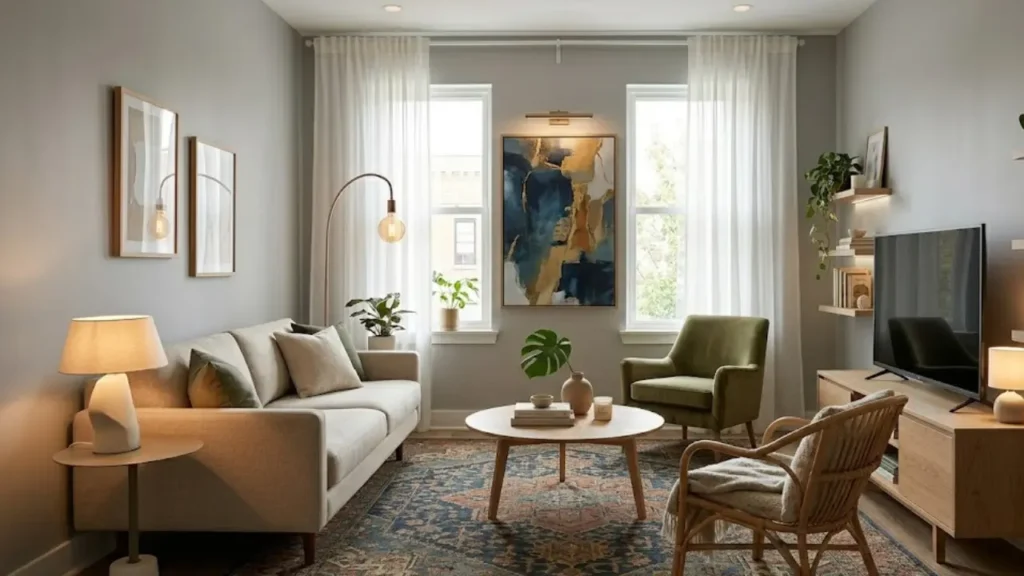
It’s worth describing the goal, not just the mistakes.
A well-arranged small living room feels intentional from the moment you walk in. There’s a clear place to sit and a clear reason for the arrangement. Movement through the room is easy and natural. The eye has a focal point to land on and then travels comfortably through the rest of the space. There’s breathing room between the furniture pieces, not because the room is sparsely furnished, but because the pieces that are there are chosen and placed deliberately.
The furniture feels like it belongs to the room rather than having been placed in it by circumstance. The rug anchors the seating area. The lighting makes the room feel warm and dimensional after dark. There’s vertical interest that makes the ceiling feel further away.
None of that requires a large room. It requires good decisions.
If you’re starting from scratch with a small living room and want a broader overview of how all these elements, furniture, rugs, color, storage, and lighting, work together in a small space, the guide on small apartment living room ideas covers the full picture with specific ideas for rooms under 200 square feet. And if the clutter problem feels like it’s the root issue, the guide on how to decorate a small living room without clutter is a good starting point for the editing process.
The Bottom Line: Small Living Room Layout Mistakes
The layout mistakes on this list are all fixable. Most of them don’t require buying anything new. They require rethinking assumptions that feel logical but work against the room: that small furniture saves space, that furniture belongs against the walls, that a small rug is fine, that the corner is a good place for the TV.
Start with the easiest fix available to you right now. Pull the sofa away from the wall. Move the rug forward. Hang a piece of art as a focal point. Turn on a lamp and turn off the overhead light.
Small changes in a small room have outsized effects. The room you have is probably better than you think. It just needs its layout rethought.


Pingback: Best Coffee Table Shapes for Small Living Rooms
Pingback: How to Arrange Furniture in a Small Living Room: 7 Ways
Pingback: 15 Proven Small Living Room Layout Ideas
Pingback: How to Make a Small Apartment Feel Bigger: 18 Proven Ways
Pingback: How to Make a Small Living Room Look Expensive on a Budget