
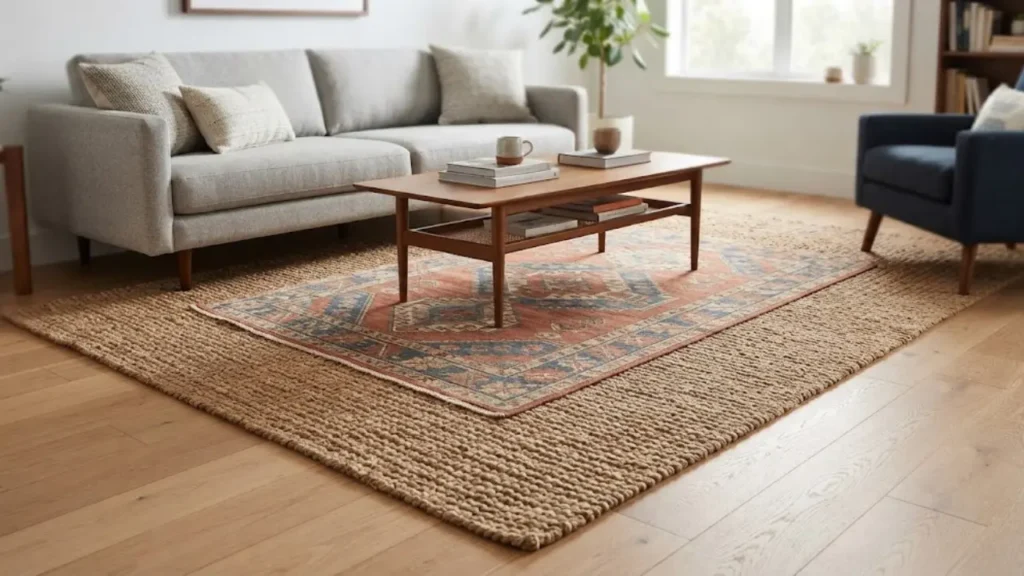

Layering rugs in a living room looks effortless when it’s done well and immediately obvious when it isn’t. The difference between a layered rug combination that looks intentional and one that looks like two rugs that both missed the trash pile comes down to a handful of specific decisions about sizing, texture, color, and placement that most guides either skip or bury in vague advice about “trusting your eye.”
This guide doesn’t do that. These 10 tips are specific, practical, and based on the actual principles that make rug layering work visually, along with honest notes on the common mistakes that derail the technique even when the individual rugs are attractive on their own.
Why Layering Rugs Works (When It Does)
The reason layering rugs in a living room became a popular technique isn’t purely aesthetic. It solves a practical problem: a single area rug, even a large one, often can’t anchor a living room’s seating area as effectively as two rugs used together, especially in rooms with irregular shapes, open-plan layouts, or furniture groupings that don’t fit neatly into standard rug proportions.
The visual logic is that the base rug defines the territory and the accent rug on top adds detail, texture, and color interest within that territory. When both rugs are right for each other and for the room, the combination feels layered in the same way a styled outfit feels layered: each element visible, each element contributing something the other doesn’t, and the overall effect richer than either piece alone.
When the combination doesn’t work, it’s almost always because one of a few specific principles was ignored. Those principles are what these 10 tips are built around.
1. Always Start With a Large, Neutral Base Rug
The foundation of any layered rug combination in a living room is a large base rug in a neutral, low-pattern material. This rug anchors the seating area the same way a single rug would, with the front legs of the sofa and chairs resting on it, and it provides the visual ground that the accent rug sits on top of.
The most common mistake when layering rugs in a living room is starting with two equally patterned or equally colorful rugs and expecting them to work together. They almost never do, because neither has enough visual quiet to let the other register clearly. The base rug needs to recede and the accent rug needs to advance, which requires the base to be significantly simpler and more neutral than the top layer.
Natural fiber rugs in jute, sisal, or seagrass are the most popular base rug choice for layering because their texture adds warmth and organic depth while their color (usually a warm natural beige or tan) is neutral enough to work beneath almost any accent rug. They’re also typically less expensive than decorative rugs, which makes them a practical choice for a piece that will be partially covered.
The sizing of the base rug follows the same principle as any living room rug: large enough for the front legs of all seating pieces to rest on it. The specific sizing logic for different seating configurations, including sectionals and L-shaped arrangements, is covered in this guide to choosing a rug for a small living room.
A large jute area rug in a natural or bleached tone is the most versatile starting point for layering — it works beneath almost any accent rug style, adds organic texture to the floor plane, and is typically less expensive than a decorative rug of the same size, which makes it a practical foundation to build on.
2. Choose an Accent Rug That’s Noticeably Smaller
The accent rug should be significantly smaller than the base rug, typically about half to two-thirds the size, so the base rug is clearly visible around all edges of the accent. When the two rugs are too close in size, the base rug’s edge is barely visible and the combination looks like one rug that’s slightly askew rather than an intentional layering choice.
A common and visually successful pairing: an 8×10 or 9×12 base rug with a 4×6 or 5×7 accent rug centered on top of it. The base rug’s perimeter remains clearly visible on all sides, which establishes the layering as intentional rather than accidental.
The accent rug’s placement within the base rug matters too. Centered looks formal and works well in symmetrical room arrangements. Slightly offset toward the coffee table end of the seating area looks more casual and works well in eclectic or layered-aesthetic rooms. What doesn’t work: placing the accent rug so close to one edge of the base that it looks like it slipped rather than was placed.
3. Contrast the Textures, Not Just the Colors
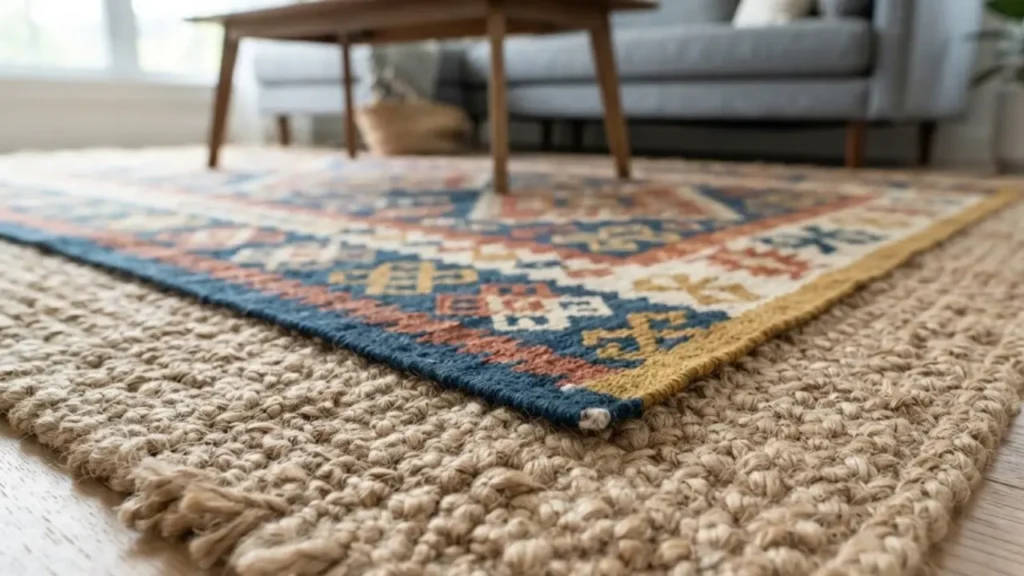
The most visually successful rug layering combinations work because of texture contrast as much as color contrast. A flat-weave or low-pile accent rug on top of a shaggy or high-pile base rug looks muddled and unresolved, because both surfaces compete at the same visual level. A flat-weave or medium-pile accent rug on top of a natural fiber base rug with visible texture reads clearly as two distinct layers.
The texture pairing that works most consistently: a smooth or low-pile accent rug (kilim, dhurrie, flat-weave wool) on top of a natural fiber base (jute, sisal, seagrass). The natural fiber’s visible texture recedes slightly under the smoother surface of the accent rug, which makes the layering feel intentional and easy to read from a distance.
High-pile or shaggy rugs work best as accent rugs on top of very flat bases, like a natural sisal or a tightly woven flatweave. The height difference between the two surfaces then reads as the visual distinction, which works well for adding warmth and softness to a room without covering the base rug’s pattern entirely.
4. Use Color to Create Relationship, Not Contrast
Two rugs that have no color relationship to each other tend to look like an accident even when the layering technique is otherwise correct. The accent rug should pick up at least one color from the base rug or from the broader room palette, which creates a visual thread that connects the two layers rather than making them compete.
The relationship doesn’t need to be a direct match. A jute base rug in warm tan paired with an accent rug in terracotta, rust, or burnt orange creates a warm-toned color family that reads as intentional. The same jute base paired with a cool-toned blue or green accent rug creates more contrast but still works if blue or green appears elsewhere in the room (a throw pillow, a piece of art, a plant pot) to connect the accent rug to the broader palette.
What doesn’t work: an accent rug in a color that appears nowhere else in the room, floating visually on top of the base with no connection to anything around it. This is the same color cohesion principle that makes the broader living room palette work when it’s right and feel disjointed when it isn’t. The relationship between sofa color and the rug palette around it is something worth thinking through carefully, and this guide to what color rug goes with a grey couch covers the specific color pairing logic that applies whether you’re using a single rug or layering two.
5. Be Careful With Pattern Mixing
Layering two patterned rugs is the highest-risk version of the technique. It can look incredibly considered when it works, and immediately chaotic when it doesn’t. The principle that makes it work: the two patterns should be at different scales, with one significantly larger or more detailed than the other.
A large-scale geometric accent rug (bold shapes, clear lines, limited color) on top of a small, dense base pattern (a tightly woven kilim or a subtle stripe) reads as intentional because the eye can distinguish each pattern clearly. Two rugs with similarly-scaled patterns compete with each other and create visual noise that makes the room feel restless.
The safer approach for anyone new to rug layering in a living room: one solid or near-solid accent rug on top of a textured but essentially neutral base. The texture of the base provides visual interest, the solid accent provides color and definition, and neither competes with the other for attention.
6. Consider How the Layered Rugs Interact With the Furniture
The placement of the two rugs relative to the furniture in the room matters as much as the rugs themselves. The base rug anchors the seating area with the front legs of the sofa and chairs on it. The accent rug should sit underneath the coffee table and extend past it on at least two sides, which makes the coffee table feel like it belongs within the layered zone rather than floating on top of it.
When the accent rug is too small to extend past the coffee table’s edges, the coffee table looks like it’s sitting on an undersized mat rather than occupying a defined zone within the larger seating area. The coffee table size relative to the rug beneath it follows the same proportional logic as the rug-to-seating relationship: the rug should be noticeably larger than the table footprint, not just barely larger.
The relationship between the coffee table’s shape and size and the overall living room layout is something that affects how rugs work within the arrangement too. This breakdown of coffee table shapes for small living rooms covers the proportional principles that apply whether the rug situation is single or layered.
7. Match the Layering Approach to the Room’s Style
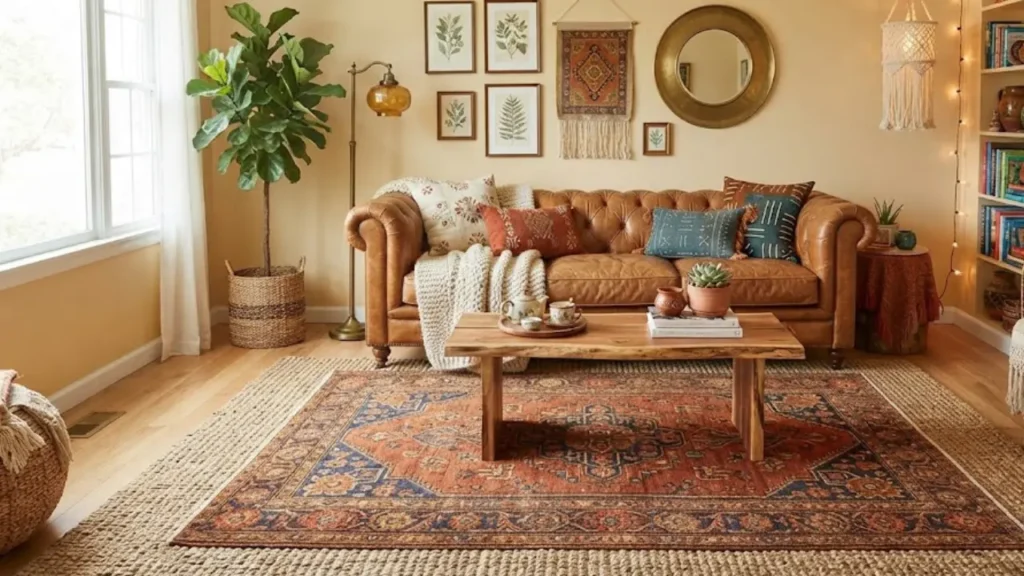
The layered rug technique reads differently depending on the room’s overall aesthetic, and the specific combination of rugs should reflect that context.
In a warm, eclectic, or bohemian living room, a vintage kilim or a Moroccan-style accent rug on top of a jute base is one of the most natural-looking layering combinations available. The mix of handmade-looking textures and warm colors fits the aesthetic without looking like a deliberate styling exercise.
In a neutral, minimal living room, the layering needs to be more restrained. A low-contrast combination, a cream or off-white flatweave on a natural jute base, adds subtle texture depth without introducing visual complexity that would feel at odds with the room’s quieter palette.
In a living room with a strong furniture color, like a brown leather sofa or a deep-toned velvet couch, the layered rugs should either complement or neutralize the furniture’s color statement rather than compete with it. A warm-toned leather sofa benefits from a layered combination that extends those warm tones into the floor plane. This guide to decorating a living room with a brown sofa covers the broader color relationships that determine what works around a strong-toned furniture anchor, and those same relationships apply directly to choosing rug combinations.
8. Avoid These Common Layering Mistakes
Knowing what doesn’t work when layering rugs in a living room is as useful as knowing what does. These are the mistakes that show up most consistently.
Two rugs too close in size. When the base rug and accent rug are nearly the same dimensions, the combination looks like one rug that doesn’t quite fit rather than a deliberate layered choice. The size difference should be significant enough that both rugs are clearly distinct.
An accent rug that floats off-center. The accent rug needs to be placed deliberately within the base rug, either centered or intentionally offset, rather than landing wherever it happened to end up. An accent rug that’s slightly crooked or accidentally off-center makes the whole combination look unfinished.
Ignoring the direction of pile. Both rugs should generally have their pile running in the same direction, or the surface will catch light differently in different spots and look patchy rather than layered.
A base rug that’s too small. The foundation principle of layering rugs in a living room requires the base rug to be properly sized for the seating area first. A base rug that’s already undersized doesn’t become adequate just because something is placed on top of it. The most consistent rug sizing mistakes, and the correct approach for different room configurations, are documented in this guide to common living room rug mistakes.
9. Think About Maintenance Practically
Two rugs layered on top of each other are more difficult to clean than a single rug, and the base rug accumulates debris underneath the accent rug that’s invisible until you move it. Building a maintenance approach into the decision from the start prevents the combination from becoming impractical to keep clean.
Vacuuming a layered rug setup requires lifting the accent rug periodically to vacuum both surfaces and the floor beneath them. Natural fiber base rugs are more difficult to spot-clean than synthetic or wool alternatives, so placing a natural fiber rug in a high-traffic living room with children or pets is worth thinking through before committing.
Low-pile and flat-weave accent rugs are easier to clean than shaggy or high-pile versions, both because they don’t trap as much debris and because they lie flatter against the base rug without creating pockets between the two surfaces. In a room where maintenance practicality matters, prioritizing flat-weave accents keeps the technique workable for daily living rather than just for occasional styling.
10. Use Layering to Solve Specific Room Problems
Beyond the aesthetic value, layering rugs in a living room is genuinely useful for solving practical layout problems that a single rug can’t address as effectively.
In a large or oddly shaped room where one rug can’t anchor the full seating area without being impractically large, a large base rug that covers the territory plus a smaller accent rug that defines the primary conversation zone gives the room both coverage and visual focus.
In an open-plan layout where the living area needs to be visually defined against the kitchen or dining area, a layered rug combination in the living zone creates a more emphatic visual boundary than a single rug, because the layered look reads as “this area is deliberately designed” in a way that helps it hold its own against adjacent spaces.
In a room where the existing rug is fine but boring, adding a smaller accent rug on top is a lower-cost way to add visual interest without replacing the base rug entirely. This is particularly useful in rentals where the existing flooring or an already-purchased rug limits what’s practical to change.
The rental-specific version of this, where layering rugs can transform a room that can’t otherwise be easily altered, connects to the broader strategies for making a rented living space feel genuinely personal without permanent modification. Both how to make a rental apartment feel like home and decorating a rental apartment on a budget cover the approach from slightly different angles, with rug layering fitting naturally into the non-permanent modification category.
How Layered Rugs Fit Into the Broader Living Room
A layered rug combination doesn’t exist in isolation. It affects and is affected by every other element in the room around it, from the sofa color to the wall color to the amount of natural light the room receives.
In rooms that feel dark or small, the base rug’s color has a more significant effect on perceived brightness than most people expect. A dark natural fiber base rug in a room with limited light can make the floor plane feel heavy and compress the room visually. A light jute or a cream flatweave base keeps the floor plane bright and open, which works with the room’s natural light rather than against it. The relationship between floor color, wall color, and perceived room size is something this breakdown of the best wall colors for small living rooms addresses from the wall side, and the same principle applies at the floor level.
The sofa color is probably the single strongest influence on what rug combination will work in a specific room. A neutral sofa gives the most flexibility for rug color choices, since the floor palette doesn’t need to navigate around a strong furniture tone. The specific color relationships between sofa and rug for one of the most common combinations, a grey sofa in a neutral room, are covered in detail in this guide to what color rug works with a grey couch.
Beyond the rug itself, the placement of furniture on a layered rug setup follows the same rules as furniture on a single rug: the front legs of the sofa and all chairs in the seating group sit on the base rug, and the coffee table sits within the accent rug zone. The full furniture placement logic for small living rooms, including how the rug anchors the seating area relative to traffic pathways, is in this furniture arrangement guide for small living rooms.
In terms of the room’s overall feel, a layered rug adds warmth and texture in a way that contributes to the same effect a well-styled bedroom achieves through layered bedding and textiles. The warmth that comes from layered textiles at the floor level in a living room is the floor-level equivalent of what a layered throw and multiple cushion textures do in a bedroom. This guide to making a bedroom feel cozy on a real budget covers the textile layering approach for bedrooms specifically, and the same underlying warmth-through-texture principle applies in a living room.
Putting It Together
Layering rugs in a living room works when the base rug is large and neutral, the accent rug is noticeably smaller and more detailed, the textures contrast clearly, the colors share at least one connecting thread, and the whole combination is placed deliberately relative to the furniture rather than positioned approximately.
It doesn’t work when two similarly-sized or similarly-patterned rugs are placed on top of each other without thought to how they relate, or when the base rug is already undersized and the layering is expected to compensate for that.
The technique is more forgiving than it looks once you understand the underlying principles, and the result, when it works, adds a level of warmth and visual richness to a living room that a single rug rarely achieves on its own.
For anyone building a living room from the floor up and trying to understand how all these rug decisions fit into a complete small space approach, this collection of small apartment living room ideas shows how rug choices function within complete, styled living room setups across different apartment sizes and aesthetics.
FAQ: How to Layer Rugs in a Living Room
How do you layer rugs in a living room?
Start with a large, neutral base rug sized to anchor the full seating area, with the front legs of the sofa and all chairs resting on it. Place a noticeably smaller accent rug on top, centered under the coffee table or slightly offset toward the seating. The base rug should be significantly simpler in color and pattern than the accent, and the textures of the two should contrast clearly so both layers read as distinct.
What size should the accent rug be when layering?
The accent rug should be roughly half to two-thirds the size of the base rug. This keeps the base rug’s perimeter visible on all sides, which establishes the layering as intentional rather than accidental. For a common 8×10 base rug, a 4×6 or 5×7 accent rug works well in most living room configurations.
What type of rug works best as a base for layering?
Natural fiber rugs in jute, sisal, or seagrass are the most popular and most practical base rug choices. They’re neutral enough in color to work beneath almost any accent, their visible texture adds warmth without competing with the accent rug’s pattern or color, and they’re typically less expensive than decorative rugs, making them a practical foundation piece.
Can you layer two patterned rugs?
Yes, but it requires the two patterns to be at significantly different scales. A large, bold geometric accent on top of a small, dense pattern (or vice versa) works because the eye can distinguish each pattern clearly. Two similarly-scaled patterns create visual competition that reads as chaotic rather than layered. For most people new to rug layering, starting with one patterned accent on a solid or near-solid base produces more consistent results.
Does layering rugs make a small living room look smaller?
Not when done correctly. A well-layered rug combination with a light-toned base rug and a properly sized accent can actually make a small living room feel more defined and considered, which reads as more spacious than an undersized single rug floating in the middle of the floor. The key is keeping the base rug light in tone and large enough to properly anchor the seating area.