


Most people rearrange their small living room furniture the same way, twice, and then give up and leave it where it landed. I’ve been there. You shove the sofa against the wall thinking it’ll create space, but the room still feels cramped. You try floating the chairs, and now nobody can walk to the kitchen without doing a sideways shuffle.
Here’s the thing nobody tells you upfront: the problem usually isn’t the furniture itself. It’s the invisible pathways — the routes people naturally take through the room — that get sacrificed first. Block those, and no matter how nice your sofa looks, the room is going to feel off every single day.
I’ve rearranged my own living room more times than I care to admit, and I’ve learned that furniture arrangement in a small space is less about aesthetics and more about geometry. Once you understand a few simple rules about clearance, focal points, and how people actually move through a room, it gets a whole lot easier — and the results last.
This guide covers everything: how to identify your traffic flow before you move a single piece of furniture, which clearance measurements actually matter, how to create a real conversation area that doesn’t eat up all your walkable space, and the specific mistakes that are silently making your room feel smaller than it is. Let’s get into it.
Understanding Traffic Flow Before You Move Anything
This is the step almost everyone skips, and it’s the reason most furniture arrangements fail in small living rooms.
Traffic flow refers to the natural pathways people take through a space. In a living room, that usually means at least two or three routes: from the entryway to the kitchen or hallway, from the seating area to the TV or fireplace, and from the sofa to wherever people grab their coffee or set down a book. In a small room, these paths overlap — and if your furniture is sitting in the middle of any of them, the whole space feels chaotic.
How to Map Your Traffic Paths
Before rearranging anything, stand in the doorway and think about where your feet naturally go. Then walk through the room the way you actually use it — not the “company’s coming” version, but the everyday version. Where do you walk to grab the remote? Where do guests naturally drift when they come in?
Grab a piece of paper and sketch a rough floor plan. Mark the doors, windows, and any architectural features you can’t move (like a fireplace or built-in shelf). Then draw arrows showing the paths you just identified. Those arrow lines? Nothing should sit on top of them. That’s your non-negotiable starting point.
The Two Types of Traffic Paths
There are two kinds of pathways to protect in a living room:
Primary pathways are the ones people use every single time — the route from the front door to the kitchen, or the path from the seating area to the hallway leading to bedrooms. These need 36 inches of clearance minimum. That’s the interior design standard, and it exists for a good reason: it’s wide enough for two people to pass comfortably without turning sideways.
Secondary pathways are the routes used occasionally — reaching around a chair to open a window, or walking behind the sofa to get to the far side of the room. These can be narrower, but never less than 24 inches. Anything under two feet starts feeling like you’re squeezing, which reads psychologically as “this room is too small.”
Once you know where your paths are and how wide they need to be, every furniture placement decision gets clearer. You’re not just arranging furniture — you’re designing around the invisible architecture of movement.
The Anchor Piece Rule: Start With Your Sofa
In almost every living room — small or large — the sofa is the anchor piece. It’s the biggest item, it’s the visual starting point, and every other furniture decision flows from where it lands. If you get the sofa placement right, the rest of the room usually falls into place.
The Biggest Myth: Sofas Against the Wall
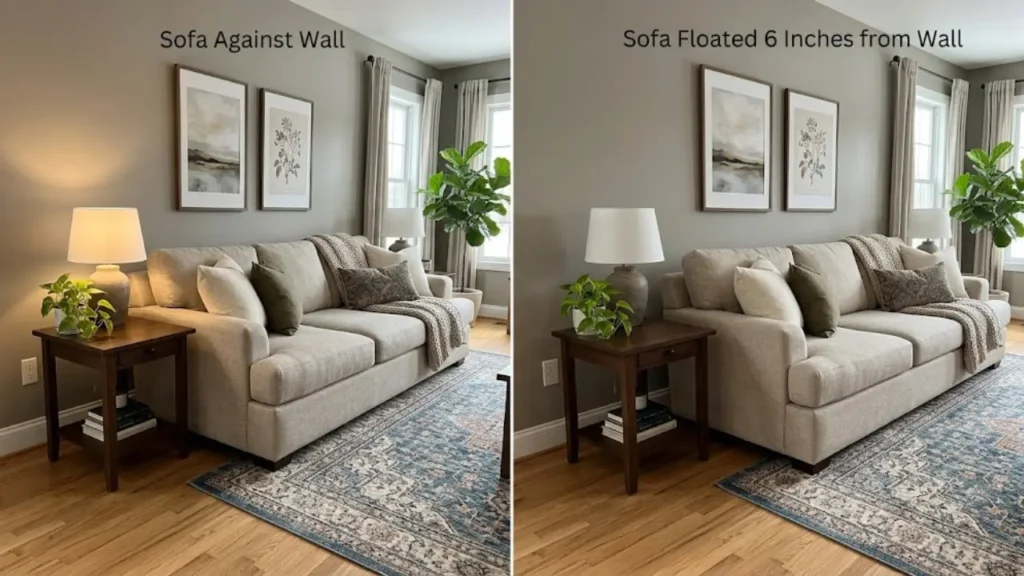
When a room is small, the instinct is to push the sofa flat against the wall to “save space.” It feels logical. But in practice, it often backfires.
Here’s why: when every piece of furniture is pinned to a wall, the center of the room becomes a big, empty, awkward gap. There’s nothing anchoring the seating area together. People sit far apart from each other. The room feels like a waiting room — technically functional, emotionally cold, and weirdly un-cozy.
The fix is called floating your furniture, which just means pulling pieces a few inches — or even a foot — away from the wall. In a genuinely small room, even 4–6 inches of breathing room behind the sofa changes how the whole space reads. It creates depth. It signals that the room was intentionally designed, not just stuffed with pieces.
If your room is truly tiny and you can’t float your sofa, that’s okay — but pair it with an approach I’ll cover in the conversation area section below to compensate.
Where the Sofa Should Face
Your sofa should face your room’s focal point — typically the TV, a fireplace, or a large window with a view. That focal point becomes the organizing principle for the whole arrangement. Everything faces in, toward it. This creates visual cohesion even in a tight space.
If you don’t have a clear focal point, create one. A gallery wall, a large mirror, or a well-styled console can all serve as a focal anchor. The sofa faces that. The chairs respond to the sofa. The coffee table sits in between. This hierarchy keeps small rooms from feeling like furniture was just dropped in randomly.
For more on the color relationship between your sofa and the rest of the room — which affects how visually “heavy” the arrangement feels — the guide on best couch colors for small living rooms breaks it down by room size and natural light.
Clearance Measurements That Actually Matter
Let me give you the numbers that interior designers actually use. These aren’t vague approximations — they’re the specific measurements that separate a room that functions well from one that feels constantly frustrating.
Coffee Table Clearance
The coffee table should sit 14–18 inches from the sofa. Any closer and you’re banging your knees every time you reach for a drink. Any further and the table feels disconnected from the seating, and people have to lean uncomfortably to set things down.
In a small room, if 18 inches feels like too much, you can go down to 12 inches and compensate with a smaller or lower table. What you should never do is remove the coffee table entirely just to save floor space — it acts as a visual anchor for the seating area and makes the arrangement feel intentional. If space is really tight, consider a nesting table set or an ottoman with a tray instead of a traditional coffee table.
Chair-to-Sofa Distance
For a functioning conversation area, chairs should sit 3–4 feet from the sofa (measuring from seat edge to seat edge). This is the distance at which two people can comfortably talk without feeling like they’re shouting or whispering. Go beyond 4 feet and the conversation area stops feeling like a conversation area — people drift back to the sofa.
In a small room, 3 feet often isn’t possible with full-size armchairs. This is where accent chairs earn their place. A pair of smaller chairs — or even one well-placed chair — can complete a conversation area in a fraction of the floor space a second sofa would require.
TV Viewing Distance
If your TV is part of the layout (and in most living rooms, it is), there’s an optimal viewing distance based on screen size. A rough rule: for every 10 inches of TV screen size, sit about 1 foot away. So a 50-inch TV works well at 5 feet of viewing distance; a 65-inch TV at 6.5 feet.
In a small room, this often means the room is dictating your TV size as much as your TV is dictating your layout. If your room is 10 feet deep and your furniture arrangement naturally creates a seating distance of 7 feet, your ideal TV size is somewhere in the 65–70 inch range — not a massive screen you think you “should” have.
Walkway Clearance Recap
- Primary walkways (main traffic routes): 36 inches minimum
- Secondary walkways (occasional access): 24 inches minimum
- Between furniture pieces in a seating grouping: 12–18 inches (enough to reach and retrieve things comfortably)
- Around dining tables (if your living room doubles as a dining area): 36 inches to pull out chairs, 24 inches on the non-chair side
These aren’t vague approximations — they’re the specific measurements that align with standard interior design clearance guidelines and separate a room that functions well from one that feels constantly frustrating.
Creating a Conversation Area That Doesn’t Eat Your Whole Room
A conversation area is just a grouping of seats arranged so people can actually talk — close enough to hear each other easily, oriented toward each other rather than all facing a TV. In a large room, you might have two conversation areas. In a small room, your whole living room usually is your conversation area, which means getting the grouping right is even more important.
The U-Shape, L-Shape, and Parallel Arrangement
U-shape: A sofa facing the focal point, two chairs angled in from either side. This is the most intimate arrangement for conversation and works beautifully when the TV or fireplace is centered. The chairs don’t have to be identical — an armchair on one side and a small loveseat on the other reads as eclectic and intentional.
L-shape: A sofa on one wall and a single chair or loveseat on the adjacent wall, forming an L. This works well in awkwardly shaped rooms or when one wall is interrupted by a door or window. The L-shape naturally creates flow because the open end of the L allows traffic through without crossing the seating area.
Parallel arrangement: Two sofas or a sofa and a loveseat facing each other, with a coffee table between them. This is actually very space-efficient for small rooms because both seating pieces run parallel to the walls. It’s formal in feel, which can be a negative or a positive depending on your style.
For a small room, the L-shape is usually the most traffic-friendly because it tucks seating into a corner and keeps one or two sides completely open for movement. The U-shape works if your room is at least 10–12 feet wide; narrower than that and you’ll struggle to hit the conversation distance of 3–4 feet without blocking traffic.
If you’re dealing with layout challenges specific to your room’s proportions — narrow rooms, awkward corners, or open-plan spaces — the article on small living room layout mistakes covers the exact errors people make with each of these arrangements and how to correct them.
Rugs as Layout Anchors
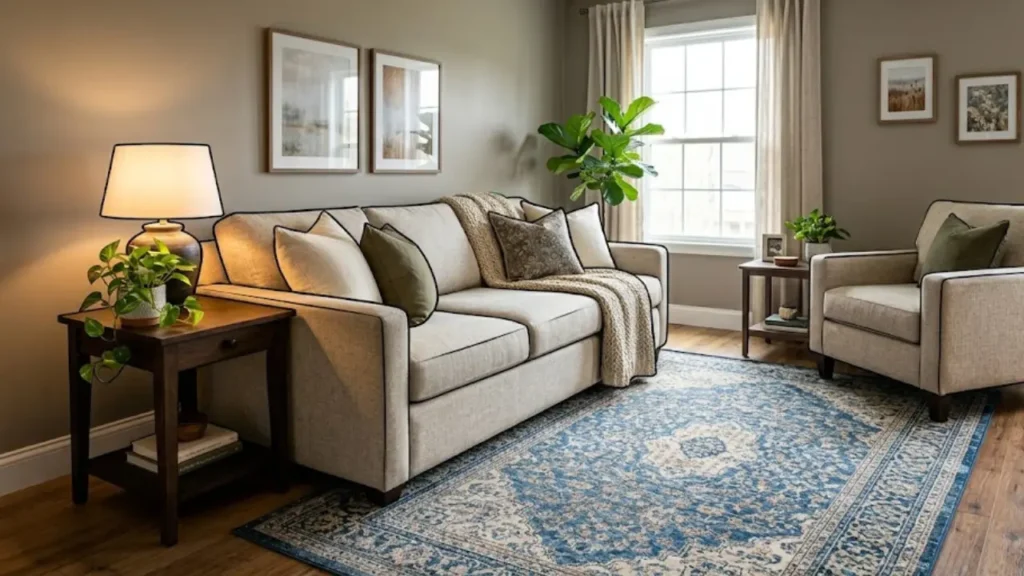
Here’s something most people underestimate: a rug can define a conversation area more powerfully than the furniture itself. When the front legs of every piece of seating sit on the same rug, the grouping reads as a cohesive zone — even if the pieces are from different sets, different heights, and different eras.
In a small living room, the rug is doing double duty. It’s not just decorative — it’s defining boundaries. The rug edge signals “this is the seating area” and the uncarpeted floor around it signals “this is where you walk.” That visual cue alone makes a room feel more organized and more spacious, because the pathways are implicitly marked.
The standard rule is that the rug should be large enough for at least the front legs of all seating pieces to rest on it. If only some legs are on the rug, the arrangement looks accidental. Choosing the right size matters more than most people think — the detailed breakdown of how to choose a rug for a small living room covers sizing by room shape and which common sizing mistakes to avoid.
The Role of Scale: Right-Sized Furniture Changes Everything
One of the most honest things I can tell you about small living rooms: the furniture is often the problem, not the arrangement. Specifically, furniture that’s too big for the space will make every arrangement feel overcrowded no matter how cleverly you position it.
What “Right-Sized” Actually Means
Right-sized doesn’t mean tiny. It means proportionate to the room. A sofa that’s 90 inches wide in a room that’s 11 feet wide is going to dominate the entire wall, leave almost no room for side tables or lamps, and psychologically shrink the whole space. A sofa that’s 72–78 inches wide in the same room? Breathing room on both sides, space for a small side table, and the wall reads as intentional rather than stuffed.
Here’s a general guide:
- Rooms under 120 square feet: sofas should be 72 inches or shorter (that’s 6 feet)
- Rooms 120–180 square feet: up to 84 inches (7 feet)
- Rooms over 180 square feet: up to 90–96 inches (7.5–8 feet)
If you already own a large sofa and can’t replace it, there are visual tricks that help. Sofas in lighter colors, with legs visible underneath, and with a lower profile all feel less massive than dark, skirted, high-backed alternatives. A sofa with visible legs looks like it’s floating, which opens up the floor plane and reads as less bulky. The relationship between sofa color and perceived room size is also worth understanding — the piece on best couch colors for small living rooms gets into the specific hues that recede versus advance visually.
Multipurpose and Flexible Pieces
In a small living room, every piece of furniture should earn its square footage. If something only does one thing, it’s competing with everything else for limited floor space.
Pieces that earn their keep in small rooms:
- Storage ottomans that serve as coffee tables, extra seating, and hidden storage
- Nesting tables that tuck away when not in use
- Lift-top coffee tables with storage underneath
- Console tables behind a floating sofa that double as a home office surface or display shelf
- Benches at the foot of a sofa that provide seating when guests come and can be pushed under the sofa to reclaim floor space
The goal is to have fewer pieces that each do more — rather than more pieces that each do less.
Furniture Arrangement for Specific Small Room Shapes
Not all small living rooms are created equal. A square room behaves very differently from a long narrow room, and both are different from an L-shaped room or one with an awkward corner fireplace. Here’s how to approach each.
The Square Room
Square rooms are actually the easiest to arrange because every wall is equidistant from the center. The natural arrangement is a U-shape or parallel seating centered in the room. The challenge is that square rooms can feel boxy if you don’t add visual interest.
Fix: angle one piece slightly (even 15 degrees off perpendicular adds dynamism) or use a round coffee table. Round shapes soften square rooms and improve traffic flow because there are no sharp corners to navigate around.
The Long, Narrow Room
This is the trickiest small living room shape because the obvious approach — sofa on one end facing the other — creates a bowling alley effect. Traffic runs down the center, seating is at each end, and nothing feels connected.
A better approach: place the sofa along the long wall (perpendicular to how you’d naturally put it), create a conversation area that runs across the width of the room rather than the length, and use a rug to mark the seating zone. This breaks the tunnel effect and uses the width of the room instead of fighting it.
Mirrors placed on the short walls help enormously in narrow rooms — they visually extend the width and bounce light. The guide on how to use mirrors to make a small living room look bigger covers placement specifically for this purpose.
The Room With an Awkward Corner or Doorway
The key with awkward architectural features is to work with them rather than against them. A corner that’s hard to furnish can become a styled moment — a floor lamp and a small accent chair, or floating shelves with plants and books. This turns a problem area into an intentional design choice and frees up your main wall for the primary seating arrangement.
Doors that open into the room need clearance, which means furniture can’t sit within the swing radius of the door. Map this out before arranging anything — it often limits sofa placement more than people expect.
Pro Tips That Change the Game
These are the things that make the difference between a room that looks okay and one that genuinely feels thoughtful.
Use painter’s tape on the floor. Before you move anything heavy, tape out the footprint of your furniture on the floor using painter’s tape. Walk around in it. Sit in different spots. Does the traffic path feel wide enough? Does the conversation area feel right-sized? This costs nothing and saves you from lifting a sofa four times.
Think in zones, not pieces. Instead of placing furniture one item at a time, think about your room as two or three zones: seating zone, walking zone, and maybe a working or reading zone. Design the zones first, then fill them with furniture. This reverses the typical approach and almost always produces better results.
Lower visual weight opens a room. Furniture with visible legs — even just 4–6 inches of clearance above the floor — makes a room feel more open because you can see the floor plane underneath. That uninterrupted sightline to the floor reads as “more space” even when the actual square footage is identical. High-backed, floor-skirted furniture has the opposite effect.
Don’t neglect vertical space. In a small room, walls are underutilized real estate. Tall bookshelves, floating wall shelves, and art hung at the right height all draw the eye upward and give the room a sense of height it might not technically have. Clustering low, horizontal furniture without any vertical elements makes a small room feel squat.
One pattern, two textures. In a tight space, visual busyness compounds the sense of crowding. Keep patterns to one dominant choice (usually the rug or a throw pillow set) and layer in two or three different textures — linen, wood, a woven accent. This creates richness without chaos.
Common Mistakes That Block Traffic (And Feel Bad to Live With)
Mistake 1: Angling Furniture Toward the Corner
This one is almost always well-intentioned — angling a chair toward the corner feels cozy on a floor plan, but in practice it points the chair away from the conversation area and creates an awkward triangular dead zone behind it that collects dust and blocks traffic simultaneously. Keep seating angled toward the center of the seating grouping, not toward the walls.
Mistake 2: Too Many Accent Tables
Side tables and accent tables are useful until there are too many of them. Three side tables in a small living room creates a visual obstacle course. Opt for one or two, make sure they’re small-footprint (a C-shaped side table that slides under the sofa arm takes up almost no floor space), and resist the urge to fill every seating position with its own dedicated table.
Mistake 3: Blocking the Window
Natural light is one of the most powerful tools for making a small room feel larger. Placing the back of a tall sofa or a large bookshelf directly in front of a window blocks that light and shrinks the room visually. If the only viable wall for your sofa is a window wall, choose a lower-profile sofa or a loveseat that sits below the window sill line, so light still comes in over it.
Mistake 4: No Clear Furniture Hierarchy
In a small room, every piece competing for equal visual weight creates chaos. You need one dominant piece (the sofa), one or two supporting pieces (chairs, loveseat), and the rest should be secondary or purely functional. When a large bookshelf, a statement chair, a big TV console, and a bold patterned rug all compete equally for attention, the room reads as cluttered even if the actual floor space is clear.
Mistake 5: Forgetting About Lamps
Overhead lighting alone makes small rooms feel flat and smaller. Floor lamps and table lamps at varying heights create layers of light that make a room feel more dimensional. They also fill vertical space without taking up floor area — a tall floor lamp in the corner of a seating area adds height, warmth, and presence for about a 12-inch floor footprint.
Putting It All Together: A Simple Step-by-Step Process
Here’s the order that actually works for arranging a small living room without blocking traffic flow:
Step 1: Map your traffic paths. Identify and protect your primary (36-inch) and secondary (24-inch) walkways before anything else.
Step 2: Find or create your focal point. Identify the TV wall, fireplace, or whatever anchor you’ll orient the seating toward.
Step 3: Place the sofa. Face it toward the focal point. Float it 4–6 inches from the wall if possible. Confirm you still have your 36-inch primary pathway.
Step 4: Add the coffee table. 14–18 inches from the sofa. Proportionate to the sofa’s width — roughly two-thirds the sofa’s length is a good rule of thumb.
Step 5: Add supporting seating. One or two accent chairs, placed to complete a conversation area. Confirm 3–4 feet from the sofa and that no secondary walkways are blocked.
Step 6: Place the rug. Large enough for front legs of all seating to rest on it. This locks the grouping in visually.
Step 7: Add accent tables, lamps, and decor. Fill function gaps (where will people set a drink? where does the lamp go?) without adding pieces that block movement.
Step 8: Stand in the doorway and walk the room. Actually walk your traffic paths. Does it feel right? Do you have to turn sideways anywhere? If yes, trace it back to the piece causing it and adjust.
The Arrangement That Took My Small Living Room From Frustrating to Functional
My old apartment had a living room that was roughly 12 by 14 feet — not tiny, but not generous either. I’d tried the sofa-against-the-wall approach twice and hated it both times. Then I tried a floating arrangement with the sofa pulled 8 inches from the wall, two small armchairs forming a gentle L-shape, and a round coffee table in the center. I added a 5×8 rug that anchored all the front legs.
The room felt completely different — not because I’d gained any square footage, but because the seating area felt purposeful and the walkway from the door to the kitchen was finally clear and generous. Guests could move freely. Conversations felt more connected. I stopped bumping into the coffee table corner.
That’s the goal: a room that works with the way people actually use it, not against it.
Small doesn’t mean compromised. It just means the planning has to be more deliberate. Get the traffic flow right first, then let the aesthetics follow — and you’ll end up with a room that feels both beautiful and genuinely easy to live in.
If you’re also wrestling with how the room looks beyond just the layout — specifically the color choices that can open up or shrink a small space visually — the article on best wall colors for small living rooms is a natural next step. Color and layout work together; getting both right makes an enormous difference.
FAQ: How to Arrange Furniture in a Small Living Room
Should you put furniture against the wall in a small living room?
Not necessarily — and often this backfires. Pushing all furniture flat against walls creates an awkward empty center and makes the seating feel disconnected. Floating your sofa even 4–6 inches from the wall adds depth and makes the arrangement feel more intentional. In very small rooms where floating isn’t possible, compensate by keeping the center clear and using a rug to visually anchor the seating group.
How much space do you need between a sofa and coffee table?
The standard is 14–18 inches between the front edge of your sofa and the nearest edge of the coffee table. This gives enough room to walk past without bumping your knees, while keeping the table close enough to reach comfortably from a seated position. In a very small room you can go down to 12 inches if you choose a lower-profile or round table with no sharp corners.
How do you arrange furniture in a long narrow living room?
Avoid the temptation to run furniture along the length of the room — this creates a tunnel effect. Instead, place your sofa along the long wall and orient the seating area across the width of the room rather than the length. This breaks the narrow feel and creates a more natural conversation zone. A large mirror on one of the short walls also helps expand the visual width.
What size rug works best for anchoring furniture in a small living room?
The most common guideline is to choose a rug large enough for the front legs of every piece of seating in the grouping to rest on it. This visually ties the furniture together into a defined zone. In a small room, a 5×8 rug works for compact arrangements; a 6×9 suits most standard small living rooms. Going too small — only the coffee table legs on the rug, for example — makes the arrangement look accidental and disconnected.


Pingback: 15 Proven Small Living Room Layout Ideas
Pingback: 15 Proven Home Organization Ideas for Small Spaces
Pingback: How to Make a Small Apartment Feel Bigger: 18 Proven Ways